

Mistral AI and NVIDIA will build AI-native engineering workflows together, the French lab announced on October 21, combining Mistral Large 4 with NVIDIA’s CUDA-X libraries, Warp and Omniverse to speed up engineering simulation. The collaboration’s centrepiece is measurement: public benchmarks and open datasets for physics AI, and dedicated evaluations for agentic AI in computer-aided engineering and electronic design automation.
“For too long, the pace of engineering has been set by the pace of simulation,” said Neil Ashton, Mistral’s vice president of computational engineering. “With Mistral’s open-weight models and physics AI capabilities, combined with NVIDIA’s accelerated computing stack, we’re giving engineers faster simulation cycles, as well as open benchmarks rigorous enough to validate agents on real CAE and EDA work.”
Benchmarks For Physics AI And Engineering Agents
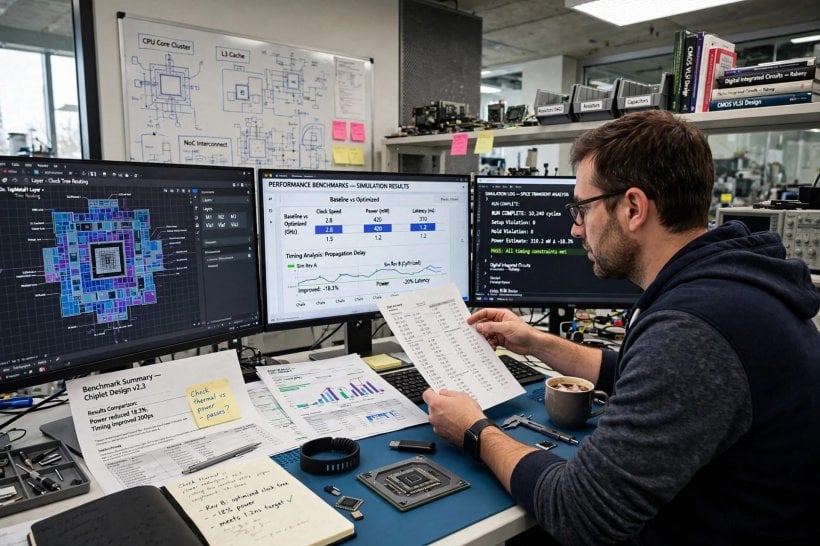
The benchmarks are designed to give researchers, developers and industrial teams a shared foundation for comparing model accuracy and performance, and for building and validating automated CAD-to-simulation workflows. The agentic evaluations will assess whether AI agents can use engineering tools, complete multistep workflows and produce technically correct results, while measuring execution time and computational cost.
The target industries are aerospace, automotive and semiconductors — sectors where a simulation cycle can take days and where an agent that reliably shortens it changes product timelines. Mistral and NVIDIA say the work will establish consistent, reproducible methods for assessing engineering AI, in the same spirit as the sovereignty-focused open-model push GER covered in Europe’s bet on Mistral.
Mistral Large 4: One Trillion Parameters, Trained In Europe
The collaboration builds on Mistral Large 4, which Mistral recently introduced in public preview under the nickname Le Chonk. It is the company’s largest and most capable frontier model to date: approximately 1 trillion total parameters with 49 billion active parameters, multimodal, and trained on 3,800 NVIDIA Grace Blackwell GPUs in Mistral-operated data centres in Europe. Mistral says it advances coding, agentic workflows and multimodal understanding, with weights planned for release at the end of October.
The two companies have worked together before — they co-developed Mistral NeMo and are now collaborating through the NVIDIA Nemotron Coalition on a frontier base model for the open-weight ecosystem. Mistral is also bringing additional NVIDIA-powered infrastructure online under a compute roadmap targeting 1 GW of capacity by 2030, adding to the capacity race behind announcements such as NVIDIA’s supply chain expansion with six manufacturing partners.
Why It Matters
The Mistral–NVIDIA engineering programme matters because it aims at the part of industry where AI adoption is gated by proof, not demos. Aerospace and semiconductor firms will not let an agent touch a design workflow until its outputs are benchmarked against real CAE and EDA tasks — which is exactly the standard-setting work announced here, and a natural extension of the voice-agent infrastructure Mistral shipped in Voxtral 3. For Mistral, pairing its open-weight frontier model with NVIDIA’s simulation stack gives it a differentiated enterprise pitch that the US labs do not own: European-trained models, European data centres, and engineering benchmarks the whole industry can audit. “The next wave of engineering breakthroughs will come from exploring ideas that were once too complex or time-consuming to test,” said Tim Costa, NVIDIA’s vice president for industrial and computational engineering.
Background
Mistral AI, founded in Paris in 2023 by former DeepMind and Meta researchers, built its reputation on open-weight models that punched above their size, and has become the centrepiece of Europe’s sovereign AI strategy. NVIDIA has been its infrastructure partner from early on, from the co-developed Mistral NeMo in 2024 to GPU supply for Mistral’s European data centres. Engineering simulation is a deliberate expansion for both: physics workloads are among the most compute-hungry in industry, and NVIDIA’s CUDA-X and Omniverse tools already sit inside many engineering departments.
Source: Mistral AI official announcement



0 Comments