

Mistral AI has launched Voxtral 3, a full voice-agent stack that combines new speech-to-text and text-to-speech models with a voice agent SDK, so an agent can listen, reason, call tools and talk back in a single real-time pipeline. Mistral announced the family on Tuesday, October 20, with availability through its EU-hosted API or for self-deployment.
The release has four model lines — Voxtral Small Transcribe 3, Voxtral Mini Transcribe 3 and its Realtime variant, and Voxtral Speech 3 (also called Mini TTS 3) — plus a Pro Voice adaptation service and an SDK built on LiveKit.
Voxtral Transcribe 3: 50 Languages, Diarization And Context Biasing
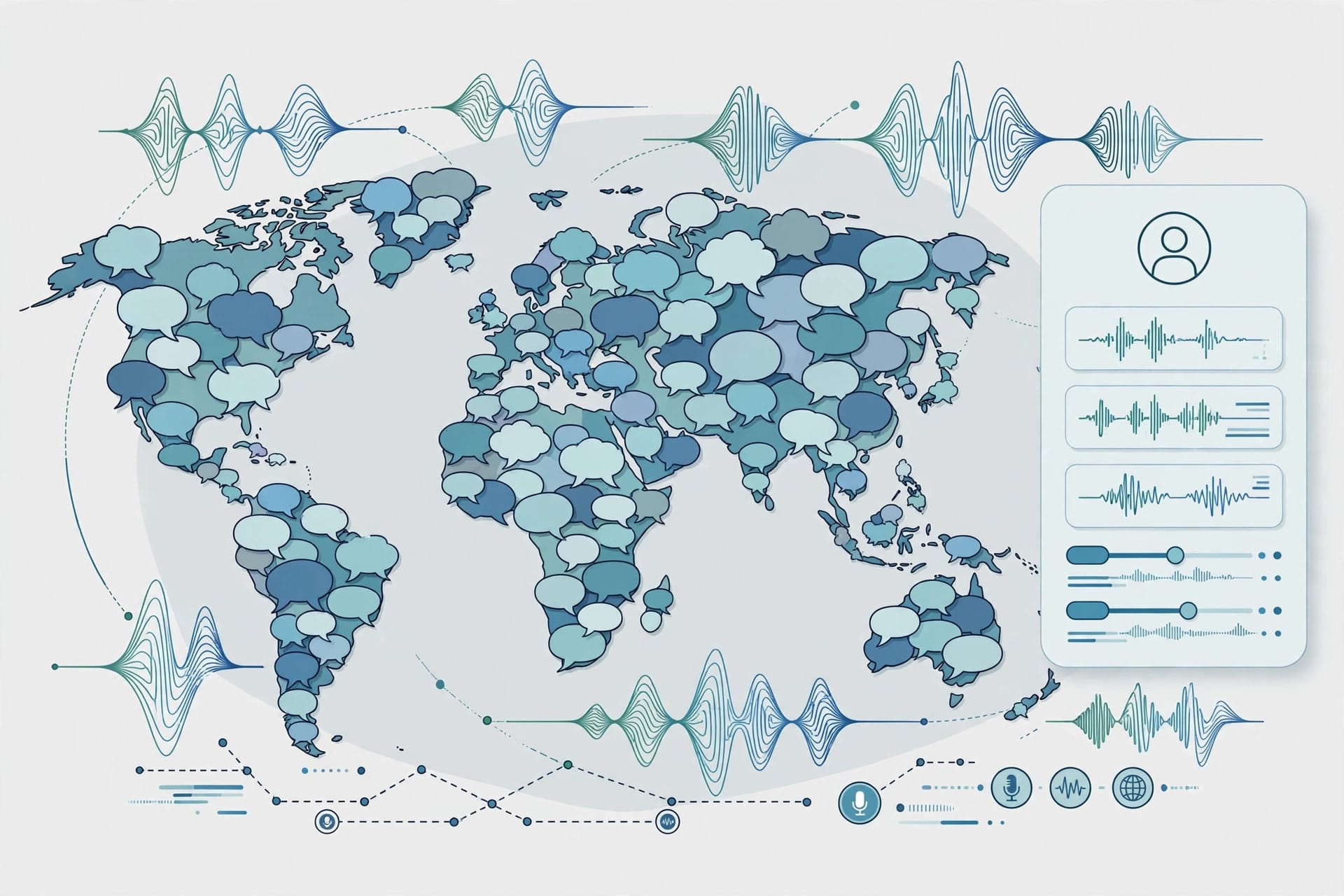
Voxtral Small Transcribe 3 covers 50 languages, including all 24 official EU languages and a range of lower-resource Asian and Indic languages. Mistral says it leads on multilingual transcription and diarization — identifying who said what — and outperforms Whisper, Scribe v2 and Gemini 3.5 Transcribe in its reported benchmarks across the FLEURS 45-language set and public diarization suites including AMI and Switchboard.
Two production features stand out. Context biasing lets developers supply keyphrases and free-form text so technical terms and names are recognised without fine-tuning, which Mistral measures as a keyphrase-recall gain on the Earnings-22 benchmark. End-of-turn detection, built into the models, predicts when a speaker has finished so agents respond without awkward delay. The Mini variant is a 4B-parameter model priced at $0.0035 per minute for batch work; the Realtime variant transcribes at sub-500ms latency in more than 35 languages at $0.008 per minute. Small Transcribe 3 costs $0.0040 per minute.
Voxtral Speech 3 And Pro Voice: Expressive Speech In 35+ Languages
On the output side, Voxtral Speech 3 generates speech in more than 35 languages and 50+ dialects at $13 per million characters, in batch and realtime through the same API. Mistral says the model reads the semantic context of a conversation to set emotion, pacing and emphasis without explicit voice prompts, and it accepts explicit instruction-following controls for emotion, pacing and emphasis when developers want them.
Pro Voice is the professional tier: from 30 minutes of audio it reproduces a speaker’s distinctive character, emotional range and speaking style across languages, aimed at cases where standard voice cloning is not accurate enough. Voice presets ship in 18 languages. The pricing and multilingual reach put Voxtral 3 in direct competition with the voice platforms covered in our ElevenLabs explainer, at a per-character price Mistral positions below OpenAI TTS-1, Deepgram, ElevenLabs Flash and Gemini Flash on its own comparisons.
The Voxtral Voice Agent SDK: One Streaming Pipeline
The SDK is the integration layer. Built on LiveKit, it runs speech in, reasoning and speech out as one streaming pipeline with no stage waiting for the previous one: a Realtime transcribe model listens and detects end-of-turn, a general model such as Mistral Small reasons and calls tools, and Speech 3 replies in the tone of the conversation so far. Mistral says each turn completes in under one second, and the agent stops talking when the caller interrupts.
During a call, an agent can verify a caller’s identity, check a bill or book an appointment, using function calling, web search and retrieval over the customer’s own systems. It places and answers calls over SIP, runs in browsers and apps over WebRTC, and connects to existing telephony, IVR and contact-centre software. Each stage is a separate model, so the LLM, the voice or the language can be swapped without rewriting the agent — and the whole stack can run on Mistral’s API in Europe or on the customer’s own infrastructure, the sovereign-deployment pitch that runs through Mistral’s open-models strategy and our Mistral explainer.
Why It Matters
Voxtral 3’s defining attribute is completeness at European terms. Voice is the one AI surface where US platforms — OpenAI’s realtime models, ElevenLabs, Google — set the pace, and contact centres are also where data-residency rules bite hardest. A single stack that transcribes in 50 languages, speaks in 35+, acts through tools mid-call and can be self-hosted inside the customer’s own environment gives European enterprises a procurement answer that does not route call audio through a US cloud. For Mistral, voice also widens the company beyond chat models into per-minute and per-character usage revenue. For rivals, the benchmark and price claims — all vendor-reported at launch — now need independent testing, but the language breadth and the under-one-second turn target set the bar competitors will be measured against.
Background
Mistral’s Voxtral line began as open-weight speech models: the first Voxtral transcription models arrived in 2025 as part of the French lab’s push beyond text, and the family has since grown through Mini and Small tiers. Voxtral 3 is the step from models to a product — an SDK, telephony integrations and a professional voice service wrapped around the same model family — reflecting Mistral’s broader pattern of pairing open models with a hosted, sovereignty-first commercial offer for European buyers.



0 Comments