

Perplexity’s AI tools can now run inside a customer’s own compute boundary under a partnership with Valarian, the London-based sovereign infrastructure company. Valarian announced the deal on October 20 in a Business Wire release, with Perplexity’s vice president of engineering for enterprise and infrastructure, Nate Kupp, on record, and Unite.AI reported the deployment details the same day.
Deployed through ACRA, Valarian’s sovereign execution environment, Perplexity’s answer, research and discovery capabilities run under the customer’s own policy, against the customer’s own data, on compute the customer chooses. Deployments are available starting October 20, Perplexity said, with institutions directed to its sovereign AI team to discuss a deployment.
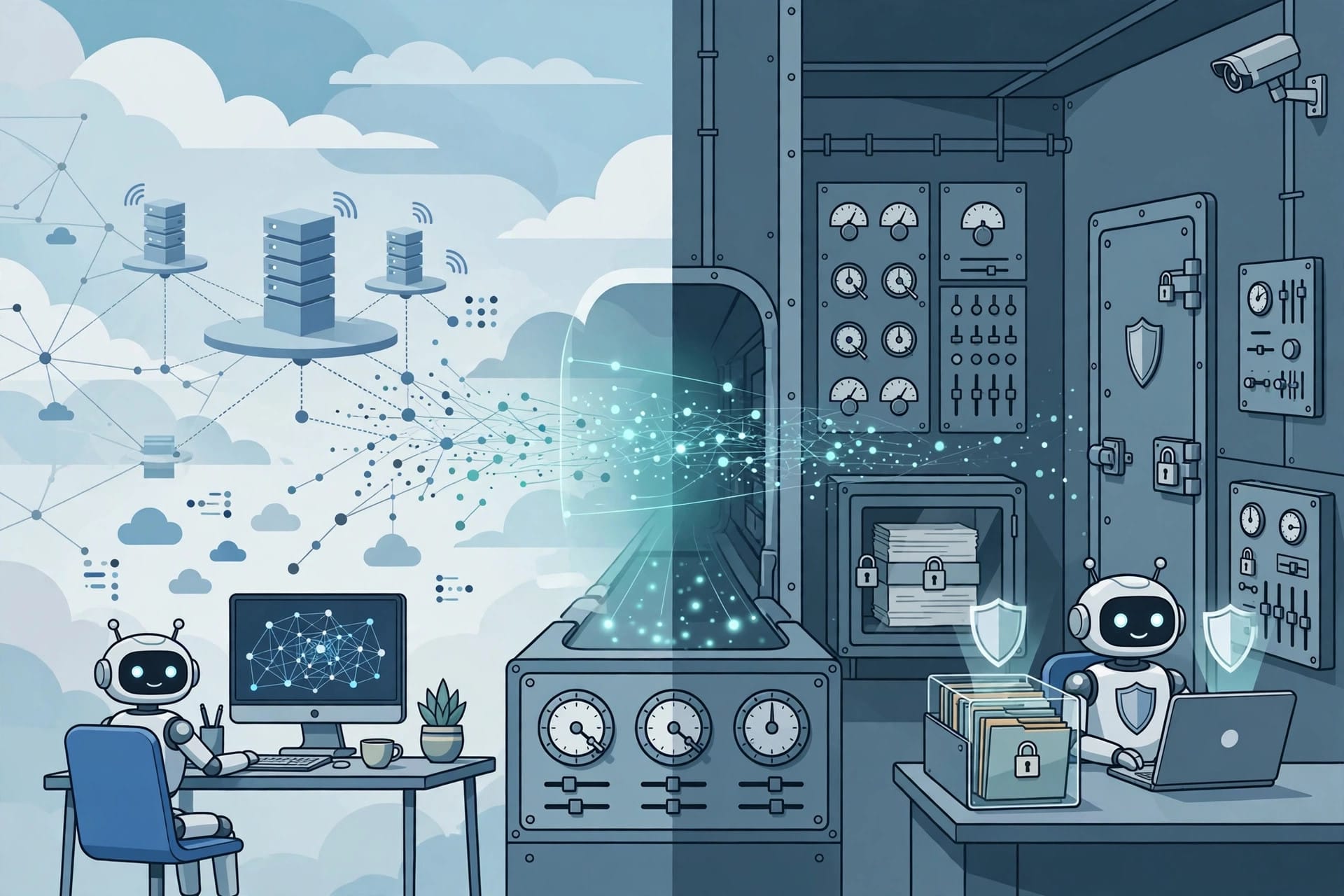
Perplexity With Valarian: Two Layers, One Architecture
The companies describe a two-layer split. Perplexity provides the experience layer: the agent harness, tools, retrieval and interface that turn inference into answers, research and action, including Perplexity Computer, its model-agnostic orchestrator of AI agents. Valarian provides the sovereign execution layer: policy, runtime boundaries, workload orchestration and compute flexibility through ACRA.
Through ACRA, organisations can serve and swap models, select the harnesses and tools they deploy, set the policies governing what agents can access and why, and schedule workloads onto the right compute substrate. That substrate can be the customer’s cloud, dedicated GPUs, multiple clouds or infrastructure the organisation physically owns, running side by side under one control layer, the release says.
Renting Intelligence Versus Owning It: How The Split Workloads Run
The practical pitch is workload-by-workload placement. One group of agents can call frontier models through external APIs for low-sensitivity research, while another runs inside an isolated enclave against a local model with access to confidential data, tools and secrets. ACRA keeps the same control layer across both, so the decision becomes which intelligence executes where, against what data, under whose authority and with what policy.
Unite.AI’s report adds the operating details: Computer uses sandboxes to contain code execution and file processing, with controlled access to the resources a task needs, and security teams receive audit records covering access decisions and workload activity. In a healthcare example, Computer could summarise a patient’s medical history and recent test results for clinician review, with access restricted to authorised records inside the provider’s controlled environment. Randox chief technology officer Joseph Clifford is quoted in the release on patient data security as the reason his organisation uses Valarian’s product.
Who It Is For: Governments, Defence, Banks And Critical Infrastructure
Valarian chief executive Max Buchan framed the deal as a shift in eras: the first era of enterprise AI was about access, renting someone else’s environment, and the next is about owning your intelligence. Kupp said Perplexity’s enterprise customers are concentrated in finance, science and law, industries where, in his words, the data is the business, and where what held customers back was where the AI runs and who controls it.
The target buyers are governments, defence organisations, banks and critical infrastructure operators, for whom consuming Perplexity as an externally operated service meant leaving execution, memory and context outside their own boundary. The partnership is a company-level deployment story for Perplexity, whose consumer answer engine is covered in our Perplexity explainer and whose browser push is covered in our Comet explainer. Its pricing tiers are in Perplexity pricing explained.
Why It Matters
Perplexity Computer’s central problem in regulated markets was never answer quality; it was jurisdiction over execution. The Valarian partnership moves Perplexity’s neighbours: the customer’s own infrastructure team becomes the operator, external frontier APIs become an optional tier for low-sensitivity work rather than the only route, and sovereign infrastructure vendors like Valarian become distribution channels into governments and defence buyers that a hosted answer engine could not reach on its own. It also puts Perplexity in the same sovereign-deployment conversation as the hyperscalers, without building data centres itself.
Background
Perplexity was founded in 2022 and built its name on an AI answer engine that now, by its own count, answers more than 1.5 billion questions a month; Perplexity Computer extended that into an agent platform that orchestrates models across tools and files. Valarian, founded by Max Buchan and Josh McLaughlin and headquartered in London, sells a sovereign control layer for high-consequence operations through enterprise and defence tracks, and raised a $50 million Series A led by NEA in July 2026, taking its total funding to $70 million.
Source: Valarian via Business Wire; Unite.AI


0 Comments