
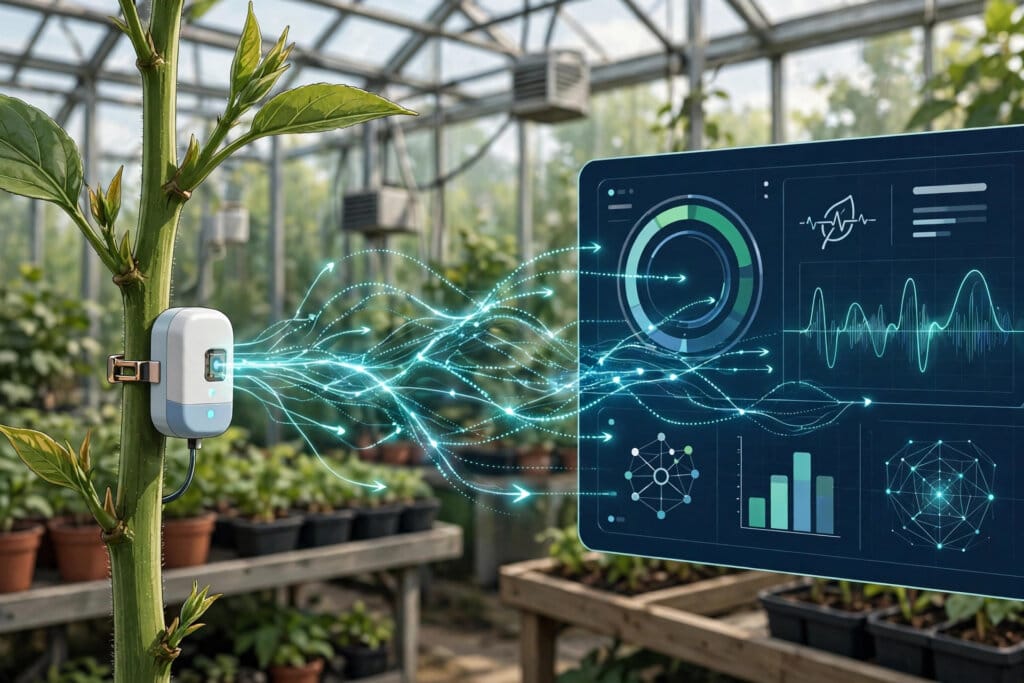
Electric Plant Company has emerged from stealth with $11.2 million in seed funding and Bombadil, a foundation AI model that reads a plant’s health directly from its own electrical signals. The company announced the launch on October 20 in a Business Wire release, and TechCrunch reported the story the same day after speaking with co-founder and chief executive Justin Mast.
Bombadil was pretrained without labels on more than 4 million hours of electrical recordings from over 1,400 plants across 100 species, the company says, making it the most species-diverse foundation model built on biological signals. Its data corpus has since grown to 7 million hours. The seed round was led by Onto Ventures and Climactic, with participation from Ponderosa, Endeavor Catalyst, Ludlow, Michigan Rise, The Fund, Schox VC and Dug Song.
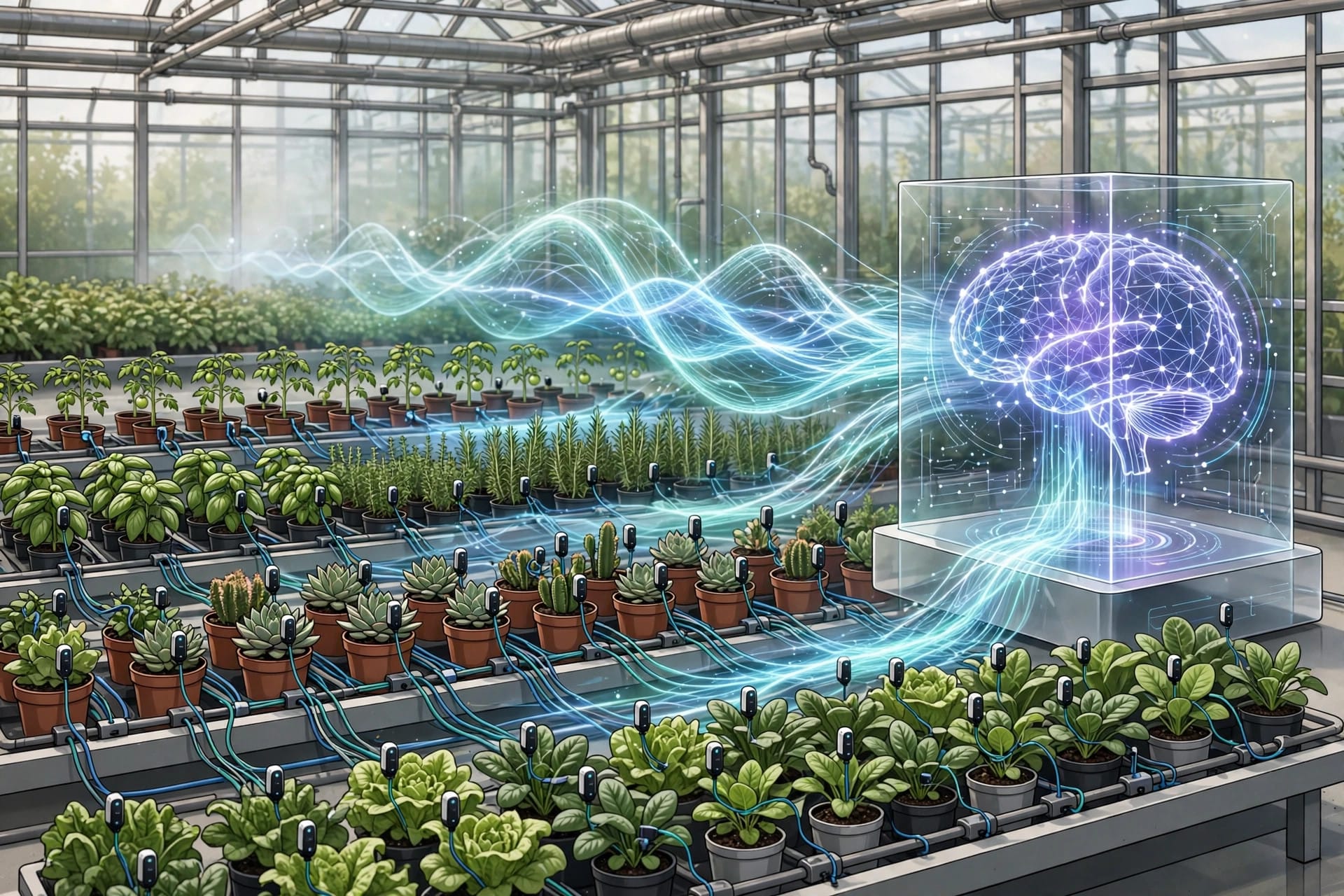
Bombadil: A Foundation Model Trained On Plant Electrical Signals
Plants generate electrical signals as part of their physiology, and those signals can be recorded continuously, in the field, by the thousands. Electric Plant applies the self-supervised approach that reshaped language and neuroscience AI to that stream: Bombadil learns the underlying structure of the signals, which lets it estimate physiological markers in species it never encountered during pretraining, the company says.
The markers it estimates from the electrical signal alone include photosystem II efficiency, leaf temperature relative to the surrounding air, and the Crop Water Stress Index, an established agricultural standard for measuring water stress. The company released a technical whitepaper documenting how Bombadil works alongside the launch, and says new tasks, from flagging a specific disease to predicting bloom timing, are designed to attach as new readouts on the same core model rather than requiring a new model each time.
Bud: The Sensor That Feeds The Model
The hardware half of the stack is Bud, a low-cost sensor that attaches directly to a plant and records electrical signals in its tissue related to the plant’s physiological state, including signs of stress. That stream goes to Bombadil, which decodes it and estimates seven physiological stress markers, turning raw voltage readings into a plain report on the plant’s condition for the user.
Head of AI and machine learning James Kirk said earlier models of plant electrical signals worked for one species in one setting, so a new plant or environment meant starting over, while Bombadil learns what is common across species. Early deployments are already running at commercial sites, with hundreds of sensors in the field, the company says. Electric Plant licenses its technology to the operators already running plant care businesses rather than replacing them, and is accepting additional founding operators as it expands crop by crop.
The Founders And The Business Behind The Seed Round
Electric Plant was co-founded in 2023 in San Francisco by Mast, who previously founded and led the online garden retailer Bloomscape, and chief scientist Lee von Kraus, a neuroscientist who has worked with DARPA and the US Environmental Protection Agency and previously co-founded Halo Neuroscience. Mast told TechCrunch he came to the idea after reading research about a houseplant wired to a motorised stand that wheeled itself toward light when its electrical signals indicated it wanted more.
Onto Ventures partner Tom McQuillen said the bet is that all plants share an underlying electrical language that can be learned across species, unlocking an interface to industries underpinning trillions of dollars in economic activity. The $11.2 million is the company’s total funding to date. The launch sits in a busy week for startup business news on this site, alongside Daytona’s $60 million Series B, Reliable Robotics’ $115 million raise and Eka Robotics’ $150 million Series A, though Electric Plant’s round is earlier-stage and its product is a model-plus-sensor system rather than an agent platform.
Why It Matters
Bombadil’s claim on attention is its input, not its size. Every neighbouring tool in plant monitoring (soil probes, handheld spectroscopes, satellite imagery, visual inspection) reads a plant from the outside and infers its state from its surroundings. A foundation model trained across 100 species on the plant’s own electrical activity would, if the company’s results hold up, give growers, foresters and researchers a direct physiological readout that transfers to new species without retraining, and it gives the foundation-model playbook a biological signal source that can be collected continuously at a scale human biosignals cannot match.
Background
Plant electrophysiology, the study of electrical signalling in plants, is a long-running research field, but earlier machine-learning models were built species by species and setting by setting. Electric Plant spent three years collecting its recording corpus before the stealth launch, applying the large-scale pretraining recipe proven in language models to a signal type that, unlike human brain recordings, can be gathered from thousands of subjects in the field at once; the company says its 7 million hours already exceed all publicly available recordings of human brain activity combined.
Source: Electric Plant Company via Business Wire; TechCrunch





0 Comments