

1Password launched 1Password for Agents on Thursday, October 22, a platform that lets personal AI agents sign in to your accounts and finish tasks without ever seeing your passwords. The agent asks for a specific login, you approve the request on your own device, and 1Password fills the credential into the sign-in form itself, so the secret never reaches the agent or the model behind it.
The company, announcing from Toronto, describes the platform in its press release as a trust layer for personal AI agents. The problem it targets is already common: an agent that can book a table, reorder groceries or plan a trip still stops at a login screen, and the current workarounds are to sign in yourself or paste a password into a chat window, where a copy can sit outside your control.
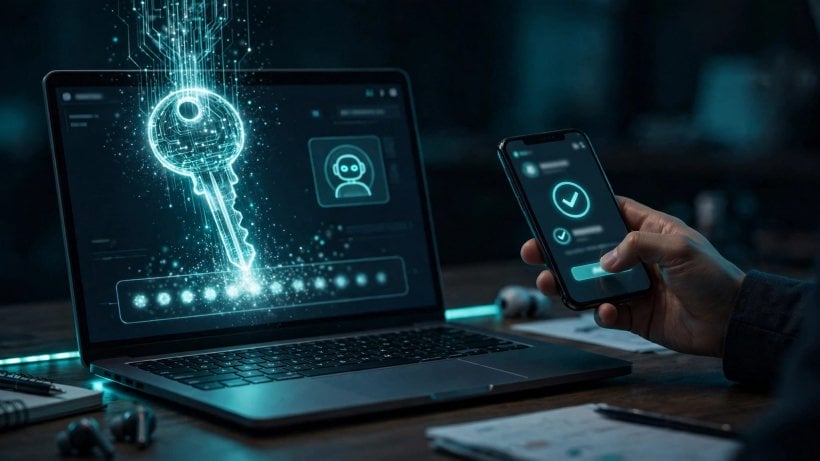
How the Sign-In Flow Works
The flow runs in five steps. First, the agent identifies itself to 1Password with its own unique digital key when it reaches a sign-in form, so 1Password can tell which agent is asking. Second, the request names the specific credential it wants and why. Third, you approve or decline on your own device — nothing proceeds until you respond, and the agent cannot approve its own access. Fourth, 1Password enters the username, password and any one-time code directly into the form through a channel it manages. Fifth, the agent continues its task knowing only that access was granted.
Access is granted per session and only for the items you approved; it does not carry over to the next task, and an integration can be disconnected at any time. Logins saved in a browser’s own password manager cannot be used — the credential has to be a proper item in your 1Password vault.
John Torrey, 1Password’s chief business officer, told PCWorld the platform “builds on integrations like 1Password for Claude,” extending the approach to personal agents that are not tied to one desktop browser session. “The user is involved in every decision,” Torrey said. “Our customers decide which credentials an agent can use and for which task, and for how long. The agent can’t approve its own access.” Chief executive Aashish Tripathi put the shift plainly in the launch statement: “Agents are starting to do real work on our behalf. The old model where you hand over a credential and hope for the best doesn’t work.”
Six Launch Partners, Nine More Building
Six agent products are named at launch: Meta’s Muse, Anthropic’s Claude Duet, OpenAI’s ChatGPT Work and dots, SpaceXSI’s Grok Bot, and Town’s Townie agents. They are not all live on day one. Muse and Grok Bot are rolling out over the coming days, while Claude Duet, ChatGPT Work, dots and Townie are listed as coming soon. Nine more companies are building integrations for later: Browserbase, Browser Use, Dana, Instinct, KERNEL, Perplexity, Ramp, Tomo and Wajo. Agents not yet on the list can be requested through a waitlist.
The feature is included at no extra cost in 1Password Individual and Family plans held on 1Password.com, and new users can start with a 14-day trial. Accounts hosted on 1Password.eu and 1Password.ca are not supported at launch, and the company says availability and safeguards vary by integration. Two notable agents are absent from the roster: Google’s Gemini Spark and Microsoft’s Scout, though 1Password says further integrations are to come. The launch roster overlaps heavily with this week’s agent news — Claude Duet, Anthropic’s proactive agent, opened its research preview on Wednesday, and SpaceXSI launched its Grok Partner Network with more than 130 companies on Thursday.
Why It Matters
1Password for Agents matters because the login screen is where personal agents either become genuinely useful or stop. Almost every service worth delegating sits behind one, and handing an agent a raw password exposes that secret to the model provider, its logs and any prompt-injection attack that hijacks the agent mid-task. By separating the ability to use an account from knowledge of the secret that opens it, 1Password removes the password from what a compromised agent could reveal — a hijacked agent, like the autonomous attacker Symantec caught hijacking exposed AI models this week, would find no credential to steal. The limit is equally clear: signing in creates a session, and inside that session the agent can still act — place the order, change the setting, send the message — which is why approval is per task rather than permanent. The other signal is who signed on. Meta, Anthropic, OpenAI and SpaceXSI compete directly on agents, yet all four agreed to route sign-ins through the same third party, which positions a password manager, not an agent vendor, as the gatekeeper for account access.
Background
The platform is the successor to 1Password for Claude, launched on July 16, 2026, which let Claude sign in without seeing usernames or passwords but worked only on the Mac, inside Chrome, with the desktop app and browser extension running alongside the Claude desktop app. 1Password says its vaults now protect more than 1.6 billion credentials and secrets, and that more than 200,000 businesses use the service. The new platform generalises the July design from one agent on one desktop to a common identity and approval process across the major personal agents.
Source: PCWorld, SaveDelete reporting 1Password’s press release and launch post




0 Comments