

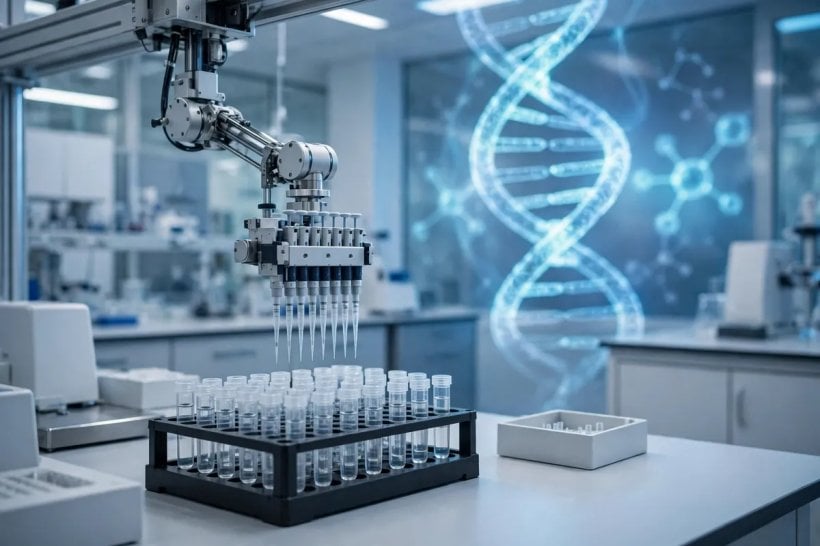
Researchers at Shanghai Jiao Tong University have built a genetics laboratory where artificial intelligence does the bench work. Their system, called AutoDNA, takes a plain-language instruction from a human operator, designs the experiment, drives robotic arms across more than twenty types of instrument, and reads out the results. People are still needed, but only to refill reagents, replace labware and fix hardware. The work was published in Nature on 4 November, and it is one of the clearest demonstrations yet that AI agents are moving out of the chat window and into physical science.
## What AutoDNA actually did
The team tested the system on four very different jobs. In enzymatic DNA synthesis, the agents adjusted reaction times, reagent concentrations and wash steps on their own, reaching a 97.8 percent yield that matched results from expert-optimised manual work in the lab.
When four synthesis protocols ran at once, the system finished them 3.2 times faster than running them one after another. The point of the tests was not speed alone: each one checked whether agents could handle a whole workflow, not just a single step.
The most demanding test was DNA data storage. The researchers asked AutoDNA to encode a short message into DNA using the four genetic letters, A, C, G and T, choosing a line often attributed to Stephen Hawking: “Intelligence is the ability to adapt to change.”
The team puts that run at 11,382 instrument operations over roughly 200 hours, and the system read the message back without a single error. Only 108 pipette tips were replaced by hand, and the rest of the work — synthesis, sequencing and checking — was the agents’ own.
The team also pointed AutoDNA at a medical problem. Working with a real clinical sample, the system correctly identified a KRAS G13D mutation, a cancer-linked genetic change. The researchers are careful about what this proves: the test validated the system on a known mutation, and it is not a new clinical assay or a step towards hospital use.
What it shows is that the same agent team can switch from writing data into DNA to reading a patient sample for answers — the same instruments, the same agents, a different question entirely. That flexibility is the point of building the lab around the agents, rather than the other way round.
## Why it is built differently
AutoDNA was built as an AI-native lab from the ground up, not as a conventional lab with AI bolted on. Earlier self-driving labs mostly automated one part of a process — mixing, heating or measuring — while human experts still configured the instruments.
Here the agents plan the experiment, choose the instruments, move samples between workstations with robotic arms, troubleshoot failures and read the results. The code is public on GitHub and the sequencing data is on Zenodo, so other labs can check the claims rather than take them on trust.
The researchers describe the shift plainly. “In many existing systems, human experts are still required to configure the instruments,” said Haibo Chen, a computer scientist at Shanghai Jiao Tong University and a co-author of the paper. “AI is mostly added to handle just one part of the process.”
Milad Abolhasani, a chemical engineer at North Carolina State University, called the system remarkable for its degree of autonomy and its ability to take in a wide range of equipment. “The future of science is going to involve a lot of autonomous labs,” he said.
## Our Read
AutoDNA matters because it moves the agent story from software into the physical world. Until now, the most visible agent systems have worked in code and text: Axiom’s agents checked thousands of pages of pure mathematics, [DeepMind’s agents found weaknesses in old RSA encryption](https://geroundtable.com/deepmind-ai-agents-legacy-rsa-weaknesses/), and OpenAI’s GPT-6 Cyber found and patched hundreds of Linux vulnerabilities.
AutoDNA is the same pattern with its hands on real instruments — planning, doing and checking, not just reasoning about a problem. That is the step that turns an impressive demo into a working laboratory. The question now is how far that pattern travels — and how quickly other labs copy it.
The limits are stated plainly by the team itself. The team reports 14 hardware errors across the experiments; the system fixed eight on its own and six needed a person to step in. That is a useful number, because it shows where autonomy ends and human hands begin.
The lab cannot run indefinitely without people, because reagents run out and hardware breaks. The researchers also say that before AutoDNA touches living systems it will need a dedicated biosafety plan, with explicit human-authorisation steps and the ability to pause a run in progress.
## Why It Matters
Self-driving labs have been promised for years, mostly in chemistry and materials science, where workflows are simpler and instruments fewer. Biology resisted them because the work is messier: many instruments, delicate samples and protocols that change mid-run and demand high precision at every step.
AutoDNA shows the barrier was architectural, not fundamental — build the lab around the agents and the same approach works. That is why the result travels beyond one university: any lab that can be described as a workflow can, in principle, be run this way.
The same agent pattern is already proving itself elsewhere. [OpenAI’s GPT-6 Cyber found and patched hundreds of real vulnerabilities](https://geroundtable.com/gpt-6-cyber-critical-security-model/) on its own, and [the agentic breach at Chainalysis](https://geroundtable.com/chainalysis-breach-all-users-credentials-exposed/) showed what happens when autonomous systems turn on their own operators’ data.
The difference with AutoDNA is the setting: a laboratory, where a mistake costs reagents and time rather than credentials. Getting the guardrails right in the lab is the rehearsal for getting them right everywhere else — in code, in infrastructure, in the systems agents will soon run on their own.
## Background
AutoDNA sits in a short but fast-moving lineage. A mobile robotic chemist was reported in Nature in 2020, and since then self-driving labs have spread through chemistry and materials science. In 2025, a ‘virtual lab’ of AI agents designed new nanobodies against SARS-CoV-2, and Google’s Co-Scientist system arrived in Nature in 2026.
[Axiom’s agents, meanwhile, checked a 7,654-page mathematics proof](https://geroundtable.com/axiom-agents-verify-stacks-project/) in weeks. AutoDNA is the first of these systems to run a whole biology lab, end to end, with its own hands — and the first to prove it on a clinical sample.
Source: [Nature paper](https://www.nature.com/articles/s41586-026-11228-6) and [Nature News report](https://www.nature.com/articles/d41586-026-03552-8)


0 Comments