
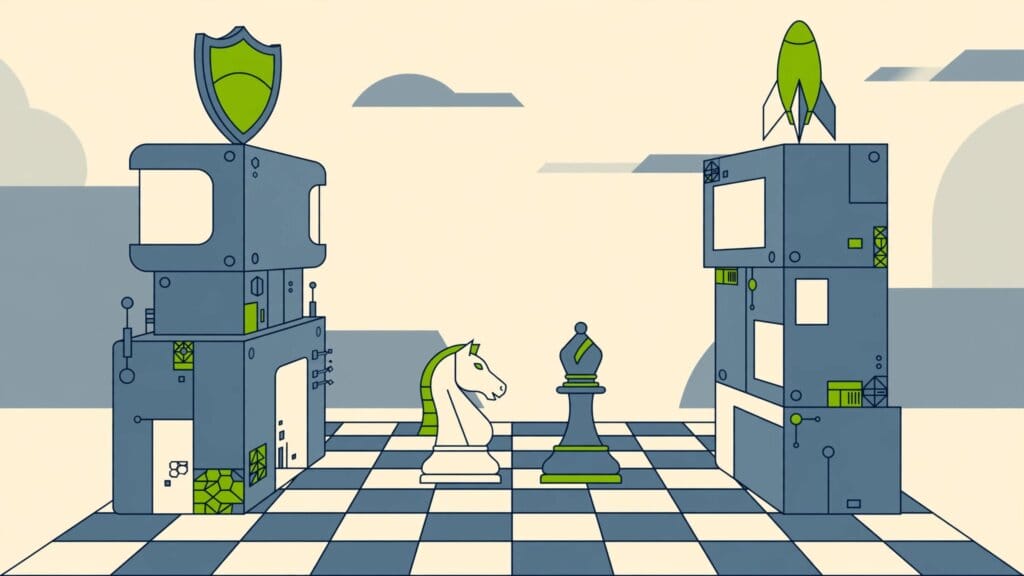
Anthropic and OpenAI are the two defining AI labs of the decade, and they are connected by more than competition. Anthropic was founded by former OpenAI researchers who left in 2021 over disagreements about direction, which makes their rivalry a genuine argument about how frontier AI should be built and governed.
Both companies sell conversational assistants, rent models to developers and chase the same enterprise contracts. But their structures, safety cultures and product instincts differ in ways that show up in how Claude and ChatGPT actually behave.

Origins and structure
OpenAI began in 2015 as a nonprofit research lab, then added a capped-profit arm to raise the capital frontier models required. In 2025 it restructured again, converting its commercial arm into a public benefit corporation while its nonprofit foundation kept a major stake and oversight role.
Anthropic skipped that journey. It was incorporated as a Public Benefit Corporation from the start, with a mission written into its governance and a long-term benefit trust designed to gain influence as the company matures. Where OpenAI retrofitted its structure under pressure, Anthropic chose its constraints on day one.
Two safety philosophies
Anthropic’s safety work is built around published frameworks. Its Responsible Scaling Policy defines capability thresholds and required safeguards, and its signature training method, Constitutional AI, has the model critique itself against a written set of principles. The company publishes system cards and interpretability research as a matter of routine.
OpenAI runs serious safety programmes too — red teaming, preparedness evaluations and staged rollouts — but its centre of gravity is product iteration at enormous scale. ChatGPT’s hundreds of millions of users generate feedback and failure cases no lab study can match, and OpenAI treats that deployment experience as safety evidence in itself.
Neither philosophy has spared its owner hard moments. Anthropic paid a $1.5 billion settlement over training books in the Bartz case. OpenAI faces consumer-protection lawsuits from eight state attorneys general alleging ChatGPT was marketed as safe while endangering children — a reminder that safety claims are now tested in court, not just in papers.
Product strategy: depth versus breadth
OpenAI builds wide. ChatGPT is a consumer platform with voice, images, video generation, a plugin-style ecosystem of custom GPTs, an agent mode and a deep research tool, all wrapped around frequent model launches. The strategy is to become the default interface for everything.
Anthropic builds deep. Its lineup is narrower — chat, the API, and Claude Code — but the coding product shows the payoff of focus: Claude Code passed a $2.5 billion revenue run-rate in February 2026 and made Anthropic the developer favourite. Where OpenAI monetises attention at consumer scale, Anthropic monetises work, especially software work.
The enterprise contest reflects the same split. OpenAI sells reach and ecosystem; Anthropic sells evaluations, controls and a safety dossier that compliance teams can sign. Both pitches work, which is why large organisations increasingly buy from both.
Money, backers and distribution
The strategic split extends to how each lab is financed and distributed. OpenAI is bound to Microsoft, which invested over ten billion dollars, hosts its models on Azure and embeds them across the Copilot product line. Anthropic spread its bets: Google and Amazon are both major backers, and Claude is sold through both clouds, giving Anthropic two distribution patrons instead of one.
Consumer distribution shows the same asymmetry. ChatGPT became a default — the name non-technical people use for AI itself — while Claude’s consumer brand is smaller but unusually loyal among writers and developers. OpenAI starts most consumer races with a head start; Anthropic often wins the professional niches it targets deliberately.
Investors read the two companies as different bets. OpenAI is a platform wager: own the interface, and the economics follow. Anthropic is a capability wager: own the models professionals trust with real work, and the interface matters less. Both valuations assume the winner takes a large share of a market that does not fully exist yet.
Where the race stands
On raw consumer reach, OpenAI remains far ahead. On developer mindshare and coding revenue, Anthropic has closed ground faster than most expected. On safety, the honest summary is that each lab’s framework is strongest exactly where the other’s is thinnest — Anthropic in published pre-release discipline, OpenAI in post-deployment learning at scale.
For users, the practical difference is temperament. Claude tends to explain, qualify and refuse at the margins; ChatGPT tends to attempt, improvise and iterate. Choosing between them is increasingly a choice about which failure mode you prefer — and the labs’ founding argument is still being settled one release at a time.

0 Comments