

Open ChatGPT and the model picker offers a small crowd: a default model, faster and slower variants, something labelled for thinking, and a Pro option if you pay enough. OpenAI renames and replaces these models several times a year, which is why “which model should I use?” is a permanent question. The names change; the underlying pattern is stable, and the pattern is what this guide teaches.
Every ChatGPT lineup is built from three ingredients: a flagship model that does a bit of everything, smaller “mini” models tuned for speed, and reasoning models that spend extra time thinking before they answer. Your plan decides which of them you can reach.
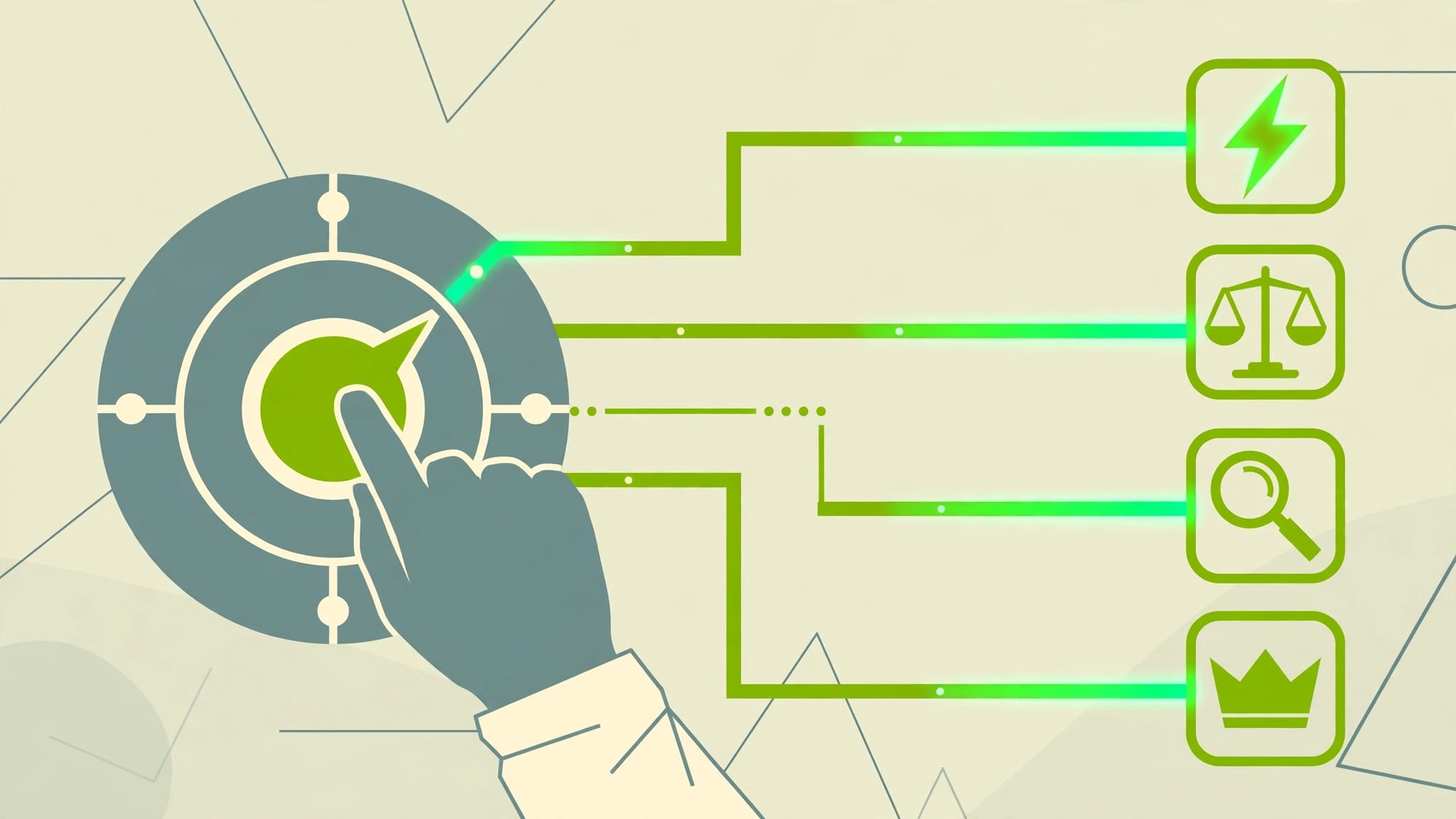
The default model: start here
The default is the flagship generalist, and it is the right choice for the large majority of tasks: writing, summarising, translating, brainstorming, everyday questions and most coding help. It balances quality, speed and the generous usage limits your plan allows.
A practical rule follows: if you cannot articulate why a task needs a special model, it doesn’t. Switching models has a cost — a fresh context, different behaviour — and the default’s whole purpose is to be the safe pair of hands.
Mini models: speed and volume
Mini models are smaller, cheaper and faster. They shine when the task is simple, structured and repeated: classifying text, extracting fields, rewriting in a fixed format, quick factual answers. In the API they are how businesses afford millions of calls; in ChatGPT they are the fast lane for light work.
The trade-off is depth. Give a mini a tangled multi-step problem and it will answer quickly and wrongly. Think of minis as excellent interns: fast, tireless, and in need of tasks with clear edges.
Reasoning models: when to think longer
Reasoning models — the “Thinking” options — work differently. Before answering, they generate internal chains of thought, checking a problem from several angles. On maths, logic, hard debugging, scientific questions and multi-constraint planning, the improvement is not subtle; it is the difference between a guess and a derivation.
The costs are time and allowance. Reasoning answers take longer and draw on a separate, tighter usage budget on most plans. Use them when correctness matters more than speed and the problem is genuinely hard — a contract’s logic, a subtle bug, a proof. For “write me a cheerful email,” thinking mode is a Ferrari at a school run.
In practice, the roles map to recognisable jobs. The default model is your correspondent: emails, summaries, explanations, plans. The mini is your clerk: sorting, extracting, reformatting, answering the same simple question a thousand times. The reasoning model is your analyst: the spreadsheet logic that must be right, the clause whose implications matter, the bug that survives three readings.
A useful test is reversibility. If a wrong answer costs you thirty seconds, speed wins and the default or mini is correct. If a wrong answer ships to a client, a court or a production system, the reasoning model’s slower, checked work is cheap insurance at any price.
Context size draws a second line. Very long documents — a full contract set, a codebase, a thesis — may only fit the flagship or Pro tiers’ larger windows. When a model seems to “forget” the start of a huge file, you have usually found that boundary, not a bug.
And remember that the picker is not the product. The same model behaves differently with a well-built prompt, relevant files attached and a clear definition of done. Skilled users get flagship results from default models more often than careless users get them from Pro.
Pro models and the honest answer
Top plans add Pro variants: the same frontier intelligence with more compute thrown at each answer and far larger context windows for huge documents. They are for professionals whose bottleneck is answer quality on very hard problems — researchers, engineers, analysts — not for faster birthday poems.
So the honest answer to the title: default for almost everything, mini for quick and simple, Thinking when the problem is hard and being wrong is expensive, Pro when you have measured the difference on your own work. Model names will keep churning — GPT numbers rise, codenames rotate — but the four roles have survived every relaunch so far, and choosing by role will outlast any specific picker.

0 Comments