
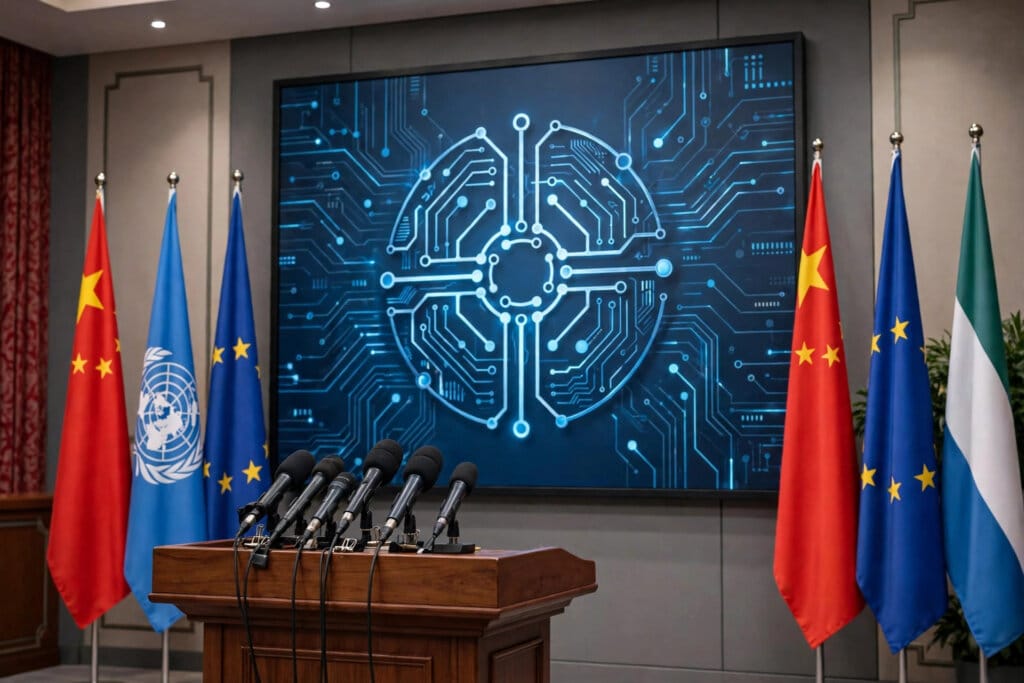
China has hit back at the United States’ ban on DeepSeek products for federal civilian agencies, vowing to safeguard the rights of Chinese companies and accusing Washington of politicising technology and trade. Foreign Ministry spokesperson Mao Ning made the remarks at a regular press briefing in Beijing on October 20, a day after the Department of Homeland Security’s removal order became public, the Associated Press reported.
The response is Beijing’s first on-record reaction to the order, which directs civilian agencies to strip DeepSeek and products built on it from their IT systems and bars them from buying it. It turns a procurement decision into the latest exchange in the two countries’ running fight over AI models, chips and data.
What Mao Ning Said About The DeepSeek Ban
Asked at the routine briefing about the US ban, Mao said China “will resolutely safeguard the legitimate rights and interests of Chinese companies”, according to AP’s report of the briefing. “China consistently opposes the overstretching of the concept of national security and the politicizing of science, technology, economic and trade issues,” she told reporters.
The order she was answering is the DHS directive covered in the US removal and procurement ban on DeepSeek: agencies must remove DeepSeek, its affiliated products and third-party products and services developed using DeepSeek from their systems, and may not procure them. The notice, published in the Federal Register and dating back to late July, alleges that DeepSeek’s models “present multiple threat vectors”, citing concerns that its servers are located in China and that Chinese authorities could potentially access private company infrastructure and sensitive US data. DeepSeek is one of China’s best-known AI companies, and its open-source models are widely available, including in the United States, and mostly free to use — the profile set out in our explainer on DeepSeek, China’s open-model challenger.
Why The DeepSeek Response Lands On Both Sides Of The Pacific
Beijing’s wording is its standard formula for US technology restrictions, but the target is new. Previous rounds of this argument were fought over hardware — export controls on advanced chips — and over apps such as TikTok. A ban aimed at a model provider’s software, extended to third-party products merely built using DeepSeek, reaches much further into the supply chain: any agency vendor whose service embeds DeepSeek models is in scope, whether or not the agency chose DeepSeek itself. The exchange also runs in both directions. Days earlier, Beijing proposed its own export controls on 23 AI technologies, including model weights and training methods, covered in China’s proposed AI export controls — a reminder that both governments are now writing rules that treat models themselves, not just chips, as strategic assets.
Why It Matters
The DeepSeek ban’s practical weight falls on the ecosystem around the model, not only on DeepSeek. Because its models are open and free, they sit inside countless third-party tools; a removal order that covers products “developed using DeepSeek” forces agencies and their suppliers to audit model provenance the way they audit software dependencies. China’s vow to safeguard its companies’ rights signals that Beijing reads the order the same way — as a precedent for excluding Chinese models from the US public sector altogether, rather than a narrow security fix for one app. For other Chinese model makers, from Qwen to Kimi, the message is that US government business is closing regardless of how open their weights are; for US agencies, the cost is a shrinking pool of cheap, capable open models and a new compliance burden of proving a negative about what sits inside their vendors’ stacks.
Background
DeepSeek, a Hangzhou-based lab spun out of the High-Flyer hedge fund, shocked markets in early 2025 by releasing frontier-class open models at a fraction of US training costs, and has kept shipping — most recently the V4.1 Flash update and its open-sourced DeepInfer inference engine. US officials have eyed it with suspicion ever since, over data flows to servers in China; the DHS order, drafted in July and published in the Federal Register in October, is the first blanket federal removal-and-procurement ban aimed at the company.
Source: Associated Press, “China defends DeepSeek after US ban” (Oct 20, 2026)

0 Comments