
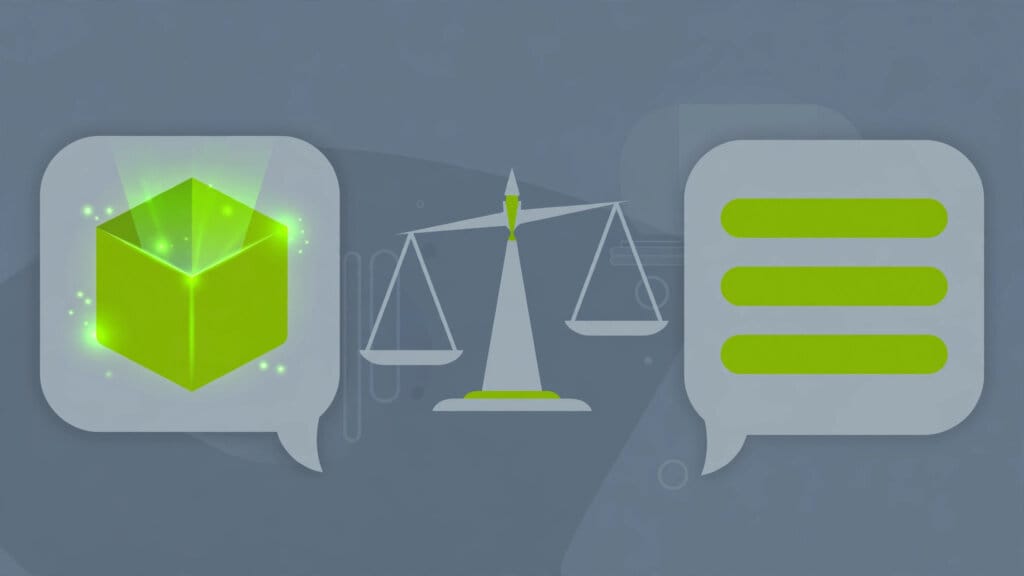
DeepSeek and ChatGPT answer the same prompt box in very different ways. One is a polished commercial product from the industry’s best-known lab; the other is an open-weight challenger from China that you can download and run yourself.
Choosing between them is less about which is “smarter” this month and more about what you value: convenience and ecosystem, or openness, price and control. Here is the comparison that actually matters.

Open versus closed
ChatGPT is a closed service. The models live on OpenAI’s servers, the features arrive on OpenAI’s schedule, and your access depends on your account and plan. In return, you get a refined app with voice, images, memory and a large ecosystem of integrations.
DeepSeek’s leading models are open-weight. Anyone can download them, run them locally or through cheap API access, and fine-tune them for specific jobs.
That difference shapes everything else. DeepSeek can be embedded in products and research with no gatekeeper, while ChatGPT offers the smoother experience for people who just want answers in a browser or phone app.
Price and access
DeepSeek built its reputation on being effectively free for ordinary users, with API pricing far below typical Western rivals. For developers burning through millions of tokens, that gap is the story.
ChatGPT runs a freemium ladder: a capable free tier, with paid plans unlocking stronger models, higher limits and extra tools. Many users happily pay for the polish and reliability.
Scale tells its own story. DeepSeek properties attract roughly 319 million visits a month in 2026 trackers, and around 130 million monthly users in China, remarkable for a lab a fraction of OpenAI’s size.
Answers, trust and rough edges
On everyday questions, both are strong, and both can be confidently wrong. Any answer engine can produce fluent nonsense, as our report on AI Overviews answering gibberish searches showed for a different platform entirely.
DeepSeek’s reasoning models won fans for visible step-by-step thinking. ChatGPT counters with breadth: multimodal tools, a mature app, and years of edge-case tuning for mainstream users.
Trust questions differ by topic. DeepSeek, as a Chinese service, faces scrutiny over data handling and avoids some politically sensitive subjects about China. ChatGPT has its own guardrails and refusals, shaped by US norms and law.
Ecosystem, extras and the fine print. ChatGPT’s lead is widest outside the chat window itself. Voice conversations, image generation and editing, file handling, memory across sessions and a deep bench of third-party integrations make it feel like an operating system for knowledge work.
DeepSeek’s extras point the other way: downloadable weights, a permissive path to self-hosting, and an API cheap enough to build into products without a finance department’s permission. Its ecosystem lives in developer tooling rather than consumer features.
Privacy follows the same split. With ChatGPT, your data travels to OpenAI’s cloud under its policies. With DeepSeek’s app, data travels to a Chinese service under different laws; with DeepSeek’s weights run locally, data need not travel at all.
Businesses weigh support and accountability too. An enterprise can sign contracts, get compliance paperwork and phone a vendor with ChatGPT’s paid tiers. With open weights, the responsibility (and the control) sits in-house.
Neither profile is “better” in the abstract. They are answers to different questions: do you want an assistant provided to you, or a capability you possess?
Which should you use?
Pick ChatGPT if you want the most complete consumer product and do not care how the model is delivered. Pick DeepSeek if price, openness or running models on your own hardware matters to you.
Availability draws another line between them. ChatGPT is a single global product with localised pricing and apps everywhere; DeepSeek’s app faces restrictions in some organisations and countries, even while its weights circulate without friction.
Updates also feel different. ChatGPT evolves as a service, with features appearing inside the same familiar interface. DeepSeek evolves as releases: new model versions that the whole ecosystem downloads, benchmarks and rebuilds within days.
Language and culture add a final nuance. DeepSeek’s models are rooted in Chinese and English data, while ChatGPT’s tuning reflects a more American centre of gravity; on local knowledge, humour and sensitive topics, each feels native in different places.
Many technical users now use both: the closed assistant for daily convenience, the open model for building. That split is exactly why this comparison will keep mattering.

0 Comments