

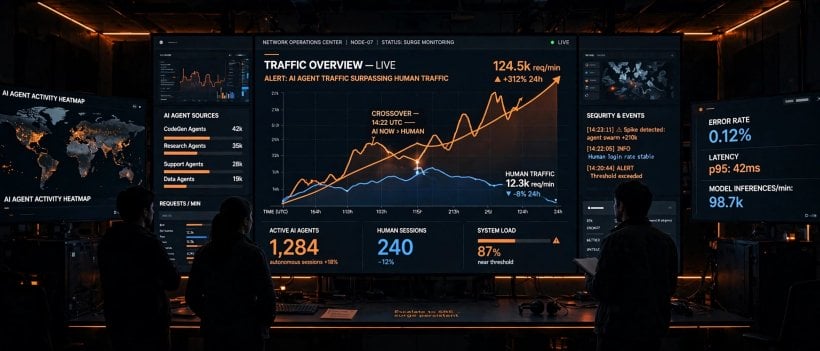
More than 10 million developers are now building on Cloudflare, the company announced on October 20, up from 7.4 million in the prior quarter — a jump of about 2.6 million in three months that Cloudflare credits to the rise of AI agents. Daily requests from AI agents on Cloudflare’s network grew by more than 1,700% over the past year, and the company said more than half of internet traffic this year was not human, for the first time.
“Cloudflare built Workers nearly a decade ago around a different kind of compute primitive, one designed for efficiency, speed and global scale from the start,” said Rita Kozlov, Cloudflare’s vice president of product management. “That foundation matters even more as developers build for the agentic era, because the software lifecycle is expanding from developers building for people to developers and agents building for people and agents.”
From Workers To A Full Agent-Era Stack
What began with Workers, Cloudflare’s serverless compute platform, has grown into a full stack across compute, storage, databases, AI, media, real-time services, observability and developer workflows. The company named Workers AI, Workers KV, AI Gateway, Durable Objects, D1 and R2 among the products developers are using to build AI-native applications that run globally from the start.
A technical choice sits underneath that pitch: Workers runs on isolates rather than traditional virtual machines or containers, which Cloudflare says helps developers deploy quickly and scale efficiently across its network. The model fits agent workloads in particular — short-lived, bursty tasks spun up by software rather than people, running continuously rather than in office hours. It is the same shift in demand that agent-infrastructure launches such as the Visa, BILL and Billtrust agent payments pilot are being built to serve.
The Network Behind The Milestone
Cloudflare’s network now spans more than 340 cities in more than 130 countries, connects with 13,888 networks and has 590 Tbps of external network capacity. “When a platform spans more than 340 cities, connects with nearly 14,000 networks, and has just under 600 Tbps of external capacity, developers don’t have to choose between speed, scale, and security,” said chief technology officer Dane Knecht.
The traffic figures are the company’s own measurements of its network, and they are self-reported: the 10 million developer count is Cloudflare’s internal figure, and the claim that automated traffic passed human traffic applies to traffic Cloudflare sees rather than an independently audited share of the whole internet. Even with that caveat, the direction matches what agent-platform operators report elsewhere — a pattern also visible in Grafana’s launch of monitoring tools for fleets of AI agents.
Why It Matters
Cloudflare’s developer milestone matters less as a headcount than as a measure of who — or what — the internet’s traffic now is. If daily agent requests can grow more than 1,700% in a year on one of the world’s largest networks, then infrastructure built for human browsing patterns is being rebuilt, in practice, for machines that request, transact and build around the clock. That is why a serverless platform designed around isolates is winning agent workloads, and why Cloudflare is positioning its stack — compute, AI gateway, durable state and storage in one place — as the default base for agent-built applications. The neighbouring platforms feel the same pressure: agent traffic is now a selling point in everything from Yelp’s AI phone agent for restaurant bookings to enterprise agent governance tools.
Background
Cloudflare launched Workers in 2017, betting that serverless code running in lightweight isolates at the edge would beat virtual machines for latency-sensitive work. The company has since widened the platform piece by piece — storage with R2, databases with D1, AI inference with Workers AI and an AI Gateway for model traffic — while its network grew into one of the largest on the internet. The 10 million figure, up from 7.4 million a single quarter earlier, is the steepest developer growth the company has reported, and it arrives as AI coding tools and autonomous agents turn application development itself into a source of machine traffic.
Source: Cloudflare official announcement via Business Wire; The News International




0 Comments