

AI agents have started paying real business invoices. Visa, BILL and Billtrust announced on October 20 that they have launched the first live pilot in which a trusted AI agent initiates and completes an approved buyer invoice payment end to end through a supplier’s portal — a step that until now usually required a person to log in and key in the payment by hand.
The pilot is not a demonstration environment. The three companies say it is already live and processing end-to-end transactions between participating buyers who use BILL, the accounts payable platform, and suppliers who receive payments through Billtrust’s accounts receivable portals. It was announced from Las Vegas in a joint release issued through Business Wire.

How The Trusted Agent Protocol Authenticates The BILL Payment Agent
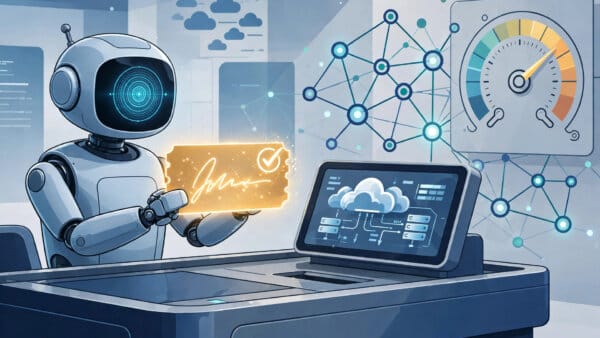
The flow starts on the buyer’s side. The authorised BILL Payment Agent is registered using Visa’s Trusted Agent Protocol and its Agentic Directory, and it pays with tokenized payment credentials — stand-in credentials rather than the real card details — under controls aligned with the buyer’s approved payment instructions. The release stresses that the agent makes no payment decisions of its own: it only executes payments the buyer has already approved.
On the supplier’s side, Billtrust uses the same Trusted Agent Protocol to recognise, authenticate and grant access to the agent. That authentication can satisfy the site protections historically provided by CAPTCHA and other bot-blocking mechanisms, without an additional agent login and without buyers sharing supplier-portal credentials. Each payment follows a purpose-built path tied to the specific invoice, with visibility into its authorisation and completion on both sides.
What Each Partner Brings To The Pilot
Visa contributes the trust layer from its Visa Intelligent Commerce portfolio: agent recognition, tokenized credentials and payment controls. “Businesses should not have to choose between automation and control when making payments,” said Mark Nelsen, Visa’s SVP and head of product for commercial and money movement solutions, adding that the pilot tests how identity, controls and transaction visibility make agentic payments work across platforms.
BILL brings the buyer base and the agent itself. Nearly 500,000 businesses use BILL to manage and move money, and its platform processes roughly 1% of US GDP annually, according to the release. BILL’s Archana Prasad said supplier portals have long been friction points requiring manual completion, and that the pilot closes that gap so suppliers are paid faster and finance teams get their time back. For Billtrust’s suppliers, Kunal Patel said, the model releases trapped cash faster while preserving the acceptance policy and reconciliation information suppliers rely on. Seeking Alpha’s market report noted BILL’s shares jumped about 5% on the morning of the announcement.
Why Portals Were The Barrier For Agent Payments
Supplier portals were designed to keep bots out. Human authentication requirements — logins, CAPTCHAs and one-off verification steps — are precisely what limited how far accounts payable automation could go, leaving a manual final step even in otherwise automated workflows. The pilot’s answer is not to weaken those protections but to give portals a way to distinguish an authorised, identified agent acting for a named buyer from an anonymous bot, and to let suppliers keep control over which agent-initiated payments they accept.
Why It Matters
The central entity is Visa’s Trusted Agent Protocol, and this pilot is its first live test moving money between two independent platforms. Its neighbours are the problems documented across the agent economy: banks and websites are blocking AI agents from accounts and bookings because they cannot tell a trusted agent from a scraper, while credential systems such as World ID’s banking suite are racing to give agents verifiable identities. A payments network solving the same problem with registration, tokenization and per-invoice controls gives AI agents a route into regulated, money-moving work — the category of task where, as the difference between agents and chatbots becomes practical, trust matters more than capability. If the model spreads, the manual portal step disappears from accounts payable, and agent identity becomes standard infrastructure for commerce.
Background
Visa launched its Intelligent Commerce programme to prepare its network for a world in which software agents shop and pay on people’s behalf, and published the Trusted Agent Protocol so merchants and portals could recognise legitimate agents. BILL, founded as an accounts payable tool for small and mid-sized businesses, has grown into a finance platform used by nearly half a million businesses, while Billtrust built its business on the supplier side of the same invoice. This pilot is where those three threads meet in a live transaction.
Source: Visa (official announcement, October 20, 2026); PYMNTS; Seeking Alpha



0 Comments