

NVIDIA and the UW Medicine Institute for Protein Design released RFD4-Proteina on October 21, an open BioNeMo model that combines programmable protein design with search, as the headline of a healthcare package announced at GTC Berlin. The same announcement covers an adaptive radiotherapy collaboration with Siemens Healthineers and a group of life-science companies building scientific agents on the BioNeMo platform.
RFD4-Proteina generates targeted protein designs, letting scientists and agents search and refine candidates using molecular inputs, constraints and scoring objectives. NVIDIA said potential applications include proteins designed to interrupt disease processes and proteins that detect signs of disease in diagnostic tests.
RFD4-Proteina: An Open Model For Designing Proteins
In testing reported in the research draft, RFD4-Proteina achieved higher computational design success rates and generation throughput than the evaluated baselines across four benchmark suites: protein binding, small-molecule binding, enzyme scaffolding and DNA binding. NVIDIA was careful about what those numbers mean: the model helps researchers explore and prioritise candidates for laboratory testing, where experiments establish how a design performs under tested conditions.
The model is available today through partners including Amazon Bio Discovery, Anthropic’s Claude Science, Benchling, Databricks, Google Cloud, Hugging Face, Nebius, OpenAI and Tamarind Bio. “We are moving from an era of discovering the proteins nature has made to one in which we can design entirely new ones,” said David Baker, the 2024 Nobel laureate in chemistry who directs the Institute for Protein Design at the University of Washington. “Making the model open will allow researchers around the world to build on these capabilities.”
The release continues NVIDIA’s push into computational biology, which GER has covered through work such as Cosmos3-H-Dreams, NVIDIA’s world model for robotic surgery.
Siemens Healthineers And Adaptive Radiotherapy
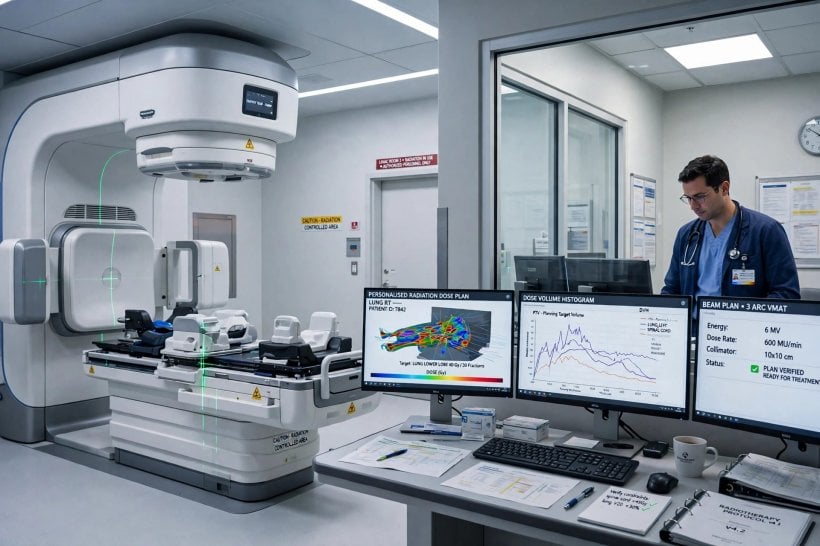
Siemens Healthineers and NVIDIA are collaborating on the next generation of adaptive radiotherapy, combining imaging and oncology expertise with accelerated computing and simulation. NVIDIA Nemotron open foundation models are being explored to power agentic co-planning, helping oncologists evaluate and refine personalised treatment strategies, combined with CUDA-accelerated dose calculation for rapid patient-specific simulation and the NVIDIA Holoscan platform to connect live sensor data with AI and simulation.
The clinical pressure behind the work is scale: by 2050, roughly 35 million people worldwide are projected to be diagnosed with cancer each year, while specialist capacity stays limited. “Treatment should adapt to the patient, not the other way around,” said Arthur Kaindl, head of Varian, the Siemens Healthineers cancer-care business, pointing to the company’s recent Accela system launch as the base the collaboration builds on.
BioNeMo Scientific Agents And Hospital AI
Seven research and laboratory technology companies — Automata, Benchling, Biolevate, Boltz, Danaher, Hologen and Therna Biosciences — are using BioNeMo, Nemotron and other NVIDIA technologies to build scientific agents that connect drug design, scientific data and laboratory workflows. Benchling is grounding agents in experimental data; Boltz is previewing a scientific agent that plans workflows and interprets results; Automata is connecting agents to automated laboratory infrastructure; and Genedata’s AI co-scientist will coordinate protein design and testing inside Danaher’s autonomous lab, in a workflow that incorporates RFD4-Proteina itself.
The announcement also lists European hospital AI work built on Nemotron — Avelios, Corti, Dedalus, Dawn Health and Sword, spanning AI scribes and clinical care — and a multilingual dialog deployment by PolyAI with medical software provider Corilus, whose network spans more than 70,000 healthcare professionals across Belgium and France. The agent side of the package follows the same pattern as NVIDIA’s OpenShell reference architecture for safe enterprise agents, applied here to laboratories and hospitals.
Why It Matters
RFD4-Proteina matters because it moves NVIDIA’s healthcare strategy from selling compute to giving away the model layer: an open protein-design model, distributed on the same day through rivals’ platforms including Claude Science and OpenAI, makes BioNeMo the common tooling underneath competing drug-discovery efforts. The Siemens Healthineers collaboration shows the other half of the strategy — embedding Nemotron, CUDA and Holoscan inside a medical device maker’s treatment systems, where switching costs are high and deployments last for years. For researchers, the practical change is speed: design candidates that once took a literature search and months of iteration can now be generated, scored and queued for lab testing inside agent workflows like those Anthropic described in Claude’s protein binder work against scorpion toxins.
Background
The University of Washington’s Institute for Protein Design, led by David Baker, pioneered computational protein design; its RFdiffusion family of models showed that generative AI could create entirely new proteins, and Baker shared the 2024 Nobel Prize in chemistry for that work. NVIDIA has spent several years building BioNeMo into its platform for AI-driven biology, and GTC Berlin — a European edition of its developer conference — gave the company a stage to pair the open-model release with Siemens Healthineers, one of Europe’s largest medical technology companies.
Source: NVIDIA official announcement via GlobeNewswire (Manila Times syndication); Unite.AI




0 Comments