
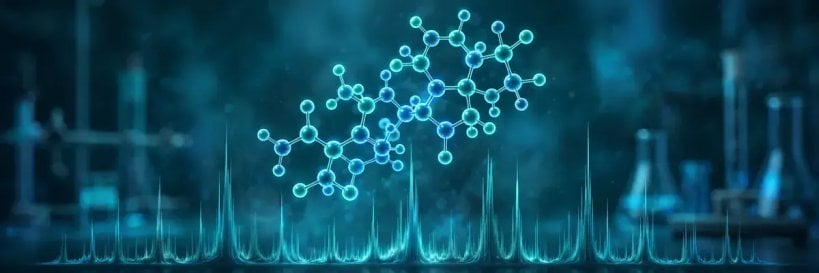
Google DeepMind has released Mass Spec Skills for its Antigravity platform, a suite that lets Gemini agents turn tandem mass spectra into proposed molecular structures. On a 100-compound benchmark, the system identified the exact molecule in about 97% of attempts, against under 4% without the skills.
What the skills do
The suite pairs Gemini’s chemical reasoning with established mass spectrometry tools and public chemical databases, including SIRIUS for formula inference, GNPS and MoNA for library searches, and PubChem for candidate structures. The agent picks and chains the right skills from a plain-language task, with no per-tool setup.
In the worked example, the agent took a negative-mode spectrum of 1,761 raw peaks, filtered to 19, and used SIRIUS to pin down the formula C20H21ClN6O. It then ranked 845 PubChem isomers against simulated fragments and singled out the true molecule, accounting for 97.7% of fragment intensity.
The benchmark gap
DeepMind tested it on 100 compounds from the Enamine REAL collection in MoNA, running three attempts per spectrum. It compared setups, no internet and no skills, internet only, and internet plus the skills, across the lightweight Gemini 3.8 Flash and frontier models Gemini 4 Argon and Gemini 4 Carbon.
With no internet access or skills, accuracy stayed under 4% for all three models, confirming they cannot deduce structures from peak lists alone. Internet access alone helped, but the frontier models still missed a quarter to a third of the spectra, and the lightweight model missed more than three-quarters.
The skills also cut tokens per attempt, by nearly four times on Flash, by half on Argon, and by nearly a fifth on Carbon. With the skills added, all three models identified and verified the exact molecule in around 97% of attempts, with the lightweight model matching the frontier ones.
Our read
The result that matters here is not chemistry but the pattern. Validated skills, not bigger models, closed the gap: the cheapest model matched the frontier ones once both had the same tools, and it did so using fewer tokens per attempt.
The same skills pattern is spreading across labs, with Claude’s servers now shipping skills alongside their tools. The lesson for buyers is to ask what validated workflows a platform ships, not only which model sits underneath, since the workflow did the work.
The limits deserve the same attention. The 97% figure comes from 100 compounds whose spectra sit in public libraries, so it says nothing about molecules with no library entry. Mirror-image molecules and close isomers still need other measurements to separate.
Genuinely new molecules, including many natural products, are not in any database, so the agent cannot retrieve or confirm a structure on its own. It can only offer a predicted formula, peak assignments and a detailed annotation table as a starting point for chemists.
Why It Matters
Most measured spectra stay unannotated: libraries cover only about 5% of them, and 10% for human samples. The rest has been called the dark matter of mass spectrometry, and scaling automated interpretation to full metabolomics studies could surface unknown molecules in health, environmental science and natural-product discovery.
Access matters too. The skills are available today in the Antigravity app through the Mass Spec plugin, with enterprise users signing in through business accounts. DeepMind is offering 10,000 scientists its top tier free for six months, onboarded on a rolling basis, subject to eligibility.
Background
Antigravity has been adding domain skills through November, from drug discovery to robot arms, and DeepMind’s benchmark this week caught top models failing easy tasks. The mass spectrometry suite is the latest sign that Google is betting on packaged workflows, not raw model power, to make agents useful for science.
Source: Google DeepMind blog



0 Comments