
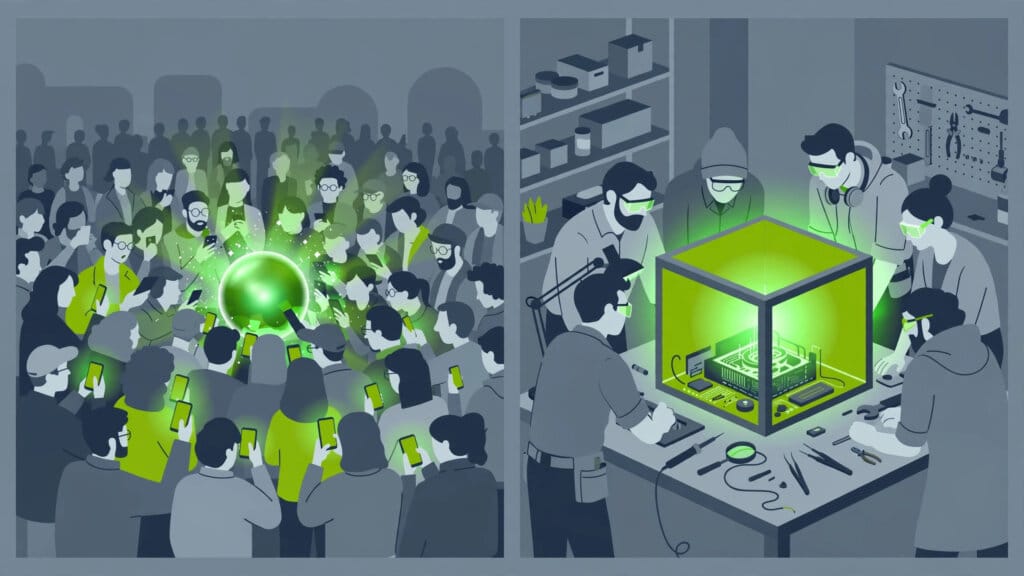
Ask who leads AI in China and two names come back, for opposite reasons. Doubao, ByteDance’s assistant, owns the consumers, with roughly 382 million monthly users. DeepSeek owns the conversation among developers and strategists, with open models the whole world downloads.
They barely compete for the same prize. Doubao is a product empire; DeepSeek is an influence engine. Understanding the difference explains most of Chinese AI.

Reach versus resonance
Doubao’s numbers are staggering: the most-used AI app in China, more than double the roughly 167 million monthly users of second-placed Qwen. Its audience is mainstream (students, office workers, families) and its interface asks nothing technical of them.
DeepSeek’s audience is smaller in app terms but outsized in impact. Industry trackers put its properties at roughly 319 million visits a month in 2026, with about 130 million monthly users in China, and its open weights are embedded in products worldwide.
One company optimises for daily habit; the other for adoption by builders. Both are forms of power, but they cash out differently.
Closed product, open models
Doubao follows the classic platform model. The assistant is free and polished, the models behind it stay ByteDance’s, and the value accumulates inside ByteDance’s ecosystem of video, cloud and commerce.
DeepSeek gives the models away. Open weights let anyone run, modify and commercialise them, which spreads DeepSeek’s technology far beyond its own app, at the cost of controlling how it is used.
The contrast mirrors the global industry’s deepest split, between AI as a destination you visit and AI as a component anyone can install. China simply runs both experiments at enormous scale, simultaneously.
Money and staying power
ByteDance can fund Doubao from one of the world’s great advertising businesses. Growth first, revenue later is a strategy it has executed before, and its cloud arm already sells the Doubao model family to enterprises.
DeepSeek grew out of a quant fund and runs lean by reputation. Its low-cost engineering is its legend and its pitch: if intelligence gets cheaper, the efficient survive whatever the giants spend.
Each model has a characteristic risk. Doubao must eventually convert attention into money without breaking the free habit. DeepSeek must keep pace at the frontier while richer rivals, including ByteDance, pour money into research and talent.
What users and builders each get. For a Chinese consumer choosing an assistant today, the decision is mostly about feel. Doubao is the warmer, more present product: voice-friendly, free, woven into the apps already on the phone, and tuned for everyday life.
DeepSeek appeals to the curious and the technical: visible reasoning, a researcher’s reputation, and the sense of using the model everyone is talking about. Its app is a front door; its weights are the real estate.
Builders face the mirror-image choice. Building on Doubao means plugging into ByteDance’s cloud and rules, with access to its models and audience. Building on DeepSeek means downloading the core technology and owning your stack outright.
Enterprises split accordingly. Consumer brands care where the users are, which is Doubao. Infrastructure teams care what they can inspect, host and control, which is DeepSeek.
Many end up using both, which is precisely why the comparison stays interesting: the two champions are not substitutes so much as answers to different layers of the same stack.
Why the contest matters beyond China
Together they sketch the two futures available to every AI company: own the audience, or own the standard. ByteDance bet on the audience; DeepSeek bet on the standard.
The two also export differently. Doubao travels inside ByteDance’s global product machine, surfacing in international apps and cloud deals under various names. DeepSeek travels as files and papers, adopted by strangers the company will never meet.
Regulators read them differently as well. A giant consumer platform raises questions about attention, data and minors; a downloadable model raises questions about capability diffusion. China’s champions thus face two separate policy debates abroad.
Even their names in the West differ in kind: Doubao is a product you may never be offered, while DeepSeek is a file already sitting in tools you use. Presence and permeation are different superpowers.
Western labs are quietly making the same choice, between polished consumer ecosystems and open releases that seed the world’s infrastructure. Watching which Chinese champion pulls further ahead is the cleanest preview of how that bet resolves.

0 Comments