

Flapping Airplanes has raised $1 billion in a Series A round that values the year-old AI research lab at $6 billion, the company announced on Wednesday, October 21. TechCrunch reports the round was co-led by Index Ventures and Lux Capital, and that the valuation, which includes the new money, is four times the price investors paid in January.
The San Francisco startup has no commercial product and no revenue. What it is selling investors is a research bet: that the next gains in AI will come from training models with far less data and compute, and from software that squeezes more work out of each graphics chip, rather than from ever-larger data centres.
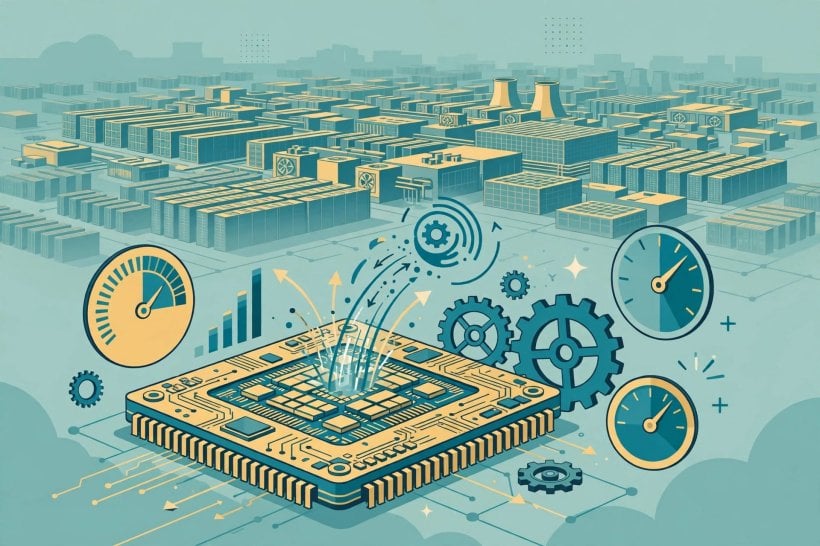
Flapping Airplanes: From A $180 Million Seed To A $6 Billion Valuation In Nine Months
Flapping Airplanes launched publicly in January 2026 with a $180 million seed round from GV, Sequoia Capital and Index Ventures that valued it at $1.5 billion. Returning backers Sequoia, GV and Kleiner Perkins joined the Series A, alongside Valor Equity Partners, Atreides Management and A*. Nvidia is also an investor in the company.
The founders are Aidan Smith, a Thiel Fellow who worked at Neuralink during college, and brothers Asher and Ben Spector. Asher Spector was a statistics PhD at Stanford; Ben Spector was a computer science PhD student at Stanford and founded Prod, a student-run startup accelerator at MIT, while still a student there. Sequoia partner David Cahn, an investor, has described the trio as building the “young person’s AGI lab.”
Flapping Airplanes: The Megakernel Bet On Efficiency
The technical core of the pitch is what the founders call the world’s most complete megakernel framework. A kernel is the program that runs on a GPU, and a megakernel bundles many tasks into one program. Flapping Airplanes says its framework can perform entire training runs, serve inference and play video games, even all three simultaneously inside a single kernel.
The economic argument is about scarcity. “The basic thesis is demand for AI is going to outpace chip and data supply,” co-founder Asher Spector said. “The company that’s going to be most successful, and create the most value for the world, is the one that can squeeze the most out of the inputs.” The company is developing its own code to run Nvidia’s GPUs more efficiently and deploy them more flexibly, and Spector said it plans to commercialise the technology.
Flapping Airplanes: The Neolab Funding Wave
Flapping Airplanes belongs to a fast-growing class of research-first startups, often called AI neolabs, that raise frontier-lab money before they have anything to sell. The round lands in a record quarter for billion-dollar AI financings, and it follows the same pattern as other recent Startups coverage on this site, from Pigment’s $250 million Series E at a $2.3 billion valuation to Legora’s $550 million raise at $8.8 billion and Blacksmith’s $66 million Series C at a $1 billion valuation, except that Flapping Airplanes is younger, earlier and larger than all three relative to its stage.
Why It Matters
Flapping Airplanes matters as a pricing signal for the whole AI economy. A $6 billion valuation for a pre-product lab only makes sense if investors believe the industry’s binding constraint is about to move, from who can buy the most chips to who can waste the fewest. If the lab’s efficiency research works, even a 10 percent improvement in chip utilisation is worth enormous sums at the scale the hyperscalers now spend. If it does not, the round becomes the cleanest example yet of how far ahead of revenue neolab valuations have run. Either way, the cheque tells founders where the money wants to go next: not another wrapper on someone else’s model, but the layer underneath the models themselves.
Background
Flapping Airplanes was founded in late 2025 and launched in January 2026, part of a wave of labs started by very young researchers with elite-lab and accelerator pedigrees. Its January seed, $180 million at a $1.5 billion valuation, was already one of the largest seed rounds on record for a company with no product. Nine months later, the same investors have quadrupled the price.
Source: TechCrunch, Bloomberg Law




0 Comments