

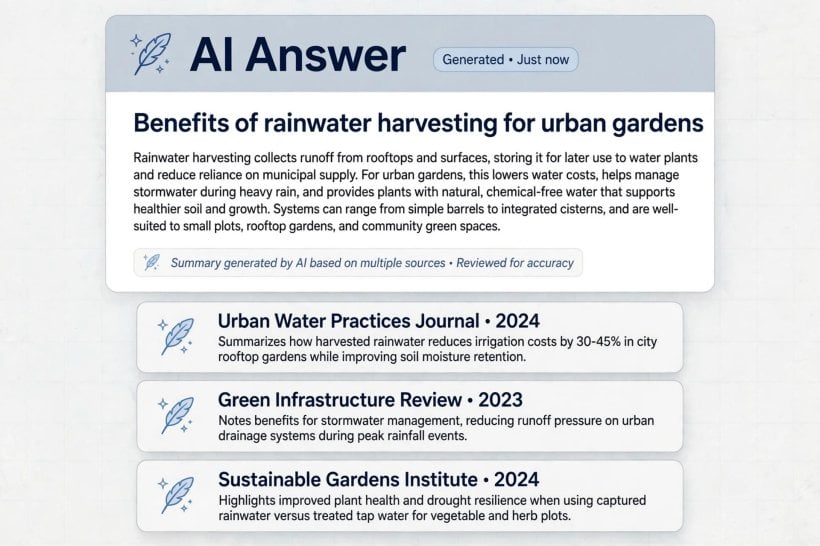
Google appears to be testing a new twist inside AI Overviews: the citation cards that point readers at the source pages are starting to carry AI-written summaries of those pages, rather than text pulled directly from them.
The change was spotted by SEO consultant Brodie Clark, who posted screenshots on X and noted he had not seen Google summarising content inside the citations before. Search Engine Roundtable’s Barry Schwartz then confirmed he sees the behaviour on some of his own test queries — not all of them. Google has not announced the change.
What Changed Inside The Citation Cards
Citation cards are the blocks of source links that sit beside or below Google’s AI-generated answers, giving each cited page a headline, a favicon or logo, and a short description. Until now, that description has been text drawn from the page itself — the same kind of snippet the page might show in a regular blue link.
In the new variant, the description is written by Google’s AI to sum up what it considers the page’s most relevant points for the query at hand. As Clark put it in his post, “the text doesn’t appear exactly like this on the page — it is being summarised based on the information that Google thinks is most relevant to the query.” The visual design of the cards looks unchanged; only the wording of the description is new.
Schwartz’s confirmation matters here because it shows the sighting is not a one-account quirk. He reproduced the AI-written descriptions on several of his own test queries, while noting that other queries still show the old page-text descriptions. That mix is the classic signature of a Google test or a gradual rollout.
A Test, Not A Confirmed Rollout
For now, publishers should treat this as an experiment. Google has a long habit of testing citation-card formats — recent months have seen tests of a Source preferences button inside AI Mode citations and of stacking the cards at the bottom of desktop answers instead of the right rail.
The company has said nothing on the record about AI-written card descriptions, so nobody outside Google knows how broadly this is deployed, whether it is limited to certain query types, or whether it will ever graduate into a permanent feature. Tests that never ship are common in Search; so are tests that quietly become the new default. Either way, the fact that both an independent consultant and a trade publication can reproduce it on live queries means it is real user-facing behaviour for at least some searchers today.
What it is not, so far, is announced policy. That distinction matters for anyone planning site changes around it — there is no official guidance yet on whether publishers can influence these descriptions, the way they can influence classic snippets through meta descriptions and on-page text.
Why It Matters
Publishers have just lost one of their last direct lines of text in AI search results. The citation card description is the final thing a searcher reads before deciding whether to click through to your page. When that text came from your own page, you controlled the framing: the words you wrote were the words on offer.
Under the test, Google inserts itself as the copywriter. The description becomes a machine’s compressed read of your article, tuned to the query rather than to your intended emphasis. That could be a net positive when Google’s summary highlights exactly the answer the searcher wants — or a loss of nuance when the summary flattens a careful argument into a generic line.
For brands and SEO teams, the practical consequence is that monitoring AI Overviews can no longer stop at “are we cited.” How the citation presents you matters just as much as whether it links you. Google’s own October 15 changes aimed at sending more traffic back to websites put inline links higher and expanded Preferred Sources carousels; this experiment shows the company is still reworking the bridge between its answers and the open web — and not always in ways publishers would choose themselves.
Background
AI Overviews launched in the United States in May 2024 after a year of testing as the Search Generative Experience, and quickly became the top-of-page fixture on informational queries — Semrush analysis puts their presence at 88% of commercial keywords. Citations have been Google’s answer to the criticism that AI answers cut publishers out: a visible, clickable link back to the source. Every rework of the cards, from layout tests to this new AI-written description experiment, changes the terms of that bargain.
Source: Search Engine Roundtable


0 Comments