

OpenAI has built a new test for AI agents that work in the laboratory, and its newest model leads the field by a wide margin. BioBasicsBench, released on 6 November 2026 with enzyme-design company Ligo, asks agents to interpret raw evidence from routine wet-lab experiments — gel images, colony plates, microscopy stacks and instrument readouts — rather than answer textbook questions. At the highest reasoning setting reported for all seven models tested, GPT-6 Astra earned 66.7% of the available rubric credit, against 43.8% for GPT-5.6 Sol.
What BioBasicsBench actually measures
The benchmark contains 100 tasks across five areas of laboratory work: protein methods, imaging and cytometry, quantification and assays, nucleic acid methods, and molecular cloning. Scientists built the tasks from data in their own experiments and wrote grading rubrics, so an agent is scored on conclusions, measurements, reasoning and knowing when the evidence cannot support an answer.
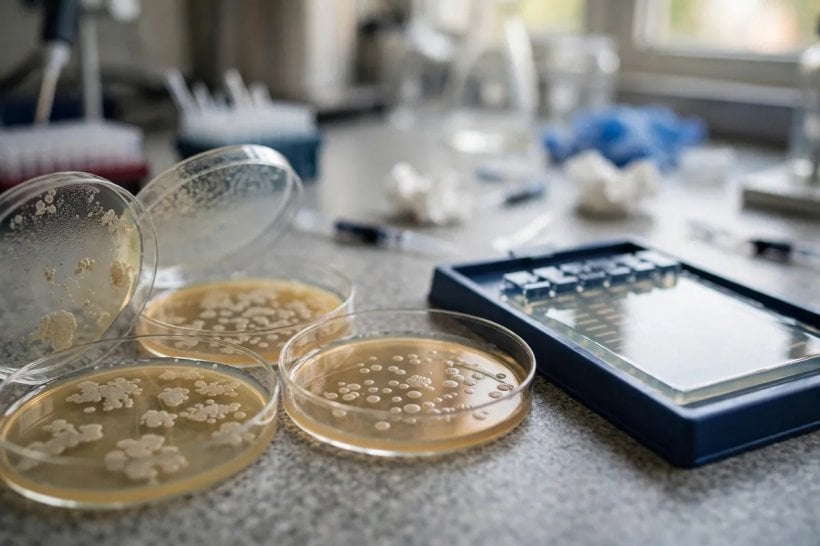
The inputs are the messy material of real bench work: gel and blot images in 31 tasks, protocols and handwritten notes in 27, tables and instrument exports in 20, and microscopy in 14. Each task passed three reviews — a Ligo scientist who had not written it, an external PhD-level wet-lab scientist, and a final internal check.
The results: Astra pulls clear
OpenAI tested seven models across 37 settings, with five attempts on every task, producing 18,500 results. Scores are mean reward — the average share of available rubric credit, including partial credit — not the share of tasks fully solved. At the xhigh setting, the highest reported for all seven models, Astra scored 66.7%, GPT-6.1 Sol 62.0%, and GPT-5.6 Sol 43.8%.
The gap is the story: Astra beats its predecessor by 22.9 percentage points while using about half the output tokens per task — 4,704 against 9,099. GPT-6 Luna, by contrast, managed only 38.3% despite 13,120 tokens per task, and GPT-5.2 trailed at 31.2% while burning 27,620. More reasoning did not buy better answers; better multimodal reading did.
Where Astra still gets it wrong
OpenAI is frank about the failures. In one colony-PCR task, Astra assumed a larger DNA product meant successful cloning and picked lanes 4, 6, 7 and 8; the reference answer picked lanes 5, 9 and 10, so Astra’s choice would purify the wrong plasmid. In a colony-counting task it overcounted by 12%, marking empty agar as colonies and merging neighbours.
Our Read
BioBasicsBench tests the part of science that benchmarks usually skip: not what a model knows, but whether it can look at messy evidence and reason honestly about it. Astra’s lead is real — 23 points over its predecessor on identical tasks — and it comes with fewer tokens, which suggests the gain is in perception, not brute-force reasoning.
That is the capability labs need, and it is the one where the benchmark’s failures bite hardest. Astra can spot a mislabelled control plate and still pick the wrong colonies, or notice that contrast varies with focus and generalise from the darker cells. The gap between seeing evidence and using it is now the frontier — and BioBasicsBench measures it.
The result reframes the model race. GPT-6 Luna, the efficiency play, trails GPT-5.6 Sol on this test despite more tokens, while GPT-6.1 Sol sits close behind Astra at 62.0%. The spread between OpenAI’s models is wider than the gap to any rival — a reminder that this benchmark is OpenAI’s own yardstick, and no outside lab has reproduced these scores.
Why It Matters
If agents are going to help in laboratories, they must handle the evidence scientists produce — failed runs, ambiguous images, controls that mislead. BioBasicsBench gives that work a scoreboard, and Astra’s 66.7% shows models are getting closer while short of reliable judgment. For labs, that means assistance, not autonomy; for rival model makers, it sets a test to beat.
Background
OpenAI built the benchmark with Ligo, a biotech company focused on enzyme design, and says tracking these capabilities will also inform its assessment of their biosafety and biosecurity consequences. The release follows a week in which independent researchers reported that nine AI agents failed a research test outright, underlining how far agents still are from work scientists can trust.


0 Comments