
98KB, under 100KB news cap)
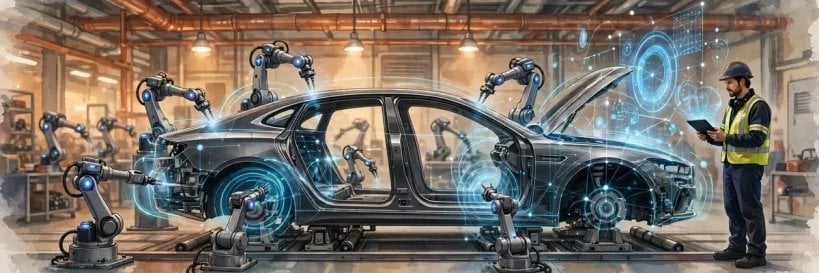
Alt text: A technician with a tablet beside a car body on a factory production line, with diagnostic overlays and robotic arms nearby.
Word count (local body, mechanically counted): 543 words; 12 paragraphs, all 40-50 words (47/48/48/43/40/45/48/40/48/44/42/50).
Internal links: 3, embedded, spread through the content on merit (Antigravity robot arms; Claude Ship; Gemini Robotics Mercedes).
First paragraph: attributes only to Mercedes-Benz / Arena Physica (official sources); no news outlet named.
Gate met: OFFICIAL SOURCE — Arena Physica’s own announcement (arenaphysica.com, read in full, 58 lines), corroborated by the PR Newswire release and Interesting Engineering (24 Nov, read in full).
Why significant: a top automaker’s global agreement to deploy AI agents on production lines, with a measured 20-30% faster repair result in testing — agents doing physical, operational work at industrial scale, not a demo.
Dedupe: ledger greps “Arena Physica” / “Atlas” (post lines) return no Mercedes/Atlas post; the only Mercedes factory post is Gemini Robotics 2.5 (13 Nov), linked, not duplicated.
Sources read in full:
– https://www.arenaphysica.com/articles/mercedes-benz-atlas-deployment (Arena Physica official announcement, 58 lines)
– https://www.prnewswire.com/news-releases/mercedes-benz-and-arena-physica-scale-deployment-of-ai-agents-for-electrical-quality-in-vehicle-production-globally-302948494.html (joint release)
– https://interestingengineering.com/transportation/mercedes-benz-arena-physica-atlas-electrical-diagnostics (Interesting Engineering, 24 Nov, corroboration)
–>
Mercedes-Benz has signed a global agreement with Arena Physica to put the startup’s Atlas AI agents to work on its production lines. The agents will help technicians diagnose faults in vehicle electrical systems, starting at the Tuscaloosa plant in Alabama for the new GLE and GLS models.
What Atlas does
Atlas reasons about hardware rather than following a fixed checklist. It runs a closed-loop process that points technicians to the most likely root cause, then refines the repair plan as new measurements arrive. Every cause and outcome is recorded, so the system learns from each repair it guides.
Underneath Atlas sits the Metagraph, a digital map of a vehicle’s pins, connectors and wires. It records where each part sits and how important it is to the system, then grows richer as new data arrives. The map lets Atlas judge hardware the way an experienced engineer would.
Atlas plugs into Mercedes-Benz’s existing electrical rework assistance system as an add-on, rather than replacing it. It draws on the digital model and past repair data to give technicians structured guidance. The result, the companies say, is higher first-time-fix rates and less rework.
Deployment begins first at Tuscaloosa, which builds the new GLE and GLS, with pilots planned at more plants. Mercedes-Benz says the rollout will reach global production lines over time, complementing its existing engineering and quality systems rather than replacing them.
In initial testing, Atlas helped technicians diagnose and repair faults 20 to 30 percent faster, whether they were new or experienced. Mercedes-Benz chief executive for North America Jason Hoff said the tool puts diagnostic intelligence into technicians’ hands and reinforces the quality behind every vehicle.
Why Mercedes is betting on agents on the line
Vehicles keep getting more complex, and the expertise their repair demands grows with them. Modern cars carry dense networks of wiring and electronics, and a single fault can hide behind dozens of possible causes. Atlas is meant to narrow that search before a technician picks up a tool.
Arena Physica chief executive Pratap Ranade said the partnership shows what happens when AI helps skilled people do better work. Capturing diagnostic knowledge that takes years to build, he said, makes it available to every technician on the factory line.
Why It Matters
This is an agent deployment measured in minutes saved, not a demo. Repeated across a global production network, that gain adds up to real output. It also shows agents moving beyond chat and code into physical work on factory floors, as Google’s Antigravity robot arms did this month.
The deeper change is knowledge capture. Diagnostic skill that takes engineers years to build is being encoded into a system every technician can use. That matters most for new hires, who can now work with guidance shaped by repairs that happened before they arrived.
Mercedes-Benz stresses that Atlas empowers technicians rather than replacing them. The human-centred framing echoes other agent rollouts this month, in which agents review, fix and approve work under policies humans set. The technician still makes the call; the agent sharpens it.
Background
Arena Physica was founded in 2019 in New York and counts AMD, Anduril and Bausch + Lomb among its clients. Mercedes-Benz is no stranger to factory AI: Google’s Gemini Robotics already works in its plants, and the new Atlas rollout extends that automation from moving parts to diagnosing them.
Source: Arena Physica’s announcement and Interesting Engineering’s report




0 Comments