

Reports emerge of a humanoid robot prototype built in about three months with a Chinese robotics partner, a machine meant to give Meta’s personal AI assistant a physical form for household help. The prototype is said to stand about 1.5 metres tall and weigh roughly 106 pounds, with a display for facial expressions, built-in speakers and hands made to pick up small objects. Meta says the work with its partner is internal research and experimentation, and that it has no plans to sell these units.
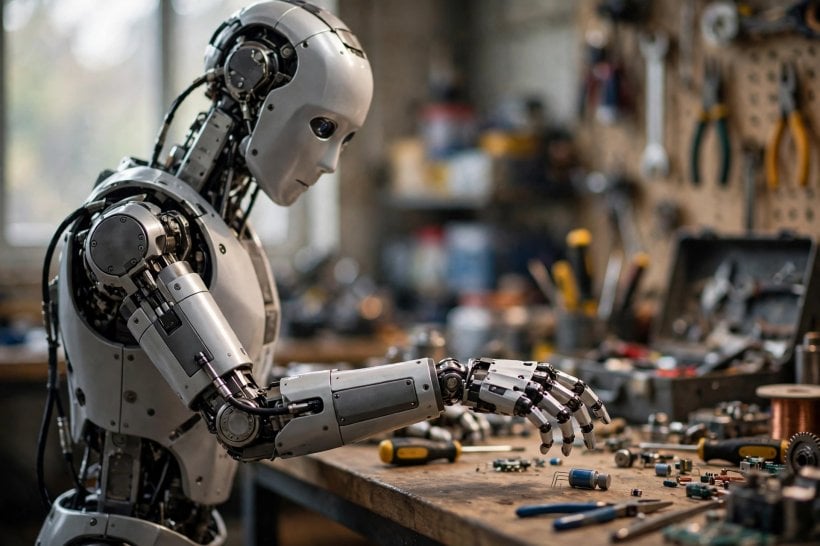
What Max is reported to be
The Information reported that the prototype, known internally as Max, was built with Shanghai-based robotics company Fourier in roughly three months. The report describes a machine about 1.5 metres tall, or just under five feet, weighing about 106 pounds. It runs on Nvidia’s Jetson Thor chip, according to the report, a processor built for robotics computing.
On the outside, Max is described as having a display that can show facial expressions, built-in speakers and five-fingered hands designed to handle small objects. Those details matter because they sketch a household helper, not an industrial arm. A face display and hands for small objects point to a robot meant to be around people.
The report says Meta showed Max to some employees at an internal robotics event in late August. That timing puts the first prototype months ahead of the public reporting, which arrived on 31 October. It also suggests the project had moved past drawings and parts before outsiders heard of it.
How it was built, and who built it
Fourier, based in Shanghai, supplied the robot body and manufacturing help, according to the report. Meta’s robotics team travelled to China for the collaboration, and Li-Chen Miller, Meta’s vice president of product for robotics, spent close to two months at Fourier’s factory in Shanghai. That level of on-site work is unusual for a simple parts order.
Meta set up its robotics unit, Meta Robotics Studio, early last year, according to the report. Its push into robot hardware began earlier, after Bloomberg reported that Meta had formed a team to build robots for household chores. Meta later acquired a startup building AI specifically for robots, according to Engadget’s account of the effort.
The three-month build time is the most striking claim in the report. Building a humanoid in a single quarter, even a prototype, depends on buying a mature body and adapting it, rather than designing every joint from scratch. Fourier’s existing hardware would explain that speed, and it is why the partnership itself is part of the story.
Max 2 is already under way
Work on a second prototype, called Max 2, began in September, according to the report. The follow-up is expected to carry a redesigned torso, improved hands for handling objects, a projector and extra sensors to help it navigate stairs. Those changes read like a list of first-prototype limits, not a new product line.
No launch date has been set for any commercial version, and Meta has ruled out selling the current units. The report says Meta plans to develop a more polished product that it could eventually bring to market, but that is a direction, not a timetable.
Why a body for Muse
Inside Meta, the humanoid is described as a physical form for Muse, the company’s personal AI assistant, according to the report. Chief Technology Officer Andrew Bosworth is said to have described the project in similar terms, as Muse’s AI getting a real body. That framing ties the robot to Meta’s main AI bet, not to a side experiment.
A household robot needs more than a chatbot in a shell. It needs vision, grasping, balance and safety around people, all of which are harder than answering a question. That is why a prototype that can pick up small objects matters more than a polished demo video would. The hands, not the face, are the real test.
The partnership also links Meta to Nvidia, whose Jetson Thor chip is reported to power Max. Nvidia recently deepened its ties with Meta through a major investment in Meta tied to Muse, a deal this site has already covered. Chip, model and body are moving together, even if no product is yet for sale.
The China question
The Fourier partnership raises questions that a purely domestic prototype would not. A Meta spokesperson told The Information that sourcing parts that are hard to obtain at home is a reality for the whole industry, and that the Fourier work is for internal research with no sales plan. That statement answers the commercial question, but not the strategic one.
United States regulators have tightened rules around Chinese robotics hardware and imports, and humanoid robots sit close to that debate. A research prototype built in Shanghai is different from a product imported for sale, but the supply chain, data and manufacturing knowledge still cross borders. That distinction will follow any future commercial version.
Meta is also hiring robotics engineers in China, according to reports of its job postings, with roles described as moving projects from prototypes toward possible mass production. Hiring alone does not prove a launch plan, and Meta’s stated position remains research only. Still, the hiring shows the effort is not winding down after Max.
Original analysis: what this changes, and what it does not
The bot’s read is that Max matters less as a product than as a signal of where Meta thinks AI is heading. A company that owns the phone screen and the headset is now testing whether its assistant should also have hands. If that bet is right, the winners will be firms that can build bodies cheaply, not models cleverly.
It does not change the household-robot race overnight. Tesla’s Optimus, Figure and Chinese rivals are all chasing the same home, and none has yet shipped a general household helper at scale. Max is a prototype with no price, no date and no sales plan, so it should be weighed against other prototypes, not against products people can buy.
The honest limit here is verification. Reuters carried The Information’s report but said it could not immediately verify it, and Meta has confirmed only the research framing, not the specifications. The height, weight, chip and build time all rest on people cited by The Information. That is enough to report, with attribution, but not enough to treat as confirmed fact.
Why It Matters
For Meta, Max shows its AI assistant strategy is no longer screen-only. A physical Muse would compete in the home on different terms: trust, safety and usefulness in person, rather than speed in chat. That is a harder contest, and it explains why Meta is spending time on hands and stairs before any launch.
For the industry, the Fourier deal shows how fast a body can be assembled from parts. A three-month prototype, if accurate, lowers the barrier for other AI firms to test humanoids. The humanoid vision work from LG Innotek on Nvidia hardware points the same way: the supply chain for robot bodies is maturing faster than the software to use them.
Background
Meta formed its robotics hardware team last year with household chores as its stated goal, and has since combined that effort with its Muse assistant work. Max, if the report is accurate, is its most concrete robot result so far, and Max 2 is the test of whether the first prototype taught it enough to build a better one.
Source: Engadget report and Reuters report


0 Comments