
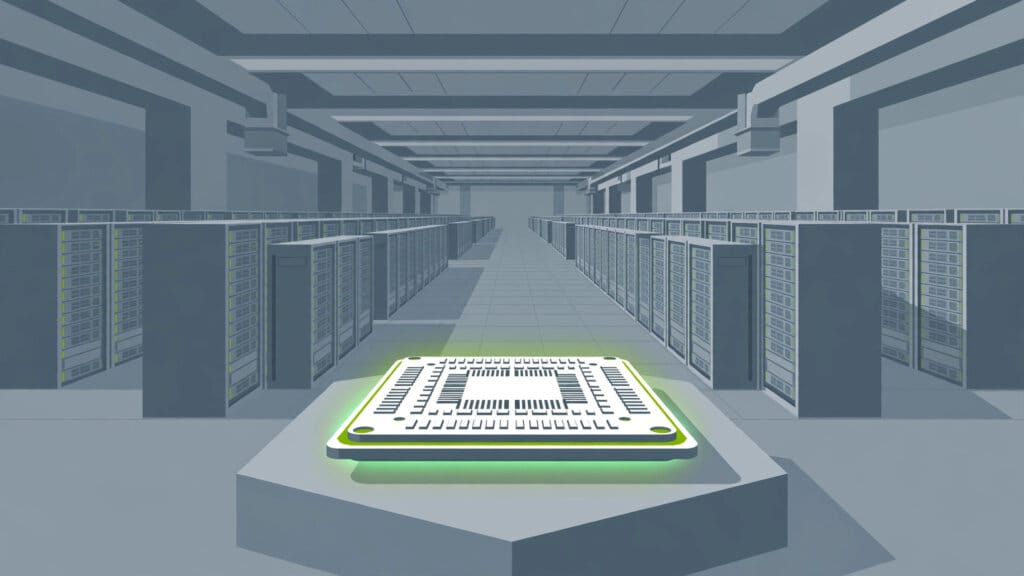
Every AI answer Microsoft sells begins as electricity in a building most customers will never see. To control the cost and supply of that computing, Microsoft has become a chip designer and one of the largest builders of data centres on the planet.
This is the least visible part of its AI strategy and, in the long run, maybe the most important. Models can be licensed or replaced. The physical capacity to run them, cheaply and at scale, is much harder to copy.

Why design your own chips at all?
The AI industry runs on accelerators that are expensive and, at the frontier, supply-constrained. Buying every chip from outside vendors leaves Microsoft exposed to their prices, their roadmaps and their other customers. A cloud of Microsoft’s size eventually hits the point where designing silicon tuned to its own workloads is cheaper than renting everyone else’s.
Custom chips also let Microsoft optimise for what its data centres actually do all day: serving Copilot requests, running Azure OpenAI models and training its own systems. A chip designed for those patterns can deliver more useful work per watt than a general-purpose part.
The two families: Maia and Cobalt
Microsoft’s accelerator line is called Maia, its in-house AI chip for training and inference in Azure data centres. Maia sits alongside, not instead of, the Nvidia and AMD hardware Microsoft also buys in volume; the point of the programme is bargaining power and cost per query, not purity.
The companion line is Cobalt, Microsoft’s own Arm-based CPU for general cloud workloads. Cobalt handles the ordinary computing that surrounds AI jobs, and Microsoft has said its efficiency helps across Azure, including the infrastructure its own services run on.
New generations of both lines are the rhythm of the programme. Each Maia revision aims to close the gap with the best merchant silicon for Microsoft’s specific mix of work, while Cobalt generations push performance per watt for the wider cloud.
The buildings: data centres at industrial scale
Chips need somewhere to live, and Microsoft’s construction programme is measured in campuses, gigawatts and tens of billions of dollars of annual capital spending. New sites are chosen for power, land and cooling as much as for customers, and the largest are built specifically for dense AI clusters.
Power is the binding constraint. Securing electricity years ahead, through grid deals and dedicated generation, has become as strategic as securing chips, and it is why data centre announcements now read like energy announcements.
There is a strategic logic tying it together. Azure sells AI capacity, Copilot consumes it, and custom silicon inside Microsoft-owned buildings lowers the cost of both. Every layer Microsoft owns is a layer where a supplier’s margin becomes Microsoft’s instead.
What “custom” does not mean
Custom silicon does not free Microsoft from the merchant market. Its data centres still run enormous fleets of Nvidia accelerators, and will for years, because frontier training clusters demand the best available parts at a scale no in-house programme can yet supply on its own.
The realistic picture is a portfolio: bought chips for the frontier, home-grown chips for the vast middle of inference and cloud work where the volume lives. Every workload shifted to Maia or Cobalt frees scarce bought hardware for the jobs only it can do, and trims a supplier’s margin out of a query served billions of times.
Software is the quiet half of the bet. A chip is only as good as the compilers and libraries behind it, and Microsoft has had to build the tooling that makes Maia useful to its own engineers. That invisible ecosystem work is what decides whether custom silicon is a strategy or a science project.
Geography matters too. Announced campuses span the United States and a growing list of other countries, each negotiated against local energy politics, water use and jobs. Data centres have become industrial policy, and Microsoft now negotiates with governments the way manufacturers once did over car plants.
The risk is equally plain: this is a bet placed years in advance, in concrete and silicon, that AI demand keeps growing into the capacity being built. If it does, Microsoft owns the cheapest seats in the industry. If it does not, it owns the most expensive empty rooms.

0 Comments