

NVIDIA says the open-source tools behind its push into next-generation wireless have passed one million downloads, a year after it released Aerial to researchers. Developer adoption of AI Aerial and Sionna has grown tenfold over the past year, and more than 8,000 research institutions now use them. The tools let researchers test AI-native 6G ideas on real wireless hardware, and the early results include robots that finish tasks faster, receivers that hold signals better, and base stations that use far less power.
A year of open wireless
A year ago, NVIDIA open-sourced Aerial, its software for running radio networks on graphics processors, joining Sionna and a set of tools for 6G research. The idea was to give researchers a foundation: simulation and AI training connected to experiments on wireless systems, so results could be compared and built on rather than starting from scratch each time.
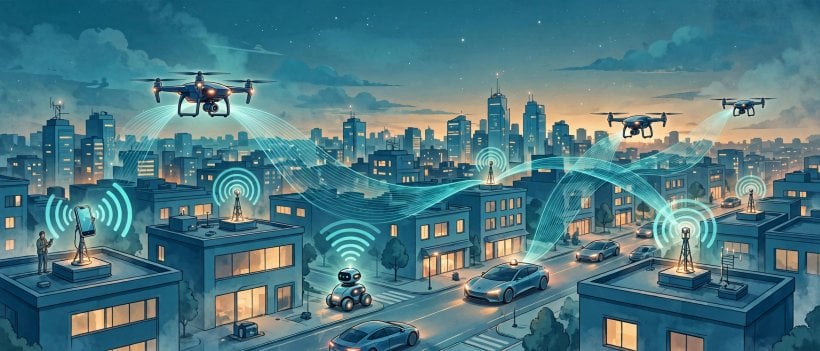
The tools cover wireless research, from simulating how signals travel to testing them over the air. NVIDIA says the point is a network that does more than move data — one that senses its surroundings, adapts as devices move, and shares computing with the applications above it. That is the AI-native 6G the company is betting on.
Robots that react faster
At King's College London, researchers connected a camera-equipped robot arm to an NVIDIA Jetson AGX Orin running Sionna, which handles both a software-defined 5G network and edge AI processing. Instead of sending full images, the robot transmits compact descriptions of objects and their positions.
The method is called goal-oriented semantic communication. In fruit-packing and cube-stacking tests with deliberately introduced faults, the approach cut task completion time by up to 52.6% — a large gain for a robot that must act before its surroundings change.
The system proved more resilient than sending periodic images. It detected dropped objects, recovered from unsuccessful actions, and, in configurations using a digital twin, checked planned movements for collisions before executing them. For a robot that must act before its surroundings change, the wireless link is part of the response time — and a leaner link means a faster one.
Receivers that learn
For a firefighter receiving live drone footage, or a rescue team searching for a missing person, timely images can guide urgent decisions. But interference and changing radio conditions make wireless signals harder to decode, causing errors and retransmissions that delay information from the field. AI receivers address this by learning to recover information from incoming signals more effectively.
SoftBank demonstrated the idea by integrating a neural receiver into NVIDIA Aerial CUDA-Accelerated RAN and testing it with a commercial 5G smartphone. In controlled tests with interference, the neural receiver delivered higher uplink throughput than a conventional receiver at all 15 tested settings, with a maximum gain of roughly 60%.
At ETH Zurich, researchers using the Aerial Testbed found that tuning neural receivers with local measurements cut block error rates by more than one-third, compared with selected pretrained versions. Better reception could help responders keep a clearer, more current view of a fire scene or search area.
Power when it matters
As 6G connects more devices and supports more AI applications, managing energy demand becomes important. A network may need enough capacity for a busy stadium, but demand changes when the crowd leaves. AI can identify when spare capacity can power down — and when it needs to come back online — so operators can cut electricity use without dropping connections.
At the University of Leeds, researchers built a system that predicts network demand ten minutes ahead and uses those forecasts to guide base station sleep decisions. Before powering down, it checks that neighbouring active stations can keep serving affected devices.
Tested with a portable DGX Spark-powered 5G "network-in-a-box" and a digital twin, the approach cut RAN power consumption by 45.6% against a full-power baseline while keeping devices connected. It keeps monitoring for changes that require capacity to be restored quickly.
Simulations in minutes
Before deploying a network, researchers need to know how it performs when hundreds of devices compete for connections or radio signals run into interference. Simulating those conditions helps teams evaluate designs before committing to costly equipment and field trials. But realistic simulations can take hours, limiting how many ideas researchers can explore.
The Centre Tecnològic de Telecomunicacions de Catalunya is speeding that up by bringing GPU-accelerated radio channel models, running on Aerial, into its open-source 5G-LENA network simulator. In an early evaluation, the approach cut simulation runtime from three hours to 10–20 minutes, while preserving the statistical behaviour and network performance. Faster simulations let researchers compare more designs and refine ideas sooner.
Our Read
This is NVIDIA doing for 6G what CUDA did for AI: owning the software layer that researchers build on. The download count is the tell — a million downloads and 8,000 institutions mean Aerial and Sionna are becoming the default workbench for 6G research.
The numbers still need a warning label. Every figure in the post is NVIDIA's own count, and the research results come from lab-scale setups — controlled interference, portable cells, simulated load — not deployed networks. A 60% uplink gain in a testbed is not a 60% gain on a city network.
But the direction is real: the four examples all point the same way, toward networks that sense, adapt and save power, and the institutions behind them are independent of NVIDIA. That breadth is what makes the milestone worth more than a download counter.
The timing matters too. Commercial 6G is years away, and nobody in this post promises a launch date. What NVIDIA is announcing is that the research community has already picked its tools — and by the time 6G standards harden, the argument over whose software runs the network may be settled.
Why It Matters
6G will not just be faster 5G. The networks now being designed are expected to carry AI workloads as first-class traffic — robots, autonomous systems and agents needing connectivity, computing and sensing from the same infrastructure. Whoever supplies the tools researchers use to design those networks shapes what they become.
The power result may matter most. Energy is now the binding constraint on AI infrastructure, with data-centre power shortages already leaving expensive hardware idle. A 45.6% cut in RAN power consumption, even in a lab test, points at the same problem from the network side.
It points at a future where the winning 6G design is the one that sips power, not the one that shouts loudest. In a buildout already limited by electricity, efficiency is not a footnote — it is the feature that decides what gets built.
Background
NVIDIA open-sourced Aerial a year ago, adding it to Sionna and a wider set of wireless research tools. The company is showcasing the work in 6G developer sessions at its GTC event in Washington, D.C., and both Aerial and Sionna are available on GitHub for researchers to download and extend.
Source: NVIDIA's blog post.


0 Comments