

NVIDIA has turned the AI data centre into a product that ships in a box. DSX POD, introduced at GTC Berlin on Wednesday, is a reference design for complete Vera Rubin AI factories that partners build inside modular containers, integrate and validate at the factory, and then deliver ready to connect to a prepared site’s power, cooling and networking.
The pitch is time. A traditional on-site build takes about six months, NVIDIA says; a DSX POD unit can be deployed at a prepared site in as little as 14 days, so customers start generating production tokens — and revenue — months sooner.
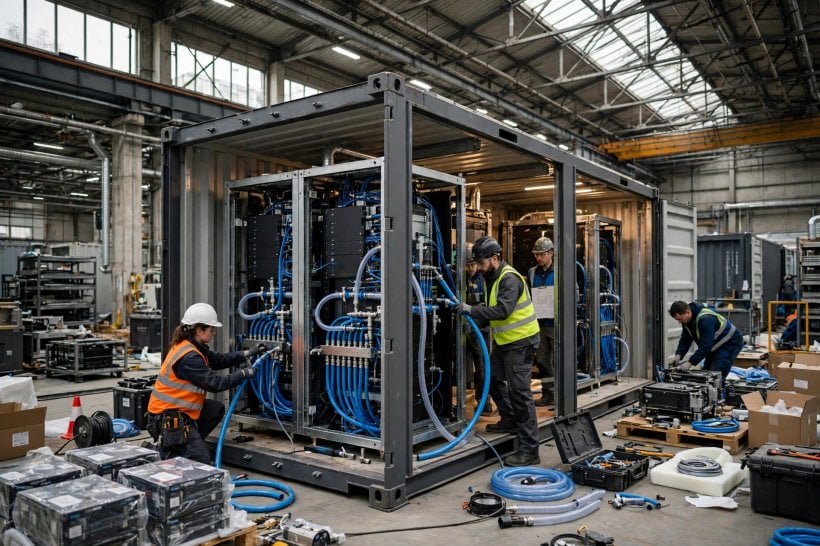
DSX POD: What Ships Inside The Container
Each unit brings Vera Rubin systems together with everything needed to run them: computing, networking, cabling, rack-level power and liquid cooling, assembled into a repeatable containerised design. Partners complete rack-to-rack cabling, wiring, piping and functional validation before shipment, work that normally happens on site with specialised labour and long logistics chains.
Moving that integration into the factory does two things, according to NVIDIA. It runs in parallel with site preparation instead of after it, and it cuts exposure to component delays and the error-prone rework of on-site assembly. The design carries forward the philosophy of the broader NVIDIA DSX infrastructure platform, with a distinct architecture built around validating complete systems before transport.
“An AI factory creates value when it starts producing tokens — not when construction is complete,” said Jensen Huang, NVIDIA’s founder and CEO. “With NVIDIA DSX POD, we’re bringing factory-built precision and speed to AI infrastructure construction — reducing deployment time from months to weeks so customers can scale capacity and bring revenue-generating production online faster.”
The Partner Ecosystem And Early 2027 Availability
NVIDIA is not building the containers itself. The delivery ecosystem named in the announcement spans Anduril, Armada, Bull, Crusoe, DayOne, Dell Technologies, Delta, Eaton, Foxconn’s Ingrasys, GIGABYTE, HPE, Lenovo, Pegatron, Quanta Cloud Technology, Schneider Electric, Vertiv and Wistron — a mix of server makers, power and cooling specialists and data-centre builders. The headline partner list in the release summary highlights Bull, Dell Technologies, HPE, Lenovo, Schneider Electric and Vertiv.
Deliveries are planned worldwide in early 2027. The reference design is aimed first at Europe’s infrastructure build-out — the release is titled around accelerating Europe’s deployment — but the partner list is global, and the same shortage of power-ready sites that slows European projects is the industry’s bottleneck everywhere.
Why It Matters
DSX POD attacks the least glamorous and most expensive part of the AI build-out: the months a finished rack spends waiting for a building. Huang’s own arithmetic, repeated across this year’s announcements, is that a gigawatt-scale AI factory earns nothing until it produces tokens, so shaving five months off deployment is worth more than a marginal chip improvement. For NVIDIA, the design also deepens its grip on the whole stack — the same platform logic visible in the OpenShell reference architecture for running agents and in the Vera Rubin systems at the heart of NVIDIA’s chip roadmap. For the partners, containerised factories create a repeatable product they can manufacture at scale rather than a one-off construction project each time. And for the banks and governments racing to add capacity, a 14-day deployment promise changes project planning: sites can be prepared speculatively, with the factory itself ordered once power is secured. The approach mirrors the modular logic behind Santander’s arena model for AI banking — standardise the unit, then compete on how fast you can field it.
Background
Containerised data centres are not new — modular units have served military, mining and overflow roles for years — but they were a niche answer for temporary capacity, not the flagship product of the world’s most valuable chip company. That changed as AI demand outran construction: with Vera Rubin systems pre-announced and power connections taking years, NVIDIA has steadily moved from selling chips to selling complete, validated systems, and DSX POD extends that logic from the rack to the entire building.
Source: NVIDIA via GlobeNewswire, Seeking Alpha (GlobeNewswire release)



0 Comments