
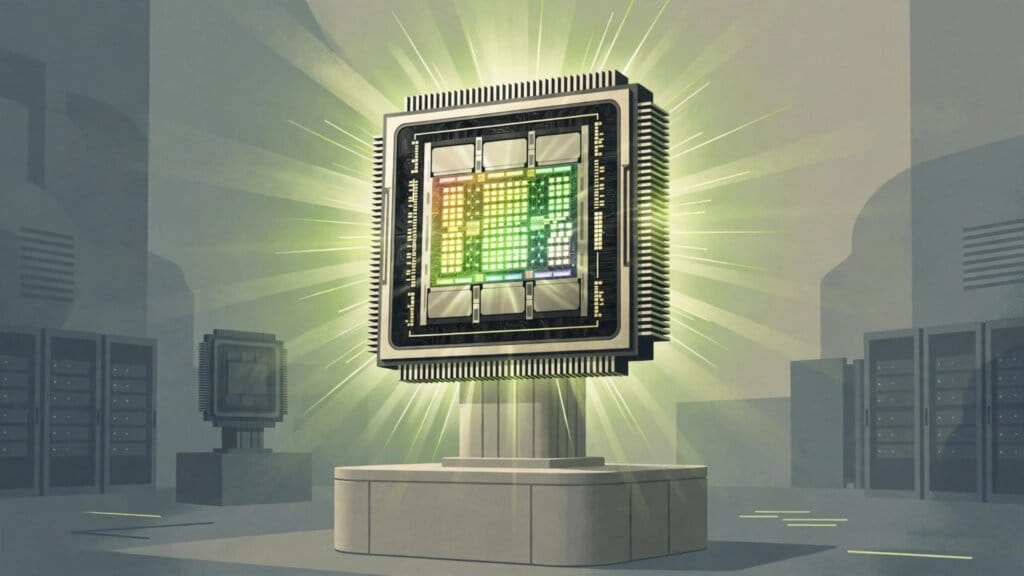
Blackwell is NVIDIA’s recent generation of data-centre GPU architecture, succeeding the Hopper generation that powered much of the first wave of large language model training. It is a platform generation as much as a single chip, covering processors, boards and systems.
The name matters because AI buyers plan around generations. Each one sets expectations for performance, memory, power use and software support, and helps cloud providers and enterprises decide when to expand capacity or replace older equipment in their data centres.
What Blackwell Is Designed To Do
Modern AI models place several demands on hardware at once. They need fast calculation, large amounts of high-speed memory close to the processor, and rapid connections to neighbouring chips so that work can be shared without creating bottlenecks between devices.
Blackwell was designed around those combined pressures rather than raw speed alone. Its purpose is to let larger and more complex models run effectively, whether they are being trained on new data or used to answer questions in production services.
That second job, known as inference, is increasingly important. Training creates a model, but inference runs every time a person sends a prompt, generates an image or asks an application to summarise a document using an already trained system.
Reasoning-style models add to that pressure because they can spend more computing time working through a problem before answering. More computation per response means providers need hardware that can sustain high throughput without making each answer prohibitively expensive to serve.
More Than A Single Chip
NVIDIA sells Blackwell in several forms, including chips and server systems built with partners. At the largest scale, it is offered as rack-scale systems in which many GPUs work together as one coordinated unit rather than as separate, loosely connected machines.
Rack-scale design changes how buyers think about installation. Power delivery, cooling, networking and management are planned for the whole rack, because a failure or slowdown in any shared part can waste the capacity of the expensive processors attached to it.
Software is part of the same package. The CUDA platform and NVIDIA’s AI libraries are intended to make the new hardware usable by existing teams without forcing them to abandon the frameworks and workflows they built on earlier generations of GPUs.
Compatibility matters commercially as well as technically. A cloud provider can offer Blackwell capacity alongside earlier systems, letting customers choose the balance of price and performance they need while keeping a broadly consistent development environment across both types of hardware.
Why Efficiency Matters As Much As Speed
Data centres are constrained by electricity and cooling as well as by budgets. A faster chip that uses disproportionately more power may add little usable capacity to a building that has already reached the limit of the energy it can supply.
This is why measures such as performance per watt matter to operators. Getting more inference or training work from the same power envelope can be as commercially valuable as a higher headline speed, especially when systems run continuously at large scale.
Efficiency also shapes where AI capacity can be built. Regions with limited grid capacity, strict planning rules or high energy costs have to weigh each generation of hardware against the infrastructure needed to support it, not just its purchase specification.
What Comes Next
Blackwell will not be the final architecture, and NVIDIA’s history suggests a continuing cycle of successor generations. Each step typically focuses on the bottlenecks exposed by current models, including memory movement, interconnect speed, precision formats and the cost of inference.
What comes next is therefore unlikely to be only a faster processor. Future progress will depend on packaging, networking and software working together, because large AI systems fail to scale when one part of the machine cannot keep pace with another.
Buyers will judge successors by practical questions rather than launch claims. How much useful work does a system deliver, how reliably can it be supplied, and how easily can existing models and teams move to it without a disruptive rebuild?
For now, Blackwell represents NVIDIA’s attempt to keep its platform central as AI moves from experimental training runs toward everyday, high-volume use. Its significance lies in the complete system around the GPU, not in any single specification taken in isolation.
Understanding Blackwell in those terms makes the generation easier to place. It is not simply a new graphics chip, but a data-centre building block designed for a period when model size, inference demand and energy limits are all rising together.

0 Comments