
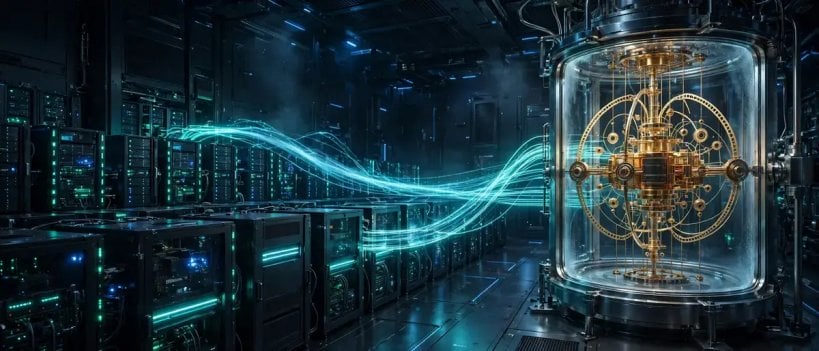
NVIDIA announced on Monday a collaboration with IBM and the US Department of Energy’s Fermi National Accelerator Laboratory to build a modular quantum computing codesign platform. The plan pairs NVIDIA DGX B200 systems with IBM quantum computers, including machines running its Nighthawk processor.
A Platform Built Around Two Kinds of Machine
The three partners will colocate NVIDIA’s accelerated computing systems with IBM’s facility quantum computers, creating one integrated system for high-energy and nuclear physics research. Fermilab’s Superconducting Quantum Materials and Systems Center brings expertise in ultracoherent cavities, quantum memories and the interconnects that link processors together.
IBM describes Nighthawk as the most powerful quantum processor it has ever built, running circuits of up to 7,500 two-qubit operations on 120 qubits at speeds up to 100,000 samples per second. The platform will test how several quantum processors can work together, with classical systems scaling alongside them.
The 13,000x Decoder
Separately, NVIDIA released TCBP-JOBS, a decoding algorithm in its CUDA-Q QEC 0.9.0 library that it says accelerates the most compute-heavy parts of error-correction research by up to 13,000 times. One design study that took 12 weeks now takes 45 minutes, according to the company.
Error correction is the central obstacle to useful quantum computing. Qubits are fragile, so their information is spread across many physical qubits, and a classical decoder reads measurement data to spot likely errors. Faster decoding lets researchers test more codes and decoder designs, and use physical qubits more efficiently.
Quantum Joins the Supercomputing Queue
NVIDIA is also extending Slurm, the open-source workload manager used by supercomputing centres, with a quantum interface. IBM is contributing its Quantum Resource Management Interface so its systems connect to the new Slurm capabilities. Centres will schedule quantum processors beside CPUs and GPUs with familiar commands.
The Chemistry Side Bet
IBM and RIKEN are separately advancing quantum-classical chemistry research on NVIDIA hardware, work now named a finalist for the 2026 ACM Gordon Bell Prize. The team modelled protein-ligand complexes of up to 12,635 atoms, more than 40 times the size of the previous 303-atom quantum-classical benchmark.
Our Read
The telling part of this announcement is who is doing the accelerating. NVIDIA builds no quantum processor; its contribution is the classical machinery around one — the GPUs that run the decoder, the software that schedules the work, and the networking that ties it together.
That framing treats error correction, not qubit counts, as the bottleneck worth attacking first. The 13,000x figure is NVIDIA’s own measurement, and decoding speed is one component of a working machine. The platform is research infrastructure, not a product, and no timeline was given for a practical, fault-tolerant computer.
Why It Matters
Quantum computing has spent years promising breakthroughs while error rates kept useful machines out of reach. A platform that pairs top classical computing with top quantum hardware attacks the problem from both sides at once, and a decoder that is thousands of times faster shortens every experiment that follows.
For NVIDIA, the deal also cements its place at the centre of quantum’s future without building a single qubit. If hybrid quantum-classical systems become the standard shape of the field, the company supplying the classical half — and the software orchestrating it — benefits from every lab that buys in.
Background
The site has tracked quantum’s slow march toward usefulness before, from six companies betting quantum computers could invent new materials to an AI system proving an 18-year-old quantum puzzle. IBM announced its Nighthawk processor days earlier, on 11 November, and this platform pairs Nighthawk-powered machines with NVIDIA DGX B200 systems.
Source: NVIDIA’s announcement, with IBM’s announcement.




0 Comments