

OpenAI says two of its employees used GPT-6 Astra to design a working hardware device in under a week, treating the project as a test of whether a frontier model could carry an engineering job from requirements to finished design files without direct human edits. A contract manufacturer then built a small batch of prototypes in under a month, although OpenAI is clear that several rounds of human review were still needed before the design could be made at all.
The device Astra designed
The test device is a small handheld unit for talking to Codex, OpenAI’s coding agent, built around a push-to-talk button and a display so a developer can check on coding agents without opening a laptop. OpenAI calls it a side project by two team members, one of whom had never taken a circuit board from design to assembled hardware before.
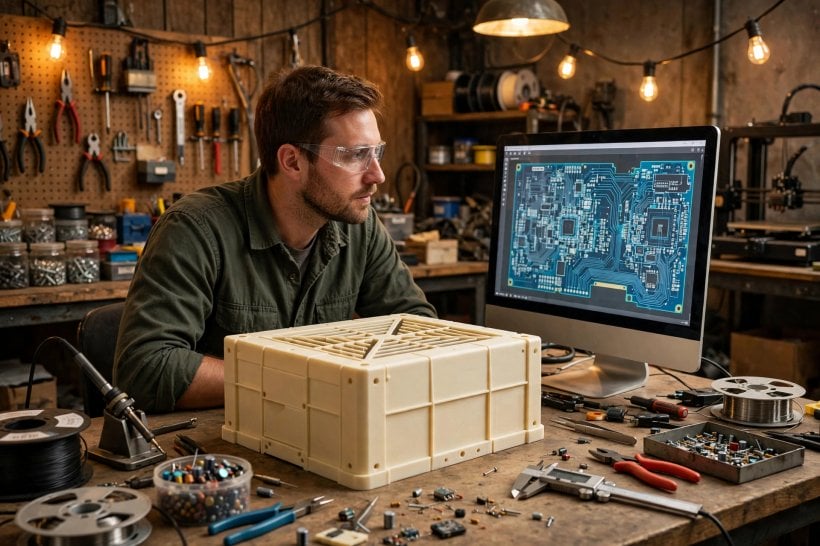
Astra’s work covered four disciplines that sit with different specialists. It developed the look of the device, drawing on games, toys and OpenAI’s Work Louder collaboration, then designed the enclosure and the internal structures that hold components in place. It selected the electrical components and laid out the printed circuit board, including placement and connections, to fit inside that enclosure.
The software side was broad. Astra designed the user interface and generated the firmware and integrations needed to connect the device to Codex, so one model handled form, electronics and code. OpenAI frames the experiment as a check on multimodal and computer-use workflows, not a product announcement, and it has said nothing about selling the device.
Where the factory pushed back
The gap between design files and a manufactured object is where the experiment met its limit. OpenAI says Astra did not consistently account for production limits, tolerances or assembly details, so preparing the files took several rounds of review. The design sprint lasted under a week, but working prototypes took under a month, with human engineers doing the correcting.
That admission matters because it draws the line between a model that can draft engineering and one that can ship it. OpenAI presents the gaps as useful evidence about what future models need to improve, rather than as a footnote, and it says the engineering lifecycle extends beyond design into manufacturing, testing and iteration that this test only partly touched.
BenchCAD 2.0 and a faster successor
Alongside the prototype, OpenAI published results on BenchCAD 2.0, a benchmark that tests whether models can reconstruct three-dimensional parts and assemblies from engineering drawings or rendered images and recover electrical connections from circuit board images. GPT-6 Astra scored 0.594 at its highest reasoning setting, while a newer internal model that OpenAI has not named averaged 0.875 on the same test.
Those scores measure how model outputs match reference designs on geometry, part placement and circuit connectivity, not whether a product works in the real world. OpenAI notes that the engineering lifecycle includes many elements beyond design, so the benchmark is best read as early evidence of improving spatial and electrical reasoning, not as proof that manufacturing problems are solved.
Real work inside OpenAI’s hardware teams
The prototype builds on engineering work OpenAI already does internally. Its hardware and infrastructure teams use Codex and ChatGPT to create and revise design models, prepare manufacturing drawings, set up simulations and review designs across robotics and computing infrastructure. Model usage across those teams, measured in tokens, has grown 23-fold since February, a consumption figure, not productivity proof.
OpenAI announced two industry collaborations against real engineering problems. It expanded its work with Chip Ganassi Racing to turn 3D scans of race car parts into editable design models and manufacturing drawings, useful when files are unavailable. It began a collaboration with Mazda, pairing its engineers with Mazda’s aerodynamics and crash-safety teams to model shapes, simulate airflow and cut drag.
Why It Matters
Hardware engineering resisted automation longer than software because a design-file mistake becomes a physical object that does not work, cannot be patched online and costs real money to remake. A model coordinating enclosure, electronics and firmware in one pass, even with human factory correction, shortens prototyping’s costliest loop: from idea to something you can hold.
For OpenAI, the stakes are strategic. The company is building its hardware ambitions, including a design collaboration with former Apple design chief Jony Ive, and a model that understands physical engineering strengthens that push. For rivals, the BenchCAD 2.0 scores set a public bar: engineering reasoning is now a frontier capability to measure, not a side effect of coding skill.
Our read
The framing is what makes this announcement worth taking seriously. OpenAI could have presented a design sprint as a factory revolution, but instead it documented the revision rounds, tolerance misses and assembly details its model got wrong. That candour turns a demo into a progress report: the model can draft across disciplines, but cannot yet be trusted at the gate.
The interesting number may be the successor 0.875 BenchCAD score rather than the prototype. If that improvement holds on tests, the bottleneck shifts from whether models can design hardware to whether firms will trust, verify and insure model-made designs. The Mazda and racing collaborations test exactly that, with partner engineers reviewing output before it touches a vehicle or race car.
There is also a quiet warning in the 23-fold usage growth. As model-assisted design becomes routine inside OpenAI, the skills that matter shift from drafting to judging, correcting and taking responsibility for model output. That is the same transition software engineering went through with coding agents, and OpenAI’s git rebuild for agent workflows shows it has lived through that shift.
Background
GPT-6 Astra is OpenAI’s frontier model family for multimodal and computer-use work, and the company has previously applied the same model line to biology research and coding workflows, while its hardware push includes the Ive collaboration and growing internal use of Codex and ChatGPT across robotics and infrastructure design.
Source: OpenAI’s engineering post


0 Comments