

OpenAI, the startup PerturbAI and Scripps Research have run nearly 2,000 AI agents in parallel over a whole-brain CRISPR atlas of the mouse brain, finishing in 32 minutes an analysis the team estimates would take human researchers months to a year. The project, announced on October 21, is OpenAI’s clearest demonstration yet of what it calls distributed biological reasoning.
Each agent took one gene disruption from the atlas, examined how brain cells responded, searched the scientific literature and wrote a report proposing an explanation. Further agents merged those reports into a searchable “reasoning atlas” of 3,397 findings, now released publicly on GitHub.
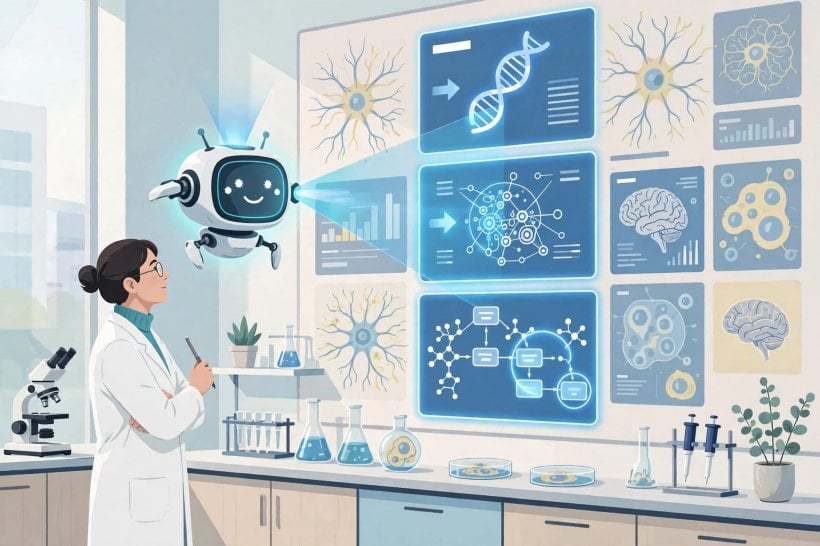
GPT-Rosalind: 1,946 Gene Disruptions, One Agent Each
The underlying data is a whole-brain CRISPR atlas built by Xin Jin’s lab at Scripps Research and published on Hugging Face: 1,946 genes switched off one at a time in living mice, with the effects measured across some 8 million brain cells. The lab’s own analysis required a team of experts in statistical analysis, genomics and neuroscience, and still left much of the biology under-interpreted, according to the companion preprint.
The agents ran on GPT-Rosalind-5.5, OpenAI’s model line for the life sciences. To keep the test honest, the team says the agents never saw the lab’s original paper, and the model’s stated knowledge cutoff, December 2025, predates that paper’s publication in March 2026. The agents still recovered its main conclusions. At the largest workload, the distributed agents cited more than 700 references, against 11 for a single agent given the whole dataset, and in blinded reviews specialists preferred the multi-agent outputs 75 percent of the time.
GPT-Rosalind: The Tsc1, Tsc2 And DCTN1 Leads
Two findings stood out. The agents found unexpected differences between how disrupting Tsc1 and how disrupting Tsc2, two genes tied to cell growth and metabolism and relevant to tuberous sclerosis, affected movement-related regions of the brain including the cerebellum. The second is a drug-discovery lead: a new hypothesis linking disruption of DCTN1, a gene associated with Perry syndrome, a neurodegenerative condition that resembles Parkinson’s disease, to altered cholesterol regulation in neurons.
Both are hypotheses, not results. The companion preprint, “Distributed AI agents enable comprehensive discovery of biological insights at scale,” was posted on bioRxiv on October 16 and has not been peer reviewed, and the team is explicit that the leads require laboratory testing. The work also sits inside OpenAI’s wider life-sciences push, which this month included OpenAI’s acquisition of Orchestra Bio to put agents inside drug development.
GPT-Rosalind: Why The Team Split The Work
The methodological claim is that distribution itself is the capability. A single agent reading the whole atlas cited 11 references; nearly 2,000 narrow agents cited more than 700, because each one could afford to investigate one perturbation deeply, check it against the literature and argue for an interpretation. Joy Jiao, OpenAI’s head of life sciences, put the parallel count at nearly 2,000 agents. Sarah Teichmann, chair in Stem Cell Medicine at the University of Cambridge and founding co-chair of the Human Cell Atlas, said in OpenAI’s announcement: “We build cell atlases so that other scientists can make discoveries we haven’t imagined yet. AI could help more researchers explore these resources and turn unexpected observations into new questions to test.” The pattern, many specialised agents coordinated over one dataset, is the same architecture now spreading across OpenAI’s enterprise platform deals.
Why It Matters
The GPT-Rosalind run matters because cell atlases are piling up faster than scientists can interpret them. PerturbAI’s atlas alone has been downloaded more than 40,000 times, and most of its biology was sitting unexamined. A method that turns months of expert reading into a 32-minute agent run, and publishes the result as a searchable atlas anyone can query, changes who gets to do discovery on data like this: not only the lab that generated it, but any researcher with a question. The caveats travel with the claim, an unreviewed preprint, company-reported timings and findings that still need a wet lab, but the direction is hard to miss, and it is why OpenAI keeps buying and building life-science capability around the model.
Background
GPT-Rosalind is OpenAI’s specialised model family for life sciences, named for Rosalind Franklin. PerturbAI, co-founded by Grace Zheng and Scripps professor Xin Jin, builds large-scale perturbation atlases that map what happens when individual genes are switched off. The brain atlas project grew out of a year-long collaboration between PerturbAI and OpenAI, with Scripps Research and the Howard Hughes Medical Institute among the preprint’s affiliations.




0 Comments