

Opentrons Labworks Inc. has raised $40 million in a Series E funding round to expand its work on autonomous science, betting that robots and software can close the growing gap between what artificial intelligence can imagine and what laboratories can actually test. The New York City company said the new capital will scale its robotics, software and data infrastructure, supporting a platform in which AI systems design experiments, robots run them, and the results feed back into the next round of work.
The funding round
The round was led by healthcare investor Avego, with BroadOak Capital Partners participating, according to the company announcement. Opentrons said its existing investors include SoftBank Vision Fund and Khosla Ventures, two firms with long histories of backing ambitious technology companies at scale.
The $40 million raise comes at a moment when AI funding remains highly competitive, with investors concentrating on companies that can show real-world deployment rather than research alone. Recent large rounds in AI infrastructure, such as FuriosaAI’s $620 million Series D for AI inference, underline how much capital is flowing toward systems built to run AI workloads in practice.
For Opentrons, the pitch is narrower and more concrete: laboratory work itself is the bottleneck. AI models can now generate hypotheses far faster than human scientists can test them by hand, and the company argues that automation is the only practical way to keep pace.
Closing the gap between AI and the lab
Opentrons describes its Flex platform as a system in which robots and AI work in a continuous loop. An AI system proposes an experiment, the robot carries it out, and the data produced helps refine the next experiment, gradually improving both speed and accuracy over time.
That loop matters because laboratory work is still dominated by repetitive manual tasks, from pipetting and sample preparation to running the same protocol many times over. Each step takes skilled time, introduces room for variation, and slows the pace at which a promising idea can be confirmed or ruled out.
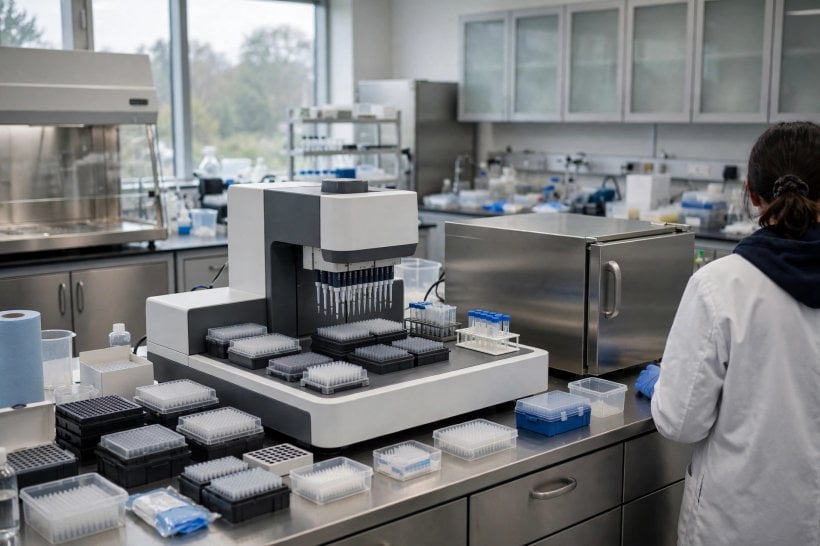
Chief executive James Atwood framed the opportunity in human terms, saying: “Millions of scientists spend much of their day on manual work a robot can do. Giving that time back to discovery is the biggest opportunity in science.” The company presents automation not as a replacement for scientists, but as a way to return their attention to interpretation and discovery.
Avego managing partner James Flexner offered a similar view from the investor side, saying: “Every AI-driven discovery still has to be tested in a real lab.” That line captures the core of the investment case: AI may accelerate ideas, but physical validation remains unavoidable.
Scale so far
Opentrons says more than 11,000 of its robots have been deployed in over 80 countries, including at 90 percent of the top 20 global pharmaceutical companies. The company also says its systems are used at every top-20 research university in the United States and at 14 of the top 15 global biopharma companies.
That installed base is significant because laboratory automation only becomes powerful at scale. A single robot speeds up one bench; a network of robots running shared protocols and comparable data can standardise work across teams, sites and even countries, while reducing variation between laboratories.
The pattern resembles other recent funding stories in applied AI, where a proven product and a clear customer base have attracted fresh capital. Serval’s $150 million Series C at a $3 billion valuation and Solink’s $100 million round for AI vision cameras both point to investor interest in AI systems already operating in the physical world.
Why It Matters
If Opentrons succeeds, the effect could be felt well beyond one company. Faster, more consistent laboratory testing would shorten drug discovery timelines, lower the cost of failed experiments, and let smaller research teams run work that once required large, well-staffed facilities.
There are limits to that promise, however. Autonomous laboratories still depend on well-designed experiments, reliable reagents and careful interpretation, and automation cannot fix a flawed hypothesis on its own. The value of the platform will therefore rest on the quality of its software, its data and its integration into existing scientific workflows.
Background
Opentrons was founded in 2014 and is headquartered in New York City. It has grown from laboratory robotics into a broader platform for AI-driven science, and the Series E is intended to extend that platform further into new applications and larger deployments.
Source: company announcement


0 Comments