
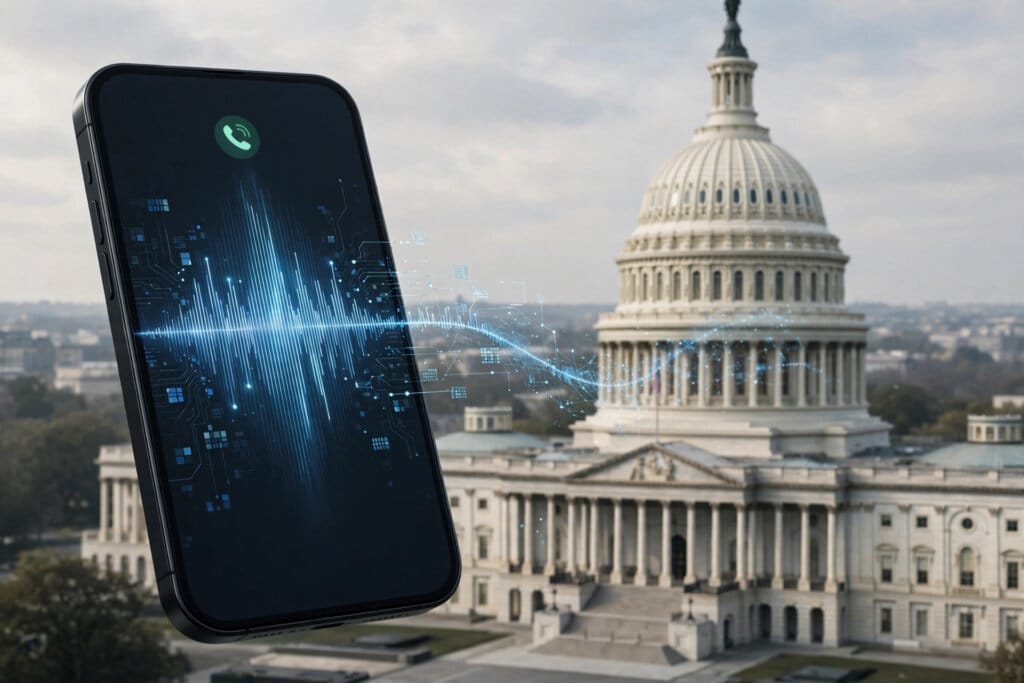
Senate Democratic leader Chuck Schumer on Monday urged the Federal Communications Commission not to approve a petition that would let Club for Growth make political calls to cell phones using AI-generated voices without obtaining prior express consent. Reuters reported the intervention on October 19, the day the petition’s comment period expires.
The timing gives the FCC a decision window this week, ahead of the November 3 congressional elections. A spokesperson for FCC Chair Brendan Carr did not immediately comment, Reuters said.
The Club For Growth Petition: What It Asks For
Club for Growth, a conservative political group, earlier asked the FCC to allow political calls to cell phones “using an artificial or prerecorded voice — including an AI-generated voice — without obtaining prior express consent.”
The group says it and its affiliated committees want to use AI-powered calling tools to inform and gather input from potential voters more effectively, including in more languages, and more efficiently. Its petition points to existing exemptions for artificial or prerecorded voice calls to wireless numbers, such as package deliveries and certain calls from financial institutions and healthcare callers, and to the FCC’s 1992 exemption for noncommercial calls to residential landlines.
Club for Growth President David McIntosh said in a statement earlier this month that the group wants “the FCC to treat First Amendment-protected political speech the same way it already treats wireless calls about package deliveries, bank accounts, and doctor’s appointments.” The group, which backs lower taxes, deregulation and smaller government, plans to spend $175 million in the midterm congressional elections, according to its website.
The petition also proposes conditions borrowed from the landline rules: no more than three calls to the same number in any 30-day period, an automated opt-out offered within two seconds of the caller identifying itself, and a company-specific do-not-call list with requests recorded within 10 business days and kept for five years. The FCC, describing the petition, noted the system “uses a perfunctory human being for the sole purpose of clicking on a ‘send’ or similarly termed button to transmit thousands of text messages per hour.”
Schumer’s Objection: Deepfake Voices In Campaigns
Schumer’s case is about what an AI voice can imitate. “Under this change, campaigns could use their opponents’ voice to send out a message that is, at best, disingenuous and, at worst, a blatant lie,” he said.
“There is absolutely no excuse to relax these standards and allow special interests to flood our cellphone lines with deepfakes or dark-money-funded AI voices,” Schumer added.
The legal backdrop is the FCC’s February 2024 declaratory ruling, which confirmed that the Telephone Consumer Protection Act’s restrictions on “artificial or prerecorded voice” already cover current AI technologies that generate human voices — so those calls require the called party’s prior express consent unless an emergency purpose or an exemption applies. The petition effectively asks the FCC to carve political AI calls out of that position. The TCPA’s private right of action carries statutory damages of $500 to $1,500 per call, a litigation risk the petition says is hindering the use of AI-powered calling.
The fight sits alongside the wider arguments in our explainers on the EU AI Act and AI laws around the world, and next to our report on always-listening AI wearables testing US wiretap laws — different technologies, the same question of where consent rules bend for AI.
Why It Matters
The central entity is the FCC’s consent rule for AI-generated voices, and the attribute at stake is whether political speech gets an exemption from it. If the petition succeeds, every campaign and political committee in the United States gains a legal route to AI-voice calling at scale in the final weeks of an election cycle, and the 2024 ruling’s consent principle gains its first big exception. If it fails, the ruling stands as written and AI voices stay in the same consent category as any prerecorded call. Either way, the decision will be read by its neighbours — election lawyers, voice-AI vendors and the campaigns deciding how much synthetic speech to buy — as the FCC’s first real line on AI voices in politics.
Background
The TCPA has restricted artificial and prerecorded voice calls since the 1990s, with exemptions built up piece by piece for landlines, deliveries, banks and healthcare. AI voice cloning reopened the question: in February 2024 the FCC ruled that AI-generated voices count as artificial voices under the law. Club for Growth filed its petition on August 31, 2026, arguing political calls deserve the same treatment as the exempt categories; Schumer’s letter lands on the last day of the comment period, with the midterm elections two weeks away.
Source: Reuters

0 Comments