
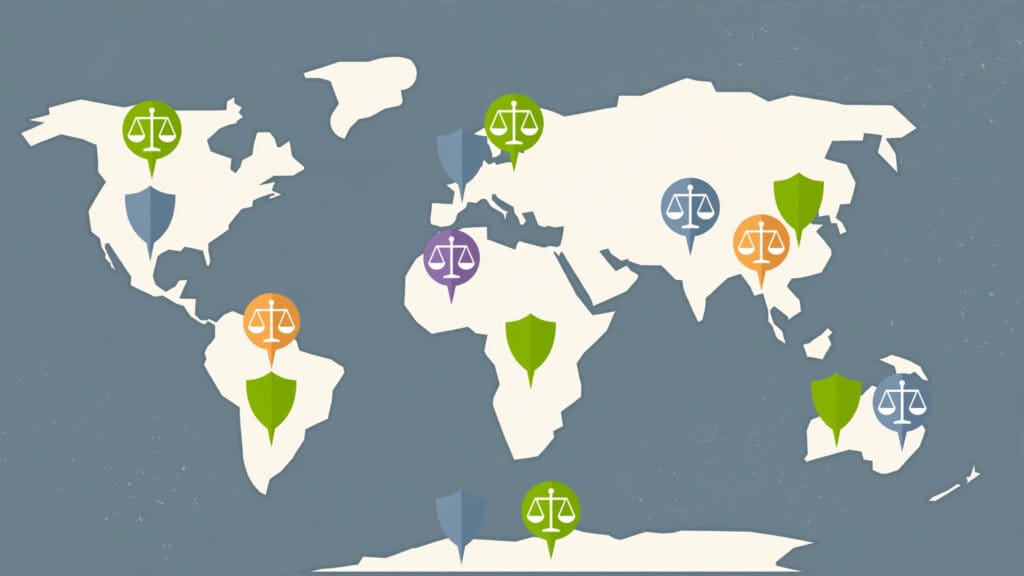
There is no world AI law, and there is not going to be one. What exists in 2026 is a patchwork: Europe regulating by risk, South Korea first out of the gate with a national framework, China ruling by category, the United States arguing state by state, and Britain still preferring guidance to statute. This is the map, in plain English.
The differences are not accidents. Each system reflects what that government fears most — harm to citizens, loss of competitiveness, or loss of control — and the fear decides the law.

Europe: the comprehensive rulebook
The EU AI Act is the only full-spectrum statute in force: banned practices at the top, heavy duties for high-risk systems, and transparency rules — Article 50, live since 2 August 2026 — that require AI content to be labelled as machine-made. It is the reference text every other regulator reads, whether to copy or to avoid.
Europe’s bet is that rules create trust and trust creates adoption. Its risk is the opposite: that compliance costs push development elsewhere. Both bets are now running in public, and every other capital is watching the results.
Asia: Korea first, China by category
South Korea’s AI Basic Act took effect on 22 January 2026, making Korea one of the first countries with a national AI framework actually in force. It pairs promotion of the industry with safety duties for high-impact systems — a deliberate attempt to be both a producer and a regulator of AI.
China regulates by category rather than by omnibus law: rules for recommendation algorithms, for synthetic content, for generative services, each with registration and content duties attached. The through-line is control and identifiability — AI output must be traceable, and providers answerable to the state.
Japan, by contrast, has leaned toward soft law and guidelines, betting that a light touch keeps its companies competitive while voluntary standards harden into practice.
The United States: a state-level patchwork
America still has no federal AI statute. What it has is motion at the edges: consumer-protection and privacy law applied to AI claims, sector regulators using existing powers, and above all the states — California and Texas among those with AI laws of their own covering disclosure, high-risk uses and government deployment.
For companies, the patchwork is the policy. A product lawful in one state can carry duties in another, and national vendors end up building to the strictest common denominator or geofencing features by state. Federal pre-emption — Washington overriding state AI laws — is the argument to watch, because it decides whether the patchwork survives.
Britain and the rest
The United Kingdom continues its pro-innovation approach: no AI Act, existing regulators told to apply their own rulebooks to AI, and heavy investment in safety research as its claim to influence. It is a wager that principles plus expertise beat statute — for now.
Elsewhere, the pattern repeats with local accents: Canada and Brazil have debated comprehensive bills, Gulf states are building AI strategies around state champions and data-centre investment, and India has favoured advisories and sector rules over a single law.
What the patchwork means in practice
For builders, 2026 is the year AI compliance became a design constraint rather than an afterthought: labelling, documentation and audit trails are now product features. For readers, the practical consequence is simpler — the AI you use is increasingly shaped by where you use it, and the labels, limits and disclosures on your screen are this patchwork made visible.
The trend underneath the patchwork
Look past the differences and the systems are converging on a few shared ideas. Synthetic content should be identifiable. The most consequential uses of AI — hiring, credit, health, policing — deserve the strictest scrutiny. And someone identifiable must be accountable when a system causes harm.
They are also converging on timing. The world’s major AI laws were written between 2024 and 2026, and most of their serious obligations land in the same window. That makes the next two years a natural experiment: different rulebooks, same technology, measurable results.
For a reader trying to keep score, the simplest dashboard is this: watch what gets labelled, what gets banned in practice rather than on paper, and where the first large fines land. Laws are arguments; enforcement is the verdict — and the enforcement era of AI law has now begun on at least three continents.

0 Comments