

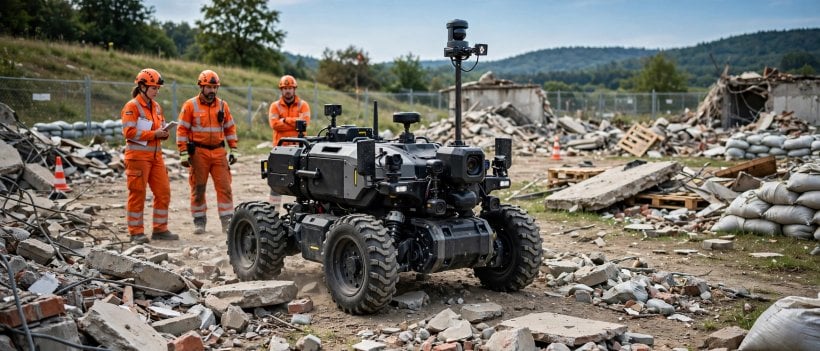
South Korea will buy and supply about 1,700 AI robots to the public sector next year, Prime Minister Han Seong-sook said on Wednesday, October 28, 2026, as the government turns itself into the first major customer for its domestic robot industry. The robots will go first to high-risk work such as fire and rescue scenes, and to areas suffering labour shortages, including mail sorting and basic process industries. The announcement came as the trade ministry opened a two-day product briefing in Seoul, running October 28 to 29, where nine government agencies and eleven domestic robot companies are discussing what the machines must do in the field.
How The First Purchase Works
The plan treats public procurement as a launchpad, not just a purchase. For AI robots, collecting operating data from real sites after development is a critical step in improving performance, and public agencies acting as first customers give companies both field experience and a sales record they can show private buyers. The ministry is holding the briefing at the Seoul Trade Exhibition and Convention Center, known as SETEC, so agencies can discuss necessary functions, performance levels and operating conditions with robot makers before next year’s rollout.
Nine demand-side organisations are taking part, including the Ministry of National Defense, the Army Headquarters, the National Fire Agency, the National Police Agency, the Ministry of Agriculture, Food and Rural Affairs, and the Korea Industrial Complex Corporation. On the supply side, eleven domestic makers of four-wheeled and quadruped robots are attending, among them Rainbow Robotics, Robotis, Hyundai Motor and Neubility. The format mixes exhibitions and live demonstrations with one-on-one consultations, and the government plans to set public supply standards covering component integration and maintenance.
A 200,000-Robot Horizon
The 1,700 robots are only the first step in a much larger programme. The prime minister said the government and the private sector will jointly supply 200,000 robots through 2030, while swiftly applying physical AI services for public safety and industrial sites. Starting in 2028, public agencies and local governments will expand public distribution, and the government will support private adoption through purchase subsidies, rental assistance and regulatory improvements.
The logic is deliberately different from the usual industrial support of loans and grants. President Lee Jae Myung, speaking at a cabinet meeting this week, described a “pioneer purchasing” model: buying imperfect prototypes directly from companies, because what cutting-edge firms most need is a first sale on their record. He also pledged to institutionalise audit immunity for civil servants, arguing that officials currently buy only verified products because they fear audits over buying an imperfect product.
Why Robots, And Why Now
South Korea’s bet reflects a wider shift in AI from screens to the physical world. Investors were reported this week to be valuing robotics software companies at tens of billions of dollars before they have revenue, as covered in our report on Physical Intelligence’s $20 billion talks, and Korean suppliers are already building the sensing layer those robots need, as in LG Innotek’s humanoid vision work with NVIDIA. Seoul’s programme is the demand-side counterpart: if robots are going to work in fire stations, mailrooms and factories, someone has to buy the first ones and prove them in service.
The choice of wheeled and quadruped machines for the first wave is pragmatic. Four-legged and four-wheeled robots can already navigate uneven ground, stairs and disaster rubble far better than humanoids, and they map neatly onto the chosen first uses: a quadruped carrying sensors into a fire scene, or a wheeled robot sorting mail through the night. Humanoids may dominate headlines, but the first government fleet is built around machines that can do a defined job tomorrow.
What Could Go Wrong
The programme’s risks are as clear as its logic. Buying prototypes means buying imperfection: early robots will break, underperform and need maintenance regimes that do not yet exist, and the audit-immunity pledge will itself be politically contested if a purchase goes badly. There is also the question of what happens after the first fleet: public demand can seed a market, but it cannot sustain one, and the companies involved will need private customers, export orders or both before the subsidies run out.
Field data is the other open question. The premise rests on operating experience improving performance, but that only works if data collected across defence, firefighting, policing and agriculture is shared back into development, rather than siloed inside each agency. The briefing’s focus on standards suggests the government understands this, but standards agreed in a two-day exhibition are easier to announce than to enforce across nine very different organisations.
Why It Matters
This matters because it is one of the clearest examples yet of a government using its own purchasing power to create an AI robotics market, rather than waiting for one to appear. If the 1,700 robots perform in fire scenes, mailrooms and factories, South Korea will have both a domestic industry with proven products and a template other countries may copy. If they falter, the experiment will still have answered an important question: whether public money can buy a robotics industry into existence.
Background
South Korea has made robotics a strategic industry, with the government casting public procurement as a demand anchor for domestic makers competing with the United States and China. The Ministry of Trade, Industry and Energy oversees the programme.


0 Comments