

The United Nations will launch its first forum dedicated to AI in the military domain on Thursday, as the head of its disarmament research institute warned that artificial intelligence is “on track to crowding out human decision-making” in warfare — including, crucially, in the nuclear domain.
Robin Geiss, director of the UN Institute for Disarmament Research (UNIDIR), announced the forum at a briefing at UN Headquarters in New York on Tuesday. The UNIDIR Centre of Excellence on AI, Peace and Security will host what Mr Geiss described as the first and only multi-stakeholder forum of its kind within the UN system. “Are we going to let machines target and kill human beings?” he asked journalists, noting that the UN Secretary-General has repeatedly urged stakeholders not to cross that “moral red line”.
What The Forum Will Work On
The forum has three stated areas of work. The first is a framework for responsible industry behaviour: practical, voluntary guidelines for companies to follow at the design and development stage of military AI tools. The second is an “AI security lexicon” to clarify concepts such as autonomy, safety and security, which different stakeholders currently use in very different ways — an ambiguity Mr Geiss said hinders trust and cooperation. The third is the risk of misuse of AI by non-State armed groups, to support their operational planning, execution and logistics.
The structure is deliberate. Two of the three workstreams are aimed not at governments’ weapons programmes directly, but at the vocabulary and the commercial design choices underneath them — the same layer where the companies building the models actually operate.
Why Human Judgment Is Slipping, On UNIDIR’s Account
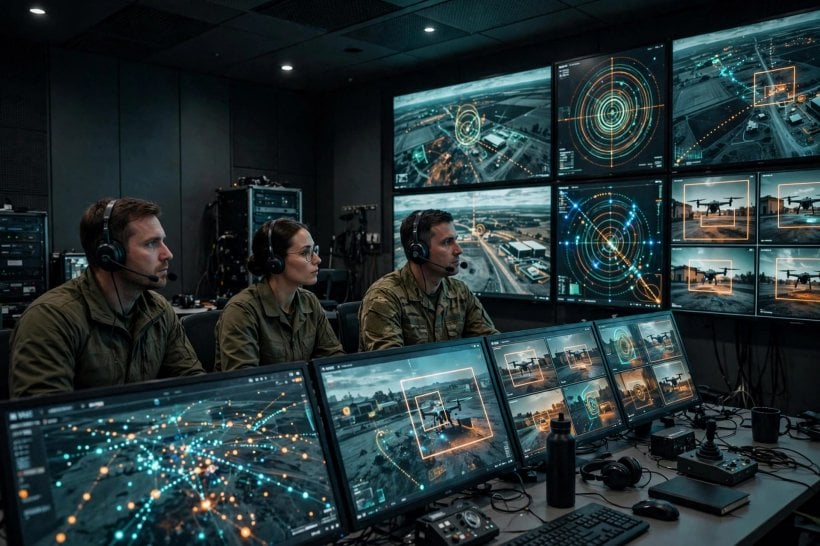
AI is being given a growing number of responsibilities in military affairs, Mr Geiss said, from intelligence analysis and target identification to drone operations and orchestrating cyber-attacks. The shift is dramatically increasing the pace of battlefield operations, shortening the time between identifying and striking targets and allowing forces to engage an unprecedented number of targets each day. Many of the systems are opaque, raising the risk of error, miscalculation and unintended escalation. And as the tools become easier to use, non-State actors gain access to ever more sophisticated military operations.
Mr Geiss recognised that geopolitical competition is a serious obstacle to regulating military AI, but stressed that concern about the risks is increasingly shared across political outlooks, including among major powers. He pointed to September’s United States proposal for an AI “notification mechanism” with China, under which the world’s two largest military spenders could warn each other about AI incidents threatening national security, and said the Secretary-General’s calls for stronger regulation and a legally binding treaty on lethal autonomous weapon systems are finding an increasing echo internationally.
Why It Matters
Military AI governance has so far been built from national pieces: incident playbooks, service-level experiments and bilateral signals. The first incident playbook for autonomous AI agents published by NIST, the NSA and CISA addressed how governments respond when their own agents misbehave, and the G7’s agreed tabletop exercises for AI cyber attacks on finance rehearsed one sector’s version of the problem. A standing UN forum is a different kind of instrument: it does not bind anyone, but it creates the shared definitions and industry guidelines that any later binding rule would need.
The urgency in UNIDIR’s framing comes from the operational side. Reporting this month on the US Army Cyber Command’s ECHOTRIBBLE project, which would turn AI agents into self-spreading cyberweapons, shows how quickly capability is moving from assistance toward autonomy. A forum that launches with industry behaviour and a common lexicon at the top of its agenda is, in effect, an attempt to build the guardrails at the same speed.
Background
UNIDIR, based in Geneva, is the UN’s independent research institute on disarmament and security, and its Centre of Excellence on AI, Peace and Security is its vehicle for work on military AI. International argument over lethal autonomous weapons has run for more than a decade through the Convention on Certain Conventional Weapons, without producing a binding treaty; the Secretary-General has repeatedly called for one. The forum launching on Thursday is the first attempt within the UN system to put governments, industry and researchers into one standing multi-stakeholder process on AI in the military domain.
Source: UN News, reporting UNIDIR Director Robin Geiss’s briefing at UN Headquarters on October 20.




0 Comments