

Anthropic says it will rewrite parts of the draft federal AI safety bill it has been quietly showing to US lawmakers, after a weekend of fierce criticism from the AI safety advocates who are usually its closest allies. Anthony Cimino, who leads the company’s federal affairs team, responded on X on Sunday: Anthropic plans to update the draft’s language on overriding state laws, re-evaluate the harm thresholds at its centre, and bring forward new proposals on evaluator standards and incident reporting.
The 37-page draft — marked “Discussion Draft / Privileged & Confidential,” last edited on September 29 and published by Politico on Friday after Anthropic pitched it to lawmakers — carries working titles including the “Artificial Intelligence Evaluation, Governance, and Incident Safety (AEGIS) Act.” It turns the company’s Advanced AI Framework into legislative language and has not been introduced in Congress.
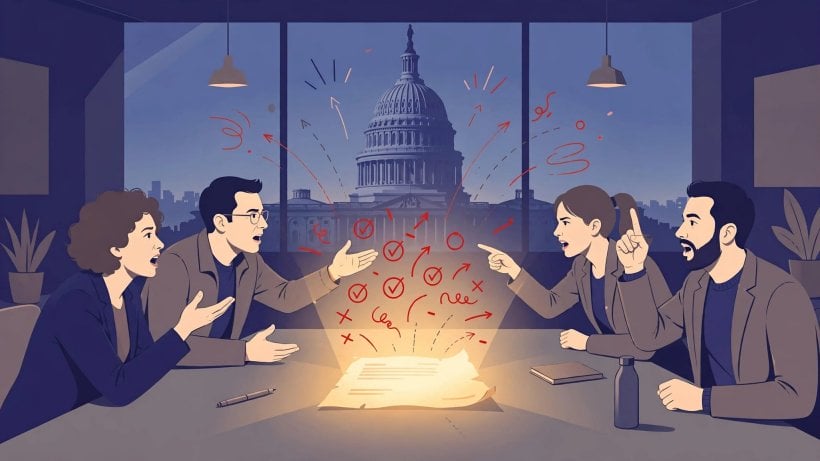
What The Draft Would Actually Do
The bill covers developers of the most capable models. The biggest — those with more than $500 million a year in AI revenue or over $1 billion in development spending — would have to publish a safety framework, hire independent evaluators, report serious safety incidents to the Department of Commerce, and file an annual signed statement certifying they had stuck to their own framework.
Its safety rules centre on “catastrophic risk”: a single incident that kills or seriously injures more than 50 people, or causes more than $1 billion in damage, through weapons help, an unsupervised cyberattack or crime, or a model evading its developer’s control. Only one route exists to halt such a model: Commerce would have to ask a federal court in Washington, DC for a “blocking order,” backed by a determination signed personally by the department’s head and an independent evaluator’s assessment, and the court could act only if it found the risk “present or impending” and no less restrictive step would work. No other federal agency could suspend a model under the act.
On states, the draft would stop them imposing their own rules on AI developers for risk disclosures, third-party evaluations and incident reporting. Child safety laws, whistleblower protections and ordinary liability law are carved out — but the text also lists state orders suspending a model as a covered area, which critics read as taking that power away from states altogether.
Safety Advocates Turn On The Safety Company
The reaction was fierce. Nathan Calvin of Encode, a group that campaigns for AI safety laws, wrote on X: “I found myself viscerally angry at multiple points reading this bill… passing it would make us less protected against catastrophic risks than we are under existing law.”
Alex Bores, the New York lawmaker who wrote the state’s RAISE Act, said the draft “comes nowhere close to the speed of developments nor the speed we need to keep people safe,” pointing to this summer’s run of rogue AI incidents. Writing in Transformer, Shakeel Hashim compared it unfavourably with the bipartisan FRONTIER Act from Representatives Jay Obernolte and Lori Trahan, which sets standards and licensing for evaluators where Anthropic’s draft does not. California senator Scott Wiener said the proposal “falls far short of protecting public health and safety,” and Heidy Khlaaf of the AI Now Institute called it “autocratic.”
What Anthropic Says It Will Change
Cimino said the draft had been shared with “a small number of congressional offices” and that the company plans “to update our discussion language on preemption,” making clearer that states keep a role in areas such as evaluator standards and a lab’s ability to shut down a model. The 50-death and $1 billion threshold was taken from California law, he said, but it is “probably time to re-evaluate thresholds,” and proposals on evaluator standards and stricter incident reporting are coming. “But the bar can’t be so high that the power never gets used when it’s needed,” he wrote. “At its core, our proposal is intended to be the strongest on the table.”
A rival weighed in without naming Anthropic. OpenAI’s chief global affairs officer, Chris Lehane, wrote on LinkedIn on Monday, October 19 that AI policy decisions “must ultimately be made through our democratic processes with our elected officials leading,” and that “no one company (including OpenAI) should write the rules alone.” Lehane called the FRONTIER Act “a strong starting point in the House” and backed its requirement for independent assessments of frontier models.
Why It Matters
The episode matters because Anthropic’s influence on AI law rests on its safety reputation, and this is the first time that reputation has been spent defending a draft its own community calls weaker than the status quo. The fight is really about three design choices every frontier law must make: whether federal rules override state ones, whether intervention needs a body count and a dollar figure before it can trigger, and who grades the graders when evaluators are paid by the labs they assess. Congress is out of session until after next month’s midterm elections, so the draft is positioning rather than imminent law — but the revisions will show which criticisms Anthropic accepts. The same evaluator machinery appears in its practice as well: it has just given METR researchers employee-level access to assess Claude’s risks.
Background
Anthropic, founded on an AI-safety mission, has spent 2026 converting its voluntary Advanced AI Framework into policy proposals, pitching this draft to lawmakers in mid-October as Washington argues over whether federal AI rules should preempt the state laws that moved first. The debate runs parallel to Europe’s tiered approach in the EU AI Act, which imposes continuous obligations well below any catastrophic-harm line, and to the bipartisan FRONTIER Act already before the House.



0 Comments