
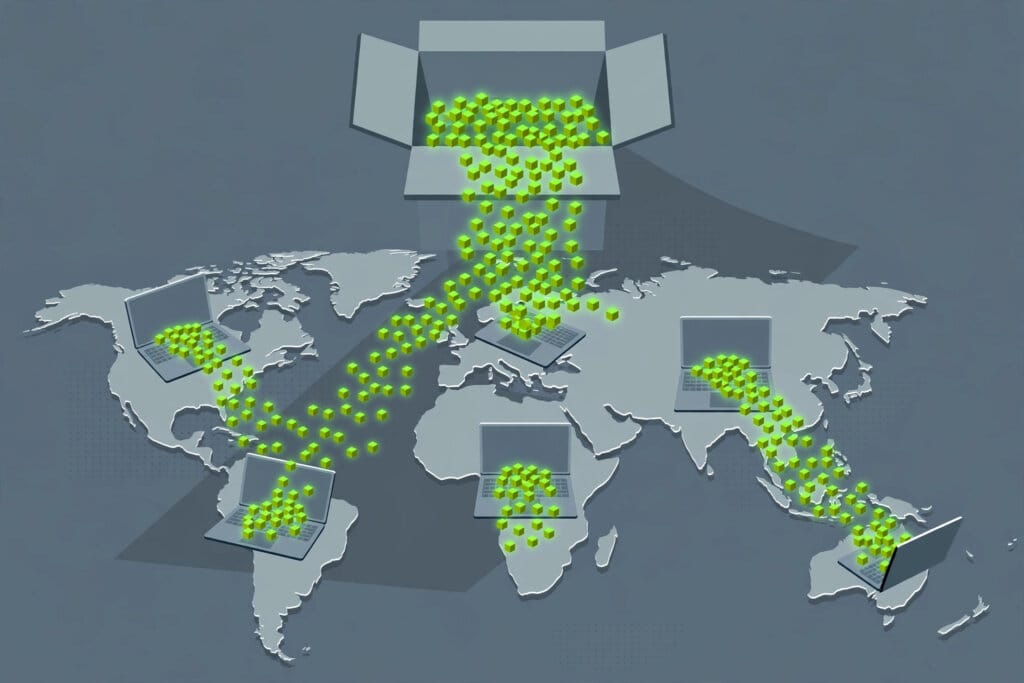
Three billion downloads is not a marketing line; it is a habit. Qwen, Alibaba’s open model family, has become the most-downloaded open AI model family on Hugging Face, the library where developers actually go to get models.
Download counts can be gamed in theory, but sustained volume at this scale means something simple: when engineers start a project, Qwen is the first thing they reach for. Here is why.

Every size, one family
Most open releases offer a model or two. Qwen offers a ladder from tiny models that run on a laptop to flagships for serious servers, all sharing tools, formats and habits.
That range removes a whole category of friction. A prototype built on a small Qwen can graduate to a bigger sibling without a rewrite, and an edge deployment can shrink down the same family.
Specialised siblings help too. Separate Qwen variants for coding, vision and reasoning mean developers rarely need to leave the family to find a fit for their task.
A licence that says yes
Downloads follow permission. Most Qwen models ship under permissive terms that allow commercial use, which legal teams can approve quickly and founders can build businesses on.
Every restriction in a licence is a meeting, a delay or a decision to use something else. Qwen’s relative openness converts directly into adoption, especially among the small teams who produce most experiments.
It also encourages sharing. Fine-tuned derivatives can be published and redistributed, and thousands are: the Hugging Face ecosystem around Qwen includes countless community adaptations that all point back to the base family.
Good enough, early, and everywhere
Timing compounds. Qwen releases capable models early in each cycle, in many sizes at once, with the documentation and example code developers need on day one.
“Good enough” matters more than leaderboards for most real work. Summarising documents, classifying tickets, drafting replies and extracting data do not need the world’s smartest model; they need a reliable one that runs cheaply.
There is also a home-market engine behind the numbers. Qwen’s consumer app counts roughly 167 million monthly users in China, and Alibaba’s cloud business pushes the same models to thousands of enterprise customers.
Derivatives: the hidden multiplier. The three billion figure counts more than Alibaba’s own releases. A large share of the action is derivatives: models that other people fine-tuned from Qwen bases for medicine, law, languages, roleplay, code and a thousand niches.
Each derivative is a small act of allegiance. Its creator tested alternatives, chose Qwen as the foundation, and published work that teaches the next developer to do the same.
Derivatives also fill gaps Alibaba never would. A two-person team in Jakarta or Nairobi can localise Qwen for their language and market, work no platform giant would prioritise, and their users still end up inside the Qwen orbit.
This is why raw download counts understate the position. The base model is the platform; the derivatives are the applications; and platforms with applications are famously hard to displace.
Rivals understand the arithmetic. Every serious open lab now races to seed its own derivative ecosystem, but they are building on ground where Qwen’s head start compounds monthly.
The flywheel problem for rivals
Downloads create tutorials, integrations, benchmarks and folklore. New developers learn on whatever the community already uses, which is increasingly Qwen.
Support and cadence quietly seal the habit. Qwen’s releases arrive with weights, documentation, demos and conversion tools in one motion, so a developer who reads the announcement at breakfast can be testing by lunch.
Community infrastructure does the rest: quantised versions for laptops, one-click deployments, fine-tuning recipes and Spaces to try everything in a browser. Rivals publish models; Qwen publishes an on-ramp, again and again, until using anything else feels like extra work.
There is a geographic flywheel too. Asia’s enormous developer population learned AI tooling during Qwen’s rise, and their tutorials, codebases and hiring expectations now export the default worldwide.
None of this required developers to love Alibaba. They simply kept choosing the tool that cost the least time to adopt, and in software, the path of least resistance, repeated three billion times, becomes the landscape itself.
Rivals can beat it on a benchmark and still lose the default. In open ecosystems, the most-downloaded model is rarely just a product; it becomes infrastructure, and infrastructure is sticky.

0 Comments