
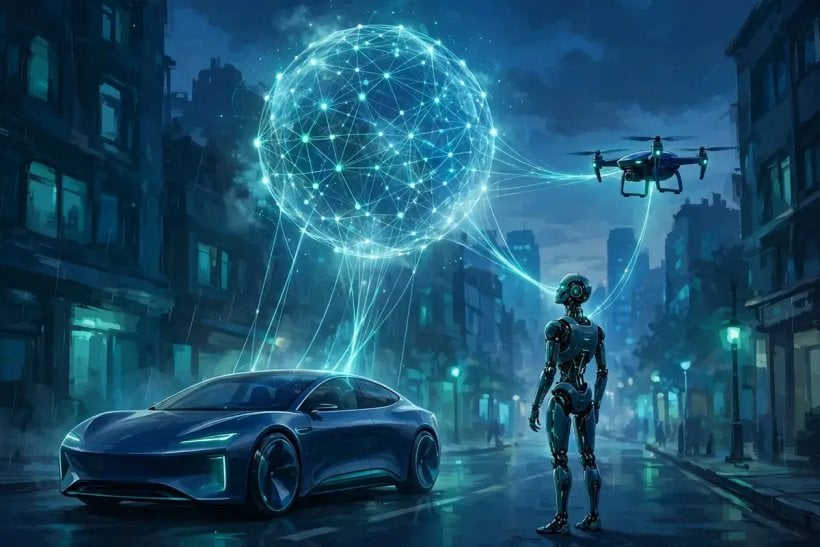
XPENG has unveiled WorldGPT, a single AI model that learns how the physical world works across six kinds of machines. The company says the model brings together cars, boats, drones, single-arm robots, dual-arm robots and humanoid robots under one shared understanding.
What WorldGPT does
The model is part of XPENG’s Turing World Model family, and the company calls it the first world model to show prediction and action planning across all six machine types. Unlike systems built separately for each machine, WorldGPT learns one set of physical principles and applies it everywhere.
A car judging the gap to the vehicle ahead and a robotic arm reaching for a cup face versions of the same problem. Both must judge distances, predict what happens next and respond in time. WorldGPT treats those shared demands as one learning task, not six separate ones.
Given earlier camera footage and a simple instruction, the model can generate video showing how a scene might evolve. It can plan the actions needed to complete a task and explain its reasoning in natural language, linking what it sees to what it intends to do.
One teacher, many machines
WorldGPT works as a large cloud-based teacher model that learns shared knowledge from data across all six machines. That knowledge is then distilled into smaller, specialised models designed to run directly on individual machines, each tuned to its own hardware and movements.
The usual route to a new machine is slow: collect specialised data, train a dedicated model and adapt it to new hardware. XPENG argues its shared foundation removes most of that work, cutting development costs and making it easier to extend physical AI to new kinds of machines.
The benchmark claims
XPENG says WorldGPT took 12 first-place results across public benchmarks in autonomous driving, robotics, visual understanding and video generation, measured as of 12 November. In driving it led four evaluations, including NAVSIM v2, in both standard and challenging driving scenarios.
In robotics the model averaged a 95.2 percent success rate across 50 single-arm manipulation tasks, the highest among published models tested. It also ranked first in tests of adapting to unfamiliar tasks and changing environments, where a fixed routine would fail.
In visual understanding WorldGPT ranked first on CV-Bench and two BLINK subtasks, which test spatial understanding and object relationships. In video generation it took the highest overall score on VBench 2.0 and tied for first on WorldOlympiad, which tests long-horizon simulation.
Our Read
Rivals are chasing the same idea from different directions. NVIDIA has opened its Cosmos world models for cars and robots, betting shared simulation data is the shortcut. XPENG’s answer is one model trained across its own machines, a narrower bet with a clearer owner.
The wider field is moving the same way. Google’s Genie 4 turns text into interactive worlds people can walk through, while XPENG’s model must also plan real actions for real machines. The test is whether shared learning survives contact with hardware, where every robot body breaks the abstraction differently.
Why It Matters
For XPENG, WorldGPT is the software core of a strategy that spans cars, humanoid robots and autonomous mobility. A shared foundation would let each new product inherit what the others learned, instead of starting from zero. For buyers, the payoff is machines that improve together, not one at a time.
Background
XPENG stages its annual AI Day in Guangzhou on 25 November, a day after this announcement, to show its humanoid robot and driving technology. The company has spent the year building a full-stack physical AI business, from Turing chips to world models. Doubao has already moved AI into cars.
Source: XPENG’s announcement and the WorldGPT project page.




0 Comments