

A new study of 4,000 AI-generated answers found that no private equity firm was named in more than 15% of responses to questions about choosing and evaluating firms. KKR had the highest visibility at 14.6%, and the data providers PitchBook and Preqin were named more often than every private equity firm except KKR, according to the 2026 study by communications firm Zen Media, published on October 22.
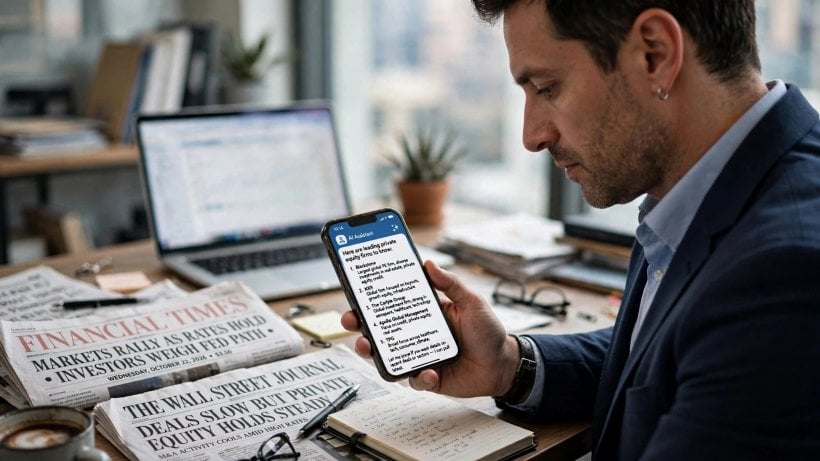
The findings add to a growing body of evidence that AI assistants have become the first place many buyers look — and that the shortlists they produce look little like the industry’s own pecking order. The study ran on Zen Media’s AI visibility engine, ZAVI, testing 1,000 prompts across ChatGPT, Gemini, Perplexity and Grok and collecting 4,000 responses. The prompts were written for 199 personas, from business owners planning an exit to M&A advisors and limited partners, and 41.2% of them carried buy intent.
The Rankings: KKR Leads, And The Average Firm Barely Registers
KKR, the mega-cap buyout firm, was named in 14.6% of the 4,000 responses. Thoma Bravo followed at 10.1%, Blackstone at 9.1%, Insight Partners at 9% and Warburg Pincus at 8.7%. The 98 ranked companies averaged just 3% visibility — and even KKR, the top firm, was absent from most answers to questions asking which firm to choose. Three lower-middle-market specialists reached the top 20: The Riverside Company at 5.3%, Shore Capital Partners at 5.2% and Audax Private Equity at 4.8%.
Of the study’s 1,000 prompts, 236 were written for owners seeking an exit, and 101 of those asked directly which firms to approach — the equivalent of asking the assistant for a shortlist of acquirers for a specific business. Another 197 prompts were written for limited partners, institutional investors and family offices, covering fund performance, vintage year and track record.
Databases Beat Firms, And Expertise Dominates The Answers
PitchBook was named in 11.8% of responses and Preqin in 11.1% — more often than every private equity firm in the study except KKR. The two databases also led the study’s source analysis with citation frequencies of 92% and 88%, ahead of Cambridge Associates at 72%, Capital IQ at 68% and Burgiss at 58%. Trade outlets PE Hub and Mergermarket followed at 45% and 42%. None of the eight most-cited sources was a private equity firm’s own website: the answers referenced PitchBook, Preqin, regulatory filings and trade publications.
The topics the assistants returned read like a due-diligence checklist. Sector expertise appeared in 88% of the AI answers, reference checks in 82%, buy-and-build value creation in 79%, operating partner resources in 75%, deal size fit in 72% and realised versus unrealised returns in 68%. “When a business owner writes a prompt in ChatGPT looking for private equity firms that buy companies like theirs, the answer almost always pulls top sources from PitchBook and Preqin and may pull from competitor sites with strong owned authority,” said Sarah Evans, CEO of Zen Media. “A company that has no authority, recency or relevancy means their owned content won’t get cited. Without that, they are left out of the answer.”
Why It Matters
For private equity firms, the buyer shortlist is increasingly being drafted inside AI answers rather than in bankers’ slide decks — and the firms themselves have almost no say in it. The two patterns the study documents point at the same fix: the assistants answer from concrete specifics, so a firm’s website needs to spell out its sectors, deal sizes and completed deals in the same structured way the databases do; and where owned content runs out, third-party coverage in the publications the answers cite fills the gaps. Zen Media, which sells AI visibility services, says its own work runs on both fronts. The caution that applies to every vendor-authored study applies here too — the methodology is transparent, but the prompts are not published, and no company participated in or funded the work.
Background
2026 has been the year AI visibility became a measurable discipline. Semrush spent a year tracking AI Overviews across commercial keywords and found them on 88% of the panel, while Envoyra asked four assistants the same buyer questions for a month and found the assistants agreeing on the top brand in only one of five software categories. Zen Media’s private equity study is the first of this wave aimed squarely at a services industry where the buying decision is high-stakes and the vendors have historically relied on relationships, not rankings.
Source: Zen Media




0 Comments