
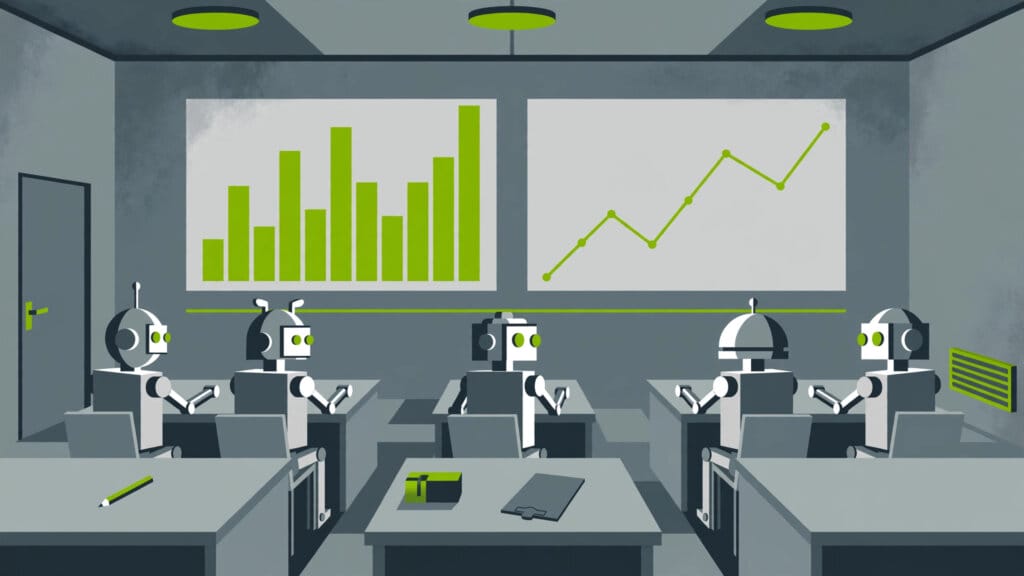
Every model launch crowns a number. A benchmark score (92 on this, top of that) is supposed to tell you which AI is smartest, the way a lap time ranks cars. The reality is murkier, and knowing why makes you a sharper reader of every AI headline.
Benchmarks are exams: fixed sets of questions with graded answers. They are useful, gameable and incomplete in roughly equal measure. Here is how to read them without being misled.

What the main benchmarks measure
The famous names each test a slice of ability. Knowledge benchmarks quiz facts and reasoning across school and university subjects. Coding benchmarks set programming tasks and check whether the code runs. Maths and science suites push multi-step reasoning, and newer agent benchmarks grade whether a model can complete whole tasks with tools.
Two families matter most in practice. Static exams are cheap and comparable across models, but they leak: questions circulate online, enter training data, and scores quietly inflate.
Live and human-judged evaluations (blind comparisons where people pick the better answer) resist leakage and capture feel, at the cost of being slower, noisier and harder to reproduce exactly.
Where scores mislead
The first trap is contamination. If a model has effectively seen the exam during training, its score measures memory, not ability, and even honest labs struggle to prove a negative.
The second trap is tuning to the test. Once a benchmark becomes the industry’s scoreboard, engineering effort flows toward it, and gains on the chart outpace gains in real usefulness. A model can top a knowledge exam and still fumble an ordinary request.
Real-world behaviour keeps humbling the charts: major answer engines have produced confident nonsense on simple queries, as our report on AI Overviews answering gibberish searches documented. No benchmark on the launch slide measured that.
Why benchmarks keep multiplying
Every time the industry masters an exam, it writes a harder one. Saturated benchmarks retire, successors arrive with fresher questions, private test sets and tasks designed to resist memorisation.
The frontier of evaluation has moved toward work itself: benchmarks that hand a model tools, files and a goal, then grade the finished job. These agent evaluations are slower and messier, but they measure something closer to value.
Private and rotating tests are the other response to contamination. If the questions are secret or newly written each round, memorisation stops working, though outsiders must then trust the test-maker instead.
There is also a market reason for the multiplication. Each new benchmark is a new crown to win, and therefore a new launch headline; the number of leaderboards grows because leaderboards are useful to the people announcing models.
None of this makes benchmarks useless. It makes them a literature to be read critically, like polls before an election: informative about direction, treacherous about exact rank, and best consumed in aggregate.
How to use scores like an adult
Treat a benchmark as a screening tool, not a verdict. Use it to build a shortlist, then test the finalists on your own tasks, in your language, with your documents and your definition of a good answer.
Prefer independent results over launch-day charts, ranges over single numbers, and recent evaluations over famous ones. A score from a saturated, years-old benchmark carries almost no information in 2026.
History offers a warning from other fields. University rankings, crash-test stars and credit scores all began as honest measurements and all bent the behaviour they measured, because being measured is an incentive.
AI labs are responding the way mature fields do: more diverse tests, rotating questions, third-party custody and task-based trials. The direction is right, even if no exam will ever capture “is this thing actually good?”
Until one does, the division of labour stands: benchmarks for orientation, your own tests for decisions, and a healthy suspicion of any single number asked to carry the word intelligence.
A useful rule of thumb: the more a score is advertised, the more it has been optimised for, and therefore the less it surprises. The most informative evaluations are usually the ones nobody put on a T-shirt.
Above all, notice what no benchmark can tell you: reliability over a long task, honesty about uncertainty, and behaviour on the day the marketing ends. Those are learned by use, which is why the smartest readers treat every crowned number as a hypothesis, not a result.

0 Comments