
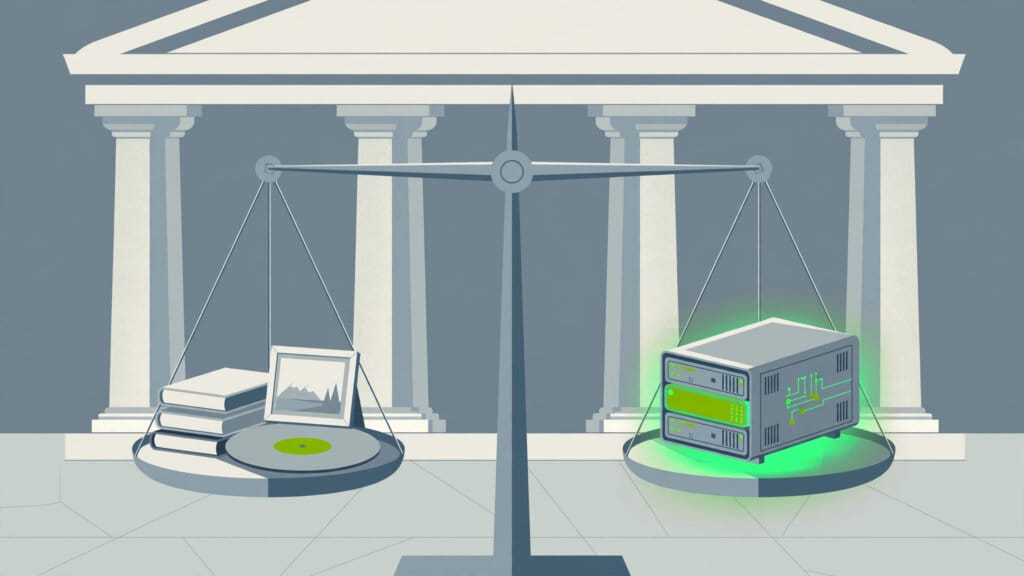
Every AI model is trained on human work — books, articles, photographs, songs, code — and almost none of that work was licensed when the training happened. The argument over whether that was legal, and what it should cost, is now the largest legal fight in the technology industry. Trackers count roughly 154 AI lawsuits in progress, most of them, one way or another, about copyright.
The cases cluster into three questions that courts are answering one at a time: was the training lawful, where did the training material come from, and what happens when a model’s output resembles someone’s work?

Question one: is training fair use?
The central doctrine is fair use. AI companies argue that training is transformative — the model learns patterns the way a student does, and does not store or republish the works themselves. Creators argue that a system built to compete with them, trained on their output at industrial scale, is a commercial copying operation wearing an academic defence.
News publishers, authors’ groups, photographers and music labels have all sued on versions of this claim, and the music industry’s cases add a sharp edge: outputs that sound like the artists whose work trained them. No supreme-court-level answer exists yet in the United States, so the doctrine is being written by district courts, case by case, with billions riding on each.
Question two: where did the data come from?
The second fight is about sourcing. The Bartz case against Anthropic turned on a library of pirated books used in training. Anthropic settled for $1.5 billion — the largest copyright settlement of the AI era — and the deal won final court approval on 20 July 2026.
The lesson the industry took from Bartz is precise: courts may tolerate training on lawfully obtained works far more readily than training on pirated ones. Provenance — being able to prove you had the right to use the corpus — has become a core asset, and it is why licensed libraries and publisher deals now command real money.
Question three: what about the outputs?
The third front concerns what models produce. If an image generator emits something substantially similar to a copyrighted character, or a chatbot reproduces long passages of a protected text, liability may attach to the output regardless of how lawful the training was. These cases are slower and more fact-specific, but for working creators they are often the ones that matter most.
A separate front — consumer-protection suits over how AI products are marketed, such as the state cases filed against OpenAI — shows copyright is only one of several legal theories now aimed at the industry.
Why settlement, not verdicts, is reshaping things
Watch what the fights are producing: licensing markets. Publishers, photo agencies, music catalogues and data brokers are signing paid training deals, because lawsuits made the alternative — unlicensed scraping — a priced risk. Copyright is being converted from an ignored externality into a line item in the cost of building a model.
That may be the fights’ largest legacy. The courts will eventually draw the legal lines, but the market is already drawing practical ones: training data with clean rights costs money, pirated data costs more, and the price of both is now built into what frontier AI costs to make.
What working creators can take from this
For individual creators, the courtroom drama resolves into practical positions. Your work is an asset with a growing market price: licensing collectives, publisher deals and opt-out registries exist because AI companies now need defensible supply. Knowing whether your catalogue is being used, and on what terms, is becoming a normal part of administering a creative career.
It also pays to watch the distinction the courts are drawing. Training on lawfully acquired material and training on pirated libraries are being treated as different acts with different consequences — the Bartz settlement’s $1.5 billion is the proof. Where the data came from matters as much as what the model learned from it.
The fights are far from over; appeals will run for years, and legislatures may yet rewrite the rules the courts are sketching. But the direction is set. The free-for-the-taking era of training data ended not with a single verdict, but with a price tag — and every model built from now on will carry that cost inside it.

0 Comments