
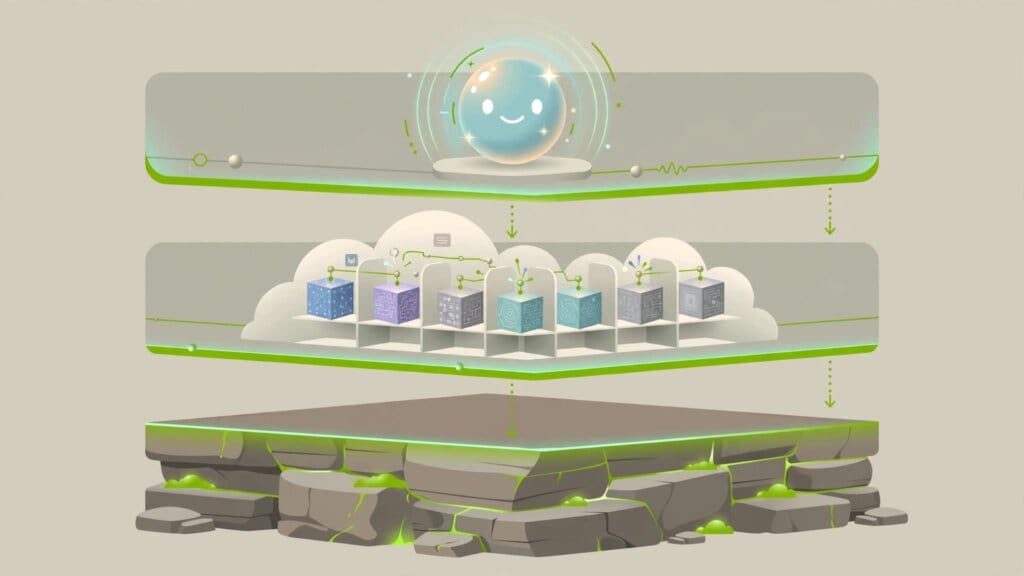
Amazon did not build its artificial intelligence strategy around a single chatbot. Instead the company has assembled a stack that reaches from the living room to the cloud, with different layers serving consumers, developers and large organisations.
At the top of that stack sits Alexa+, the generative version of its voice assistant. Beneath it sits Amazon Bedrock, the cloud platform where businesses build applications, and Nova, Amazon’s own family of foundation models that powers much of the system.

Three Layers, Three Different Jobs
Understanding Amazon helps if you separate those three names by audience. Alexa+ is a product people talk to, Bedrock is a service developers build with, and Nova is a set of models that can run underneath both.
That separation is deliberate and reflects how Amazon itself operates. Amazon sells infrastructure to other companies as much as it sells devices to households, so its AI has to work as a consumer experience and as a business platform at the same time.
Alexa+ At The Consumer Edge
Alexa+ is what most people will notice first in daily life. It replaces the rigid command style of the original Alexa with conversation that can handle follow-up questions, remember context within a chat, and complete multi-step tasks.
Because it is agent-like, Alexa+ is designed to do more than answer a question. It can coordinate services, draft messages, summarise information and control smart home devices through natural language rather than exact memorised phrases.
Rolling out across Echo devices, Alexa+ also acts as a public showcase for the wider stack. Every improvement in understanding or reasoning that works reliably in the home helps demonstrate what Amazon’s models and platform can do for business customers too.
For Amazon, that consumer presence matters commercially as well as technically. An assistant already present in homes can introduce new services, support shopping and entertainment, and keep Amazon in the conversation when people choose their next device.
Bedrock In The Middle
Amazon Bedrock sits in Amazon Web Services, the company’s cloud division. It is a managed service that gives businesses API access to foundation models from multiple providers through a single, consistent place.
Through Bedrock, a company does not have to build a model from scratch or manage heavy infrastructure itself. It can choose a model, connect its own data securely, and build chatbots, search tools, summarisation systems or software agents.
Choice is central to the Bedrock pitch to businesses. Alongside Amazon’s Nova models, customers can use models such as Anthropic’s Claude and other leading systems, and in October 2026 AWS added Chinese open models including Kimi K3 and GLM.
That marketplace approach means Amazon does not need its own model to win every single task. If a business prefers a different provider for a particular job, Amazon still provides the cloud, the security controls, the tools and the billing.
Bedrock also handles concerns that matter more to companies than to individual users. Those include access controls, monitoring, compliance support and ways to keep private business data separate while still using powerful external models.
Nova As The Foundation
Nova is Amazon’s own family of foundation models, covering text and multimodal work. Multimodal means a model can work with more than words alone, including images and other kinds of input, depending on the version and the use case.
For Amazon, having its own models matters for control, cost and independence. It can optimise Nova for Alexa+, for Bedrock customers and for its own retail and logistics operations without relying entirely on outside suppliers for every improvement.
Nova also gives Bedrock a first-party option that Amazon can develop on its own roadmap. Customers who want consistency across many applications can build on Nova, while others can mix and match models for different needs and budgets.
In practice the stack is circular rather than strictly top to bottom. Alexa+ uses models available through Amazon’s platform, Bedrock delivers those models to outside builders, and feedback and demand from both sides shape the next generation of Nova.
Amazon’s wider business reinforces that loop every day. Its retail site uses AI for recommendations, search and seller tools, its warehouses use automation and forecasting, and AWS then sells many of the resulting capabilities to other organisations.
That scale is Amazon’s main argument against more focused rivals. A company that only offers a chatbot has one surface, while Amazon can embed AI in shopping, entertainment, workplace software and cloud infrastructure at the same time.
There are trade-offs in that breadth, however. A stack with many parts can be harder to explain, products can overlap, and customers need to trust that their data stays private when the same company runs the assistant and the underlying platform.
Still, the logic becomes clear once the names are separated by job. Alexa+ is the interface, Bedrock is the distribution and development layer, and Nova is Amazon’s own engine room sitting within a wider choice of models.
For readers following Amazon, that distinction prevents confusion when a new feature is announced. Ask who it is for, which layer it sits in, and whether it uses Nova or a partner model, and the company’s strategy becomes much easier to follow.

0 Comments