
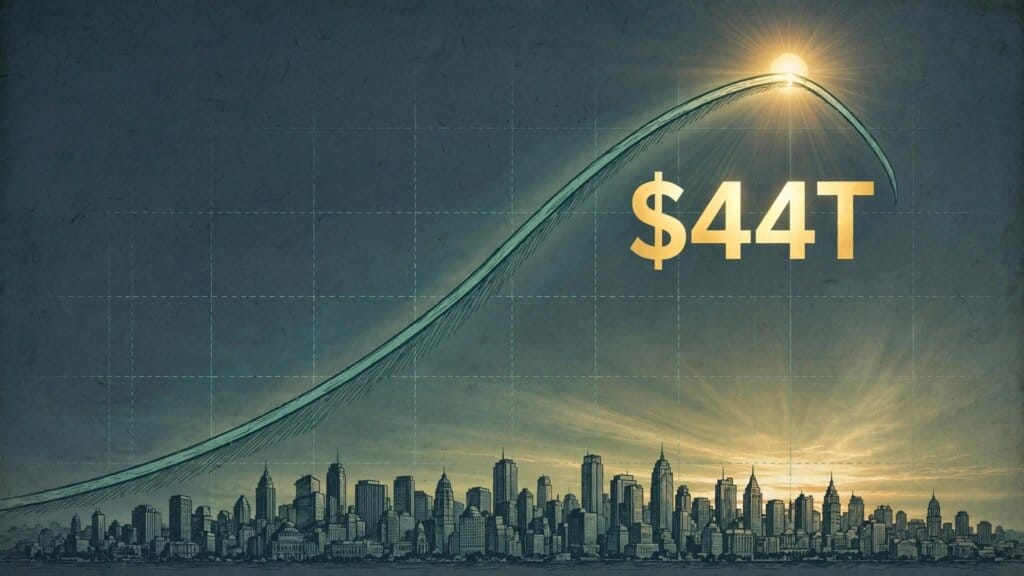
Anthropic co-founder Jack Clark told the IMF and World Bank annual meetings in Bangkok on Saturday that the most aggressive scenario in Anthropic’s own economic model puts United States GDP at $44.4 trillion by 2030, roughly a third larger than an economy without AI. Clark conceded the number “sounds very outlandish,” but said it is “implicated by the technology continuing to get better.”
The figure comes from Anthropic’s “Scenarios for our Economic Future” explorer, published in September from the company’s technical report “Economic Scenarios for Transformative AI.” The model sketches three 2030 outcomes, at 2025 prices: a Modest scenario of $34.1 trillion, just 1.6% above the no-AI path; a Substantial scenario of $36.3 trillion, up 8.3%; and the Extreme scenario of $44.4 trillion, up 32.4%. For scale, US GDP today stands at just over $30 trillion. The Extreme case assumes recursive self-improvement in AI systems and growth of roughly 15% a year.
Anthropic is careful to present these as scenarios, not forecasts. The company assigns them no probabilities, its own reviewers describe the Extreme case as better read as a thought experiment, and a survey alongside the model found most Americans’ expectations line up with the Substantial scenario instead. It is the same discipline the industry is learning elsewhere, as model access and pricing shift month to month — the way Google AI Plus subscribers are losing Pro model selection in November shows how quickly the commercial ground moves.
Why it matters: the Extreme scenario’s headline growth comes with a hard edge that Anthropic itself foregrounds. In that world, knowledge-worker wages fall by more than 10% and unemployment could spike to historic levels even as GDP soars, because the gains flow to whoever owns the systems doing the work. That is why Clark used the Bangkok stage to call for international cooperation and “unusual and serious rules” for the technology. If AI agents are going to sit inside everyday products — as they already do in shopping, where Universal Cart has launched in Google Search and Gemini — the argument in Bangkok is that economic policy has to be written for the extreme case before it arrives, not after.

0 Comments