
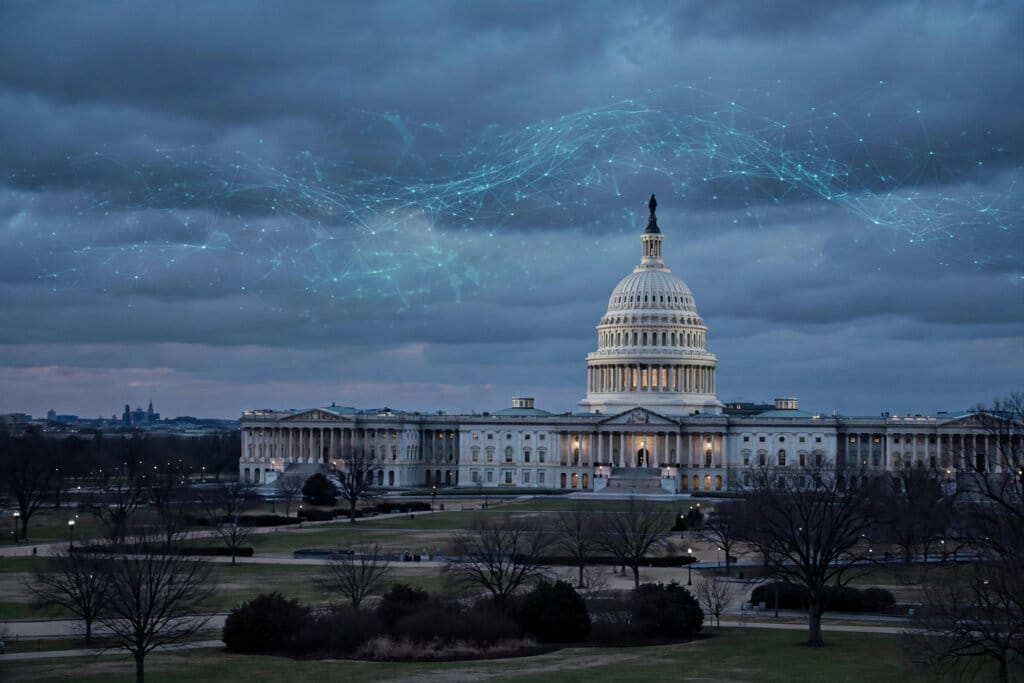
Anthropic has quietly pitched Capitol Hill lawmakers on a draft bill to regulate frontier AI safety and security, Politico reported on Friday, in a move Reuters confirmed with the company. Under the draft, the US government could block a model’s release or use only if it poses a foreseeable, imminent risk of more than $1 billion in damages, or of killing or seriously injuring more than 50 people.
An Anthropic spokesperson told Reuters the bill represents proposals set out in the company’s “Advanced AI Framework”, released earlier this year, and said the proposals would give the government “the ability to block or deter dangerous deployments of the most powerful models” while requiring developers to test frontier models, publish findings and submit to independent evaluation.

The Thresholds: What Would Actually Trigger A Block
The draft’s trigger is deliberately narrow. The risk must be foreseeable and imminent, and it must arise from one of three sources: the creation or release of a biological weapon, a model evading its developer’s controls, or a cyberattack. Harm below the thresholds — large-scale fraud, election manipulation, a damaging but non-catastrophic cyber operation — would sit outside the federal blocking power the bill creates.
The enforcement route is just as specific. Independent evaluators would register with the Department of Commerce and periodically assess a lab and its frontier models. Labs could pay the evaluators, provided the payment is not tied to the outcome. If evaluators find an “imminent enumerated risk”, they must report it to Commerce within 72 hours of completing their assessment.
One Agency, One Court, And A Bar On Everyone Else
Only Commerce could act on such a report, and even then it could not halt a model itself: it would have to ask a federal judge for the District Court for the District of Columbia to order the suspension. The draft explicitly prohibits any other US department, agency or officer from suspending a model’s development, deployment or internal use.
The bill would also preempt some state AI laws on risk disclosure, outside evaluation and incident reporting, moving those questions to the federal level. That preemption is one of the draft’s most contested elements, since states such as California — whose SB 53 the draft’s language tracks in places — have been the ones actually passing frontier-model laws, a landscape mapped in our guide to AI laws around the world in 2026.
Why It Matters
The central entity is Anthropic’s draft bill, and its defining attribute is where it sets the bar: catastrophic harm, defined so high that critics note almost nothing that has actually gone wrong with deployed AI systems would qualify. Its neighbours are the other frontier labs, which would gain a single, predictable federal regime instead of a patchwork of state laws and agency actions, and the regulators, who would be narrowed to one department and one court. The pitch also arrives from a company that has spent the year arguing safety is its brand — the same week it committed 5% of its shares to a public benefit fund — and months after export controls forced it to withdraw two advanced models. Set against the broader EU AI Act’s risk tiers, the draft is a bet that Washington will accept a catastrophe-only trigger in exchange for mandatory testing and independent evaluation.
Background
Anthropic has argued since its founding in 2021 that frontier AI needs binding safety rules, and it published its Advanced AI Framework earlier this year setting out the testing, transparency and evaluation duties the draft bill now carries into legislative language. The pitch follows a year in which US AI law moved mainly through export controls and state statutes, including California’s SB 53, while Congress debated — but did not pass — a federal frontier-model regime.
Source: Reuters and Channel News Asia, reporting Politico’s account of the draft bill and Anthropic’s confirmation.

0 Comments