
Avicena has raised over $100 million in Series C funding to commercialize LightBundle, its laser-free optical interconnect for AI infrastructure. The Sunnyvale company says the money will take its microLED-based platform from evaluation kits to a first commercial product next year.
The round was led by InterVest, with Tiger Global, Cerberus, SK hynix Ventures, Samsung Catalyst Fund, AMD Ventures, Prosperity7, Diamond Edge Ventures and Hitachi Ventures joining. Avicena did not disclose a valuation. The backers sit on both sides of the link it wants to fix.
What LightBundle does
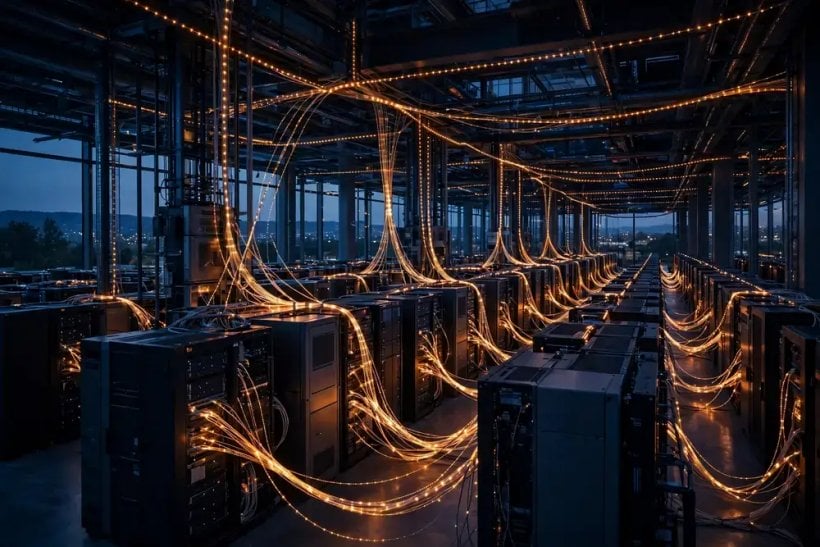
AI systems move enormous volumes of data between accelerators, memory and switch fabrics, and copper links are running into limits on reach, routing density and energy. LightBundle replaces copper and lasers with dense arrays of microLEDs and silicon photodetectors joined by multicore fiber.
Its wide-and-slow design spreads bandwidth across many lower-speed channels instead of pushing a few channels ever faster. That cuts the need for heavy data-rate conversion and complex signal processing, and the company says it delivers high bandwidth density with low power and low latency.
The platform targets two kinds of connection: scale-in links within and between chip packages, and scale-up links across accelerator systems. Both matter as AI clusters grow, because moving data between chips is fast becoming as expensive as the computation itself.
A new chief for the commercial phase
Kevin Pope will succeed Marco Chisari as chief executive as part of the financing. Pope brings technology and operations experience, including guiding companies to successful exits, and will lead the shift from research and development to production. Chisari called him the right person for this stage.
InterVest director John Dongwoo Ha joins Avicena’s board with the round. Ha said the company’s progress is bringing microLED interconnects closer to practical deployment, and that Avicena is well placed to attack the scale-up and scale-in bottlenecks in next-generation AI infrastructure.
The financing follows two milestones this year. In August Avicena began shipping 1 Tbps LightBundle evaluation kits, and in September it showed a connectorized version at the ECOC conference. Together they move customer testing forward and cover the practical needs of assembly, testing and servicing.
Our Read
The investor list is the strongest signal here. Memory makers SK hynix and Samsung and chipmaker AMD’s venture arm are all betting that the bottleneck in AI is no longer just compute. Amazon is buying Decart’s chip-optimization tech to make Trainium faster, chasing the same efficiency from the software side.
Avicena’s pitch is the hardware mirror of that bet: if data cannot move cheaply between chips, faster accelerators sit idle. The open question is manufacturing. MicroLED arrays at data-centre scale are unproven, and nothing in the announcement has been independently tested or priced.
The company names no customers and gives no valuation, so the $100 million is a vote on the team, the kits in customer labs and the roadmap — not on a product anyone can buy. Its product is promised for next year, when the claims get their first real test.
Why It Matters
AI infrastructure spending is running into physics, not just money. Meta’s $60 billion AI war chest has already hit a courtroom wall, and every hyperscaler is hunting for cheaper ways to move data. If microLED links work at scale, they cut the power and cost of the connections between accelerators.
Background
Investors have been pouring money into the plumbing of AI all month. Marlowe raised $277 million to build AI inference factories beyond Nvidia, and Avicena’s round is the same bet at a different layer: not more chips, but faster, cheaper movement between the chips already being built.
Source: Avicena’s announcement and the BusinessWire release




0 Comments