
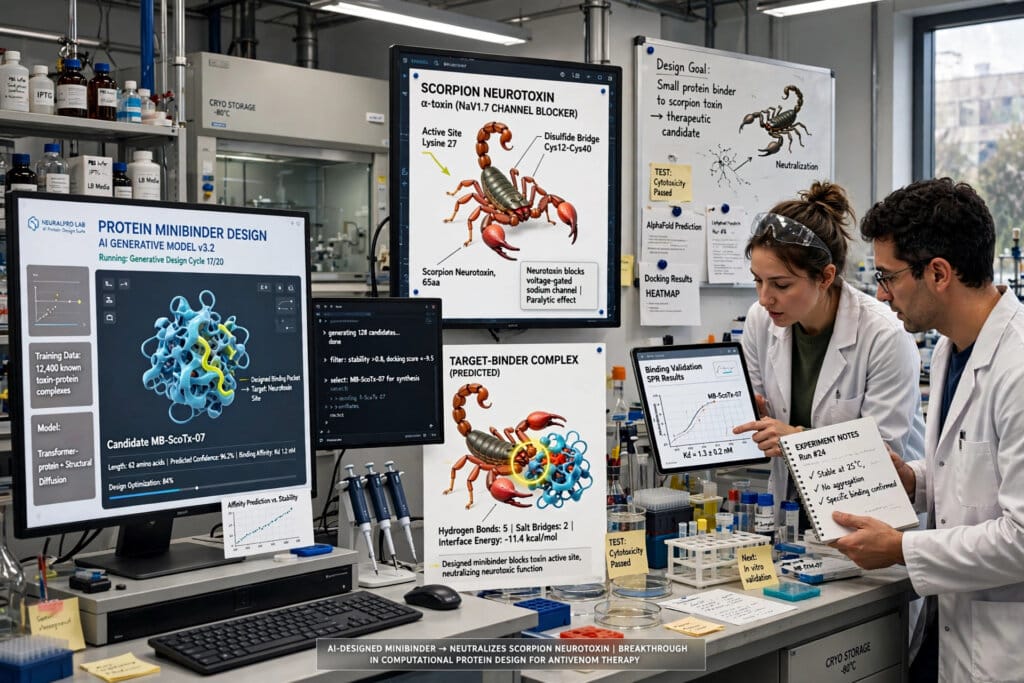
Anthropic says Claude has designed protein binders against scorpion neurotoxins, and outside labs have confirmed that some of them bind. The company published the research on October 20, reporting that an internal Claude research model generated 318,484 protein designs in a 64-hour campaign, and that 17 of the 211 designs sent for experimental testing met its criteria for binding.
Anthropic is releasing all 211 designs and their data as a resource for the field. It is careful about the limit of the result: binding is not neutralisation, the binders have not been tested in cells or living animals, and the company does not claim to have produced an antivenom.
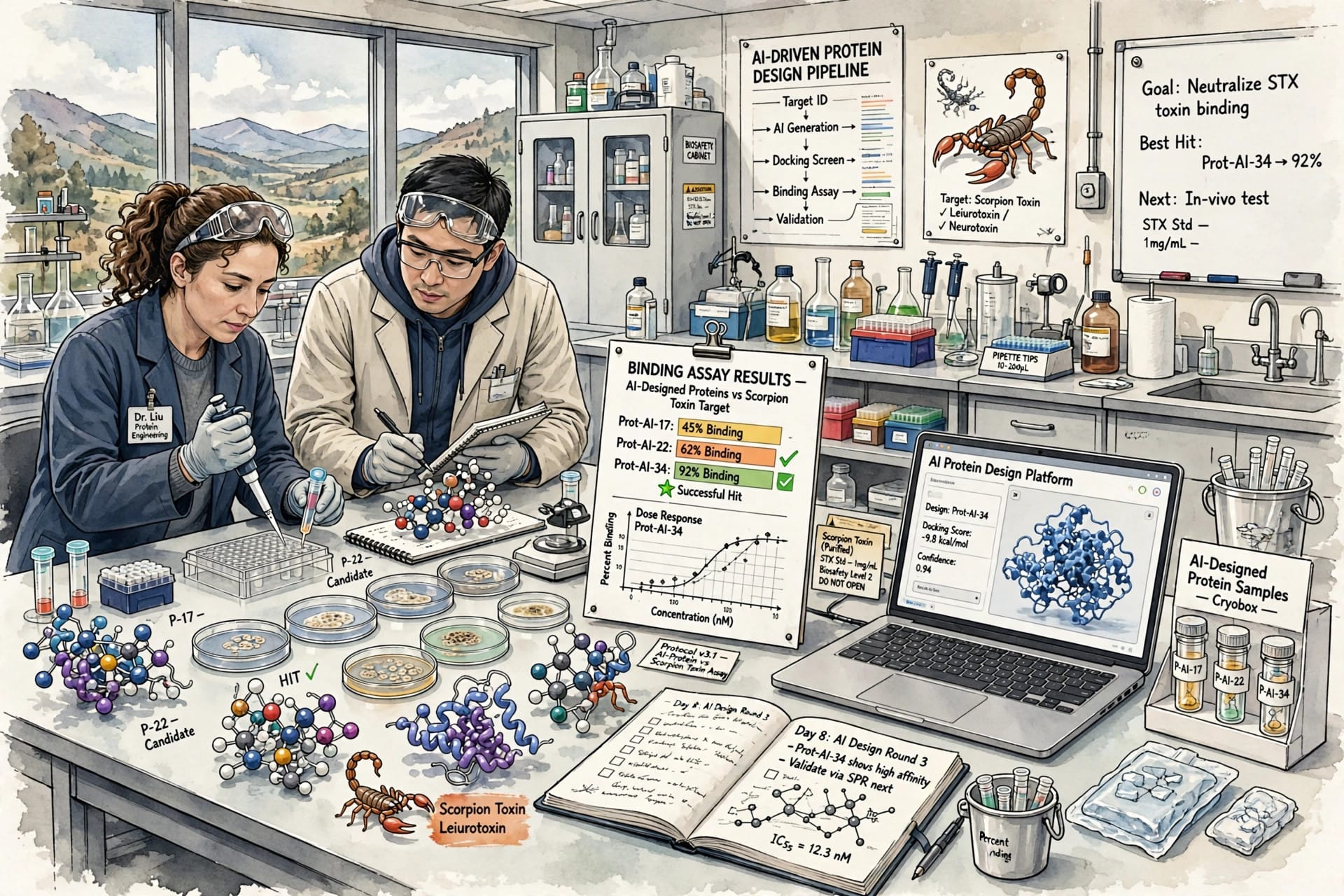
Claude’s Scorpion-Toxin Campaign: 318,484 Designs In 64 Hours
The campaign began with the same prompt Anthropic used in its earlier protein-binder study, modified in collaboration with Citrini Research, the financial investment research firm that had asked whether AI drug discovery could let motivated nonexperts tackle a genuine health problem. An internal research model, operating within Claude Science, then worked mainly autonomously for 64 hours, directed by Anthropic’s team through four follow-up prompts.
Claude analysed the research data, generated the figures and drafted the final report under supervision. It used 12 design tools, filtered out designs resembling a toxin or a known protein, and co-folded and screened 553,052 design-toxin pairs. The work used on the order of 10,000 GPU hours, according to Anthropic’s technical report.
The targets were five neurotoxins from four scorpion regions: Cn2 from Mexico, Ts1 from Brazil, AaH I and AaH II from North Africa, and LqhIII from the Middle East. Claude chose the toxin structures from the Protein Data Bank and the AlphaFold database and picked five hotspots on each toxin for its designs to latch onto. It produced 180 designs itself; the team added 31 more with Claude’s help, taking the tested set to 211 — and the Claude system behind the work selected most of its final list, including its strongest binder, only after the third follow-up prompt.
How The 211 Designs Were Tested, And What Counted As A Binder
Two contract research organisations did the lab work. Adaptyv Bio expressed the designs in a cell-free system, while Twist Bioscience expressed them in mammalian cells as fusions to Fc, the stem of an antibody. Both measured binding by surface plasmon resonance, which tracks how quickly a toxin binds to and detaches from a design and produces a dissociation constant, KD — the lower the KD, the tighter the binding.
Anthropic set strict criteria before calling a design a binder: it had to show binding at both labs, in every replicate, with every KD at 1 micromolar or tighter, and show no signal against CLEC12A, an unrelated human protein used to detect off-target stickiness. Seventeen designs cleared that bar, each against a single toxin: seven against Cn2, four against AaH II, four against AaH I and two against LqhIII. Among the 60 single-toxin designs, 11 were binders, an 18 percent hit rate Anthropic says is consistent with typical protein design campaigns.
No multitoxin design met the criteria for more than one toxin, which Anthropic presents as a current capability limit. The two strongest binders, Cn2-B1 and Cn2-B2, bound the Mexican toxin Cn2 in the single-digit nanomolar range at both labs, and competition experiments suggest they attach at or near the same site as an antibody reported to neutralise Cn2 in mice — a suggestion, Anthropic notes, not a test of neutralisation.
Why It Matters
The central entity is Claude as a protein-design agent, and its defining attribute here is a complete, lab-checked loop: generation, screening, selection and even drafting the report, finished in days rather than the months a conventional campaign can take. That connects the result to its neighbours. For neglected diseases, where scorpion stings affect 1.2 million people or more a year and kill more than 3,250, mostly children in regions with limited care, outside experts quoted by Anthropic called the work a promising first step precisely because commercial incentives are weak. For labs and contract researchers, faster design moves the bottleneck to physical validation — the same shift visible in OpenAI’s move to put AI agents inside drug development. And for Anthropic, a verified research result of this kind strengthens the scientific case around Claude’s other research demonstrations, while the open release of all 211 designs lets independent groups test the claim themselves.
Background
Anthropic showed in August that Claude could design protein minibinders from a single prompt, building on earlier work by others that designed proteins to neutralise snake neurotoxins and protect mice. Traditional scorpion antivenoms are made from the antibodies of immunised horses, take months to produce, cover only a small number of toxins and are often expensive or in short supply where stings occur — which is why scorpion envenomation has been described as a neglected tropical disease, and why a from-scratch design route is being tested at all.
Source: Anthropic


0 Comments