
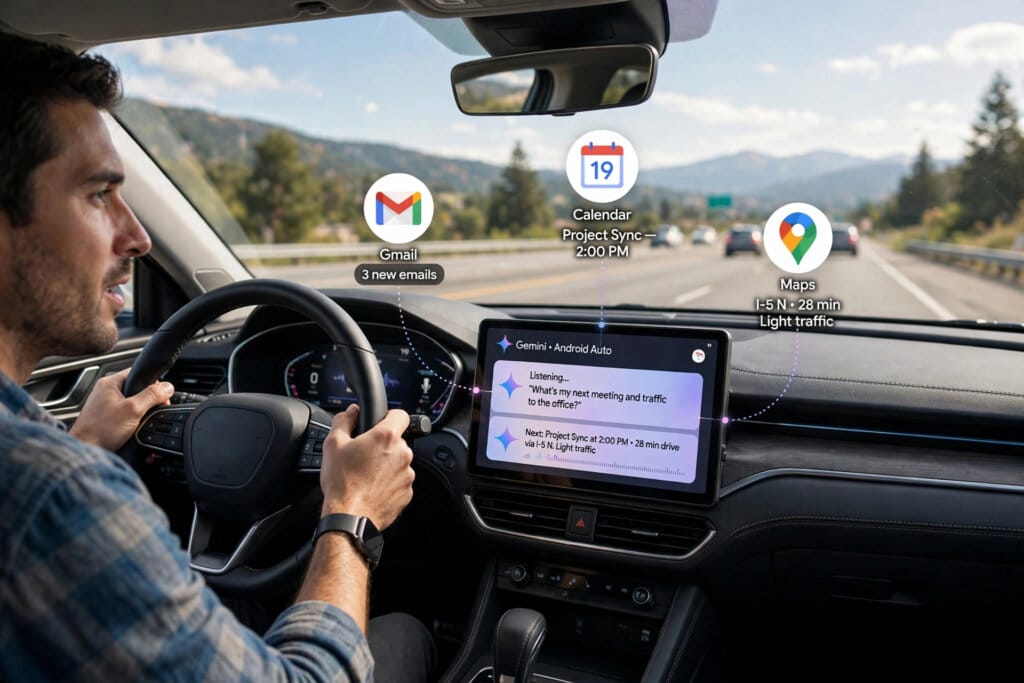
Google is bringing Personal Intelligence to Gemini in cars. The company said on October 20 that Personal Intelligence with Gemini is rolling out starting today on Android Auto, and will reach cars with Google built-in in the coming months.
With a driver’s permission, the feature securely connects information from the Google apps the driver already uses — Workspace, including Gmail and Google Calendar, plus Google Photos, Google Maps, YouTube and Search — so Gemini can give uniquely tailored answers while the driver’s hands stay on the wheel.
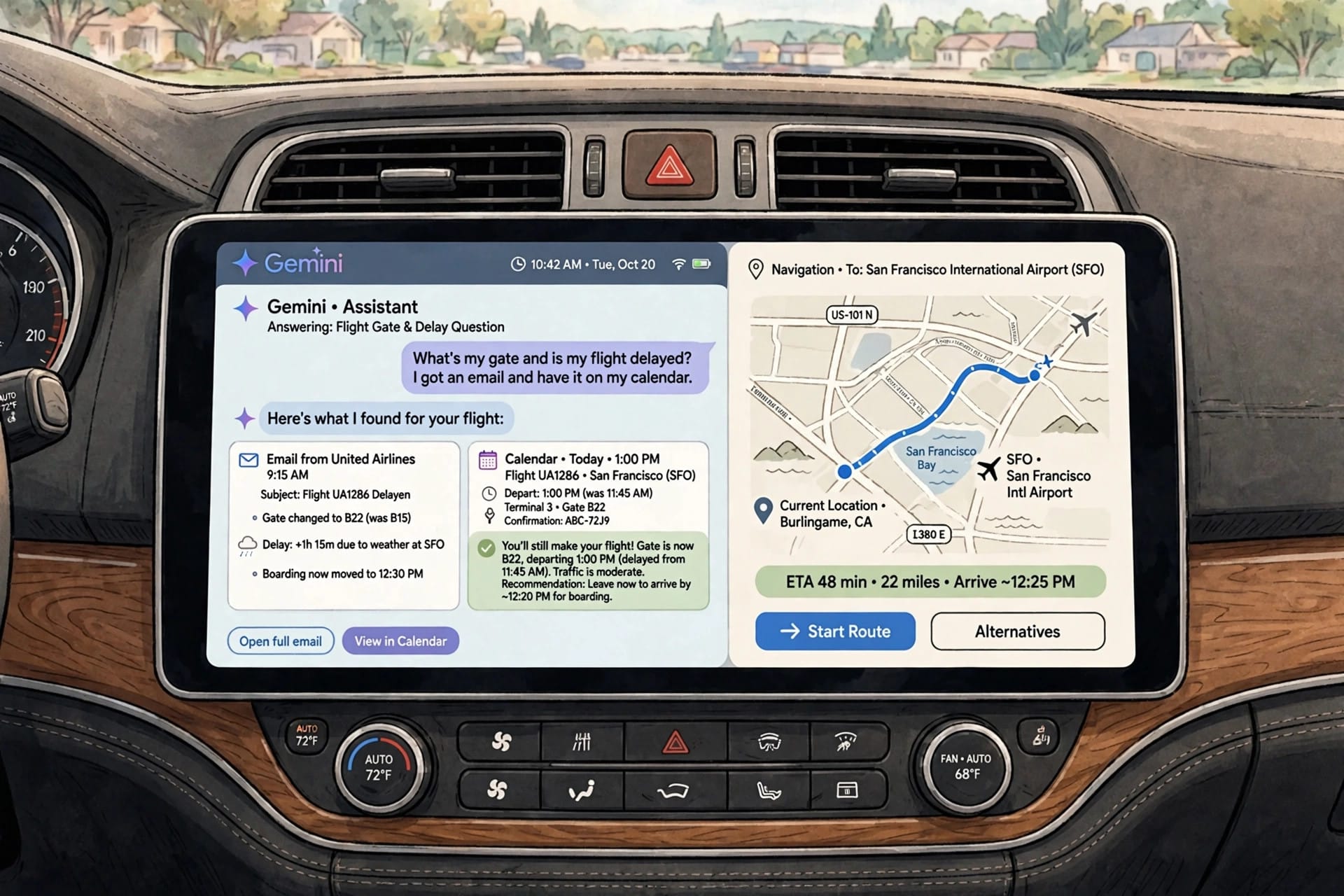
Gemini Personal Intelligence In Cars: What It Connects And How It Answers
Google describes Personal Intelligence as having two core strengths. The first is retrieving specific details — from an email, a photo or a place saved in Google Maps — to answer a question. The second is reasoning across complex sources, combining those details into a single answer instead of forcing the driver to dig for each piece.
That combination is built for natural, spoken requests. On the way to the airport, a driver can ask, “What’s my flight gate? And is my flight on time?” Gemini is meant to find the gate in the confirmation email and check the flight status at the same time, returning both answers in one go rather than making the driver hunt for the email and then run a separate search for delays.
The same retrieval works for everyday trips. A driver can say, “Take me to my doctor’s appointment,” without remembering or looking up the street address first, because the appointment details sit in connected apps. Asking Gemini to “find the car wash from the photo I took last week and navigate there” uses a photo to identify the place and start navigation, with no need to scroll through a camera roll or pull over.
Personalised Picks, Preferences And Picking Up Where You Left Off
Personal Intelligence also carries preferences into its suggestions. In a new city, a driver can ask Gemini to find an indoor restaurant along the route that matches their usual tastes — if the driver is vegetarian, Google says the shortlist will reflect that without the preference having to be restated on every request.
Continuity is the other half of the pitch. A driver can say, “Take me to the coffee shop we were talking about yesterday,” and Gemini is expected to work out which shop was meant and start navigation.
Google also confirmed Gemini itself is now available globally on Android Auto and in cars with Google built-in. Personal Intelligence is the personal layer on top — alongside the assistant’s expanding role in the Gemini business hub Google launched for small business owners the same day.
Controls, Rollout Scope And The Built-In Delay
The feature is opt-in. Google says apps are not connected until the user chooses to turn Personal Intelligence on, it can be turned off at any time in Gemini settings, and each connected app is selected by the user. Drivers who already enabled Personal Intelligence in the Gemini app carry it into the car automatically; everyone else can set their preferences in Gemini settings.
There is an extra safeguard for cars with Google built-in: those cars only share personal responses when the driver is in the car with their phone connected. Google also stresses that turning the feature off does not break the car experience — navigation, music, calls and ordinary Gemini questions still work, only without tailored answers.
On timing, Android Auto comes first, starting today. Cars with Google built-in follow in the coming months. Independent reporting of the launch by TechCrunch and Engadget put the rollout at global scale for Android Auto, with residents of Switzerland, the European Economic Area, the United Kingdom and Nigeria excluded from this wave. The staged timing matters for the wider Gemini product line, where the same Personal Intelligence layer already spans the app and AI Mode.
Why It Matters
The central entity is Personal Intelligence with Gemini, and its defining attribute in this story is context retrieval inside the car: the assistant no longer answers from the prompt alone, but from a driver’s own email, calendar, photos, saved places and search history, with permission. That connects the feature to its neighbours. For drivers, it turns multi-step lookups — a gate number, a delay check, an appointment address — into one spoken request. For Google, it deepens the value of holding a user’s data across Workspace, Photos, Maps, YouTube and Search, because each connected app makes the in-car assistant harder to replace. For rival assistants in cars, the bar moves from voice control to personal context, which is exactly the ground where ecosystem owners hold the advantage. And for the Gemini plans that package Personal Intelligence, the car becomes one more surface where the same personal layer is expected to work.
Background
Gemini arrived in Android Auto last November, replacing the older assistant experience in cars, while Personal Intelligence first rolled out across the United States in March and has since been in beta in global markets. Bringing the two together in vehicles is the latest step in Google’s push to make Gemini a single assistant that follows the user across phone, web and car, drawing on the same connected Google apps in each place.
Source: Google, TechCrunch, Engadget



0 Comments