
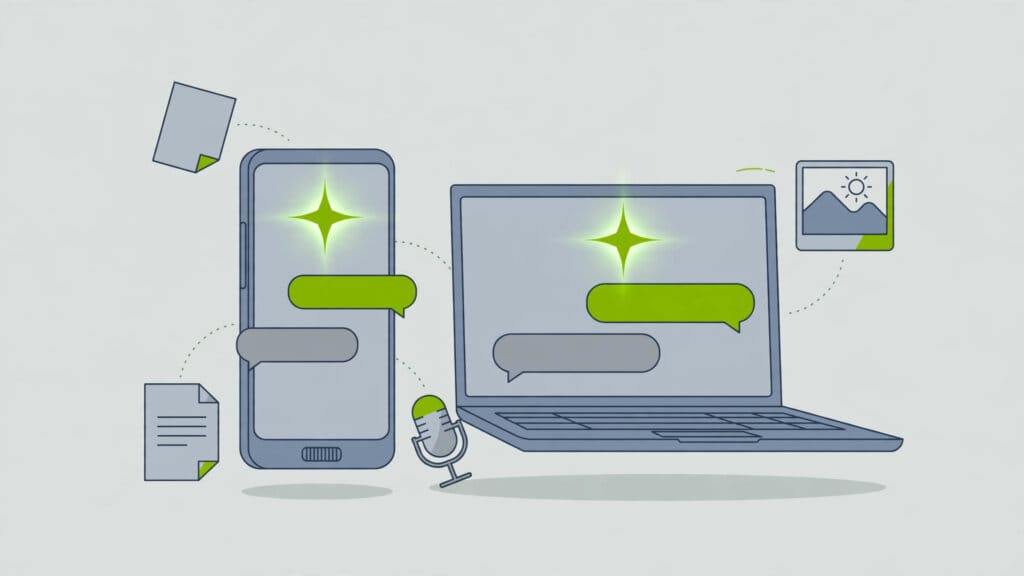
Gemini is the name Google gives to two things at once: its family of AI models, and the assistant those models power. When someone says they “used Gemini,” they usually mean the chatbot. When Google announces a “new Gemini,” it usually means a new model arriving underneath several products at the same time.
That double meaning explains most of the confusion around the brand. Gemini is not simply one app competing with ChatGPT. It is a layer of intelligence spread across Search, Android, Gmail, Docs and YouTube, with a standalone assistant tying the whole thing together.

The model family, in plain terms
Google splits the Gemini line by depth and speed. The Pro models are the flagship tier, built for hard reasoning, coding and long documents. The Flash models trade some of that depth for speed and lower cost, and Flash-Lite is the lightest option, aimed at quick, high-volume everyday tasks.
On Google’s current subscription pages, the flagship is Gemini 3.1 Pro. Higher tiers pair it with a context window of around one million tokens, which is enough room to hold an entire codebase, a long legal file or hours of transcripts inside a single conversation.
Multimodality is built in rather than bolted on. Gemini was designed from the start to work across text, images, audio, video and code, which is why the same brand covers chat, image generation and video tools without changing apps.
Sitting alongside the chat models are specialist systems. Deep Research sends Gemini out to browse the web and compile cited reports, Deep Think is a heavier reasoning mode reserved for the top Ultra tier, and creative tools such as the Flow video editor draw on the same model family.
Where you actually meet Gemini
The most-used Gemini surface is not an app at all. AI Overviews and AI Mode place Gemini-generated answers directly inside Google Search, so most people meet the technology there whether they chose it or not. Google is pushing that surface further into tasks, too, with shopping agents such as Universal Cart launching inside Search and Gemini.
The dedicated Gemini app, on the web, Android and iOS, is the conversational home. It handles chat, voice conversations, image generation and file analysis, and on Android it is woven into the operating system itself as the default assistant.
The third home is Google Workspace. Inside Gmail, Docs, Sheets, Slides and Meet, Gemini drafts, summarises, rewrites and analyses, working from the documents and mail already sitting in your account. For many paying users, that quiet integration matters more than the chatbot.
What it does well, and where it still frustrates
Gemini’s structural advantage is distribution plus grounding. It can draw on Google’s search index, an unusually large context window and, with your permission, your own Google data. That combination makes it particularly strong at research-heavy and document-heavy work.
Its weakness has rarely been the model itself. Features land at different times in the app, in Search and in Workspace, and plan changes keep reshuffling what subscribers actually get, as AI Plus users are finding with Pro models leaving their tier this November. The packaging, not the intelligence, is what trips people up.
One name, several products, some assembly required
New users often meet three different Geminis in their first week. There is the model name in the headlines, the assistant in the app, and the label attached to features inside other Google products, and they do not always update in step with each other.
A feature announced for “Gemini” might arrive in the Android app one month, in Workspace the next, and in Search later still, or in the reverse order. Google’s habit of announcing at brand level rather than product level is why “when will I get it?” is the most common Gemini question of all.
It helps to think of the tiers as one product at different depths. The free experience most people meet in Search is deliberately thin; the app adds conversation and creation; the paid tiers add the largest models, the longest memory and the keys to your Workspace. Same name, widening circles.
The short version is this: Gemini is Google’s bet that AI belongs inside the products billions of people already use, not only inside a destination chatbot. Whether or not you ever open the app, you are already one of its users.

0 Comments