

Google is testing a rearranged local knowledge panel in Search that moves a business’s name, ratings, description and action buttons to the top of the panel, pushing the business photos down. The change is subtle, but for any local business that depends on Search for clicks, calls and directions, the order of elements in that panel is the whole game.
The test was spotted by Ben Fisher, who posted screenshots of the new layout on LinkedIn. Barry Schwartz reported it after spending a day trying to replicate the test himself without success — a reminder that, like most Google interface experiments, it is only visible to a small slice of searchers for now.
What the test changes
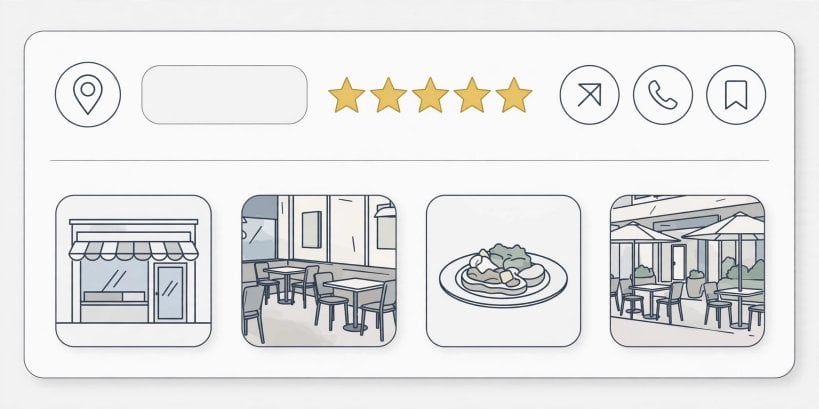
In the current desktop layout, the local knowledge panel typically leads with the business name at the top, followed by a large photo strip, with ratings, reviews, description and action buttons arranged below and around the imagery. In the variant Fisher captured, that order is flipped: the company name, star rating, description and the row of action buttons — Call, Directions, Website — sit right at the top, and the business photos drop beneath them.
The lower portion of the panel is tightened up too. The overall effect is a denser, more information-first block: a searcher sees who the business is, how it is rated and what it can do for them before ever seeing what it looks like.
Interestingly, the new desktop arrangement closely matches the current mobile design of Google Search, where the name and key details already sit above the photo area. That alignment suggests Google may be consolidating toward one consistent panel structure across devices rather than maintaining two distinct hierarchies.
How this fits the month’s local test streak
The layout test is the latest in a busy run of local-panel experiments this month. Earlier in October, Google was spotted moving Google Posts higher inside the local knowledge panel, giving a business’s own updates more prominent placement. The panel has also been a live proving ground for bigger shifts: Ask Maps has replaced the old Business Profile Q&A, with an AI system now answering customer questions directly in the panel.
None of these tests is guaranteed to roll out. Google experiments with local interfaces constantly, and many layouts are discarded after the data comes in. Schwartz himself wrote that it is “super possible that this new layout goes live in the near future” — possible, not certain. But the direction of travel is clear: Google is re-examining every pixel of the panel that sits between a searcher and a local business.
Why it matters
The local knowledge panel is the single most valuable piece of screen real estate a business can own in Google Search. For “near me” style queries it often answers the question before a website visit is ever needed, which means the ordering of elements inside it directly shapes what a customer notices first.
Putting the name, rating and action buttons above the photos changes the panel’s job. Instead of a visual showcase that leads with imagery, the panel becomes a decision block: rating and actions come first, atmosphere second. For highly rated businesses that live on their reviews, that is a win — the stars do the talking immediately. For businesses whose selling point is the look of the place, like restaurants and hotels, it is a demotion of the photos that may have been doing the persuading.
There is also a competitive angle. The tightening of the lower section suggests Google wants the panel to cover more ground in less space — more businesses reachable, more actions per scroll. As visibility inside AI answers joins the map pack as a local ranking battleground, the classic panel is quietly being re-optimized to hold its own against AI Overviews and AI Mode summaries that can answer “where should I go” without any panel at all.
Background
Google’s local knowledge panel has been evolving since it first began pulling Business Profile data into Search over a decade ago, through years of steady iteration on photos, posts, reviews, booking buttons and AI-driven answers. Interface tests like this one rarely arrive alone — they tend to cluster around the moments Google is preparing a broader refresh of the panel, and October 2026 has seen an unusual concentration of them. Whether this particular layout survives the test phase or not, local businesses should expect the panel they rely on to keep moving.
Source: Search Engine Roundtable



0 Comments