
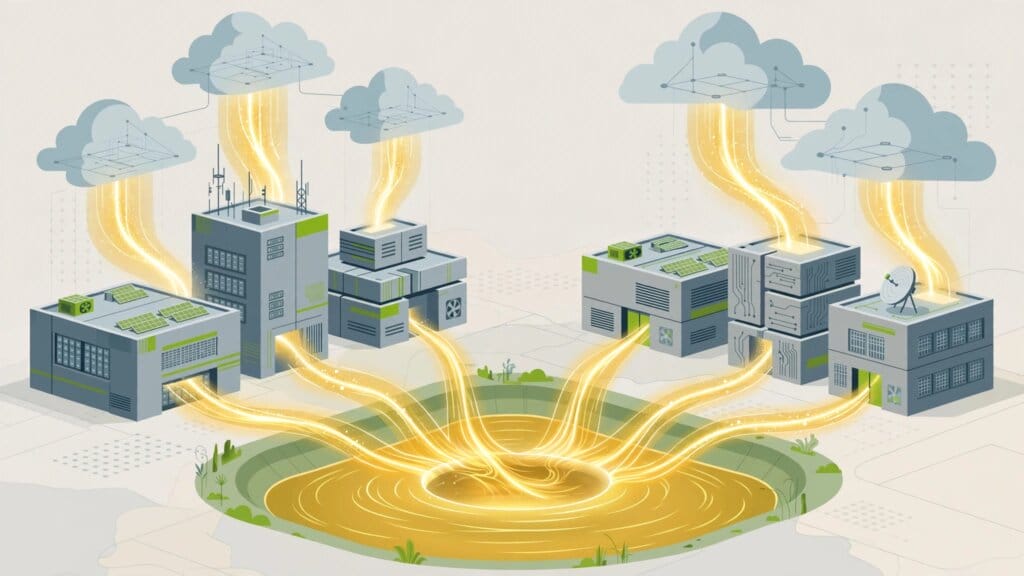
NVIDIA makes money from AI mainly by selling the hardware that other companies use to build AI services. Cloud providers, technology firms, research organisations and enterprises buy its GPUs and systems, then use them to train models or offer computing capacity.
That simple description hides several connected revenue streams. Around the core accelerator business sit networking products, software, development platforms and smaller businesses in gaming, professional visualisation, automotive and robotics, each with a different role in the company’s overall model.

Data Centre Sales Do The Heavy Lifting
The data-centre segment is by far NVIDIA’s largest source of revenue, ahead of gaming, which was once the business most people associated with the company. AI demand changed that balance by creating customers willing to buy accelerators in very large quantities.
A data-centre sale can include far more than one GPU. Customers may buy servers containing multiple accelerators, complete rack-scale systems, or the components and reference designs that partners use to build machines for cloud platforms and private facilities.
The value grows with the cluster. When thousands of processors are installed together, buyers also need high-speed networking, management tools and support, so a large deployment can pull several parts of NVIDIA’s catalogue into a single long-term infrastructure decision.
Sales are not mainly subscriptions to a chatbot or fees from each question a consumer asks. NVIDIA sits further down the chain, earning when providers expand capacity, refresh older clusters or build new facilities, regardless of which AI application becomes popular.
Networking And Software Complete The System
Networking became a major part of the offer through NVIDIA’s acquisition of Mellanox, whose technology moves data quickly between servers. In a large AI cluster, slow connections waste expensive computing capacity, which makes interconnects a product customers pay for directly.
Software adds a different kind of value. CUDA itself helps sell and retain hardware customers, while enterprise software, development tools and platform licences can create paid relationships around deployment, support and specialised uses in areas such as healthcare or industrial work.
This layered model strengthens each sale. A customer that standardises on NVIDIA hardware, networking and software faces a larger task if it later wants to switch suppliers, while NVIDIA gains more revenue from each data centre it helps to equip.
The Other Businesses Still Matter
Gaming remains a substantial business built on GeForce graphics cards sold through partners to players and creators. It no longer defines the company’s AI story, but it provides a consumer market, a strong brand and experience with high-volume graphics products.
Professional visualisation serves designers, engineers and media producers who need powerful workstations. Automotive and robotics are smaller and longer-term bets, selling computing platforms for driver assistance, autonomous systems, factory automation and robots rather than finished vehicles or machines themselves.
These segments also spread risk. Demand for games, cars and industrial systems does not move in exactly the same cycle as spending on AI data centres, so they give NVIDIA other customers and product routes if one market slows unexpectedly.
Omniverse and related simulation tools connect several of these markets. They let companies design products, test robots and model factories in virtual environments, creating another way to sell computing and software beyond a single physical chip sale in one quarter.
Why The Model Is Powerful, And Where It Is Exposed
The model works because NVIDIA sells essential infrastructure during a period of intense investment. Its customers compete to offer AI capacity and applications, and many of them need the same underlying platform at roughly the same time to avoid falling behind.
It also benefits from selling systems rather than isolated parts. More of each customer’s spending stays with NVIDIA when the purchase covers accelerators, networking and software, and the installed base encourages future upgrades to remain within the same platform family.
Exposure comes from that concentration. If large cloud providers slow construction, develop more of their own chips, or shift spending to rivals, the segment that now drives the business could also be the source of its sharpest disappointment.
Supply and geopolitics add further risk. Advanced chips depend on complex manufacturing and packaging capacity outside NVIDIA’s own factories, and export controls can limit which products may be sold into particular markets, affecting both sales and product design decisions.
Even with those risks, the basic model is clear. NVIDIA earns most when organisations build AI at scale, and it has arranged its products so that building at scale usually means buying several layers of its platform at once.

0 Comments