

A quantum computer that can check its own workings and correct course in the middle of a calculation — not once, but thousands of times, without stopping — is a basic requirement for any useful quantum machine. Researchers from Rutgers University, IBM and six collaborating institutions have now demonstrated that coordination at the largest scale yet: nearly 5,000 checks and resets across a chain of up to 100 qubits on a 156-qubit IBM Quantum Heron processor.
The study, published in Nature Physics on October 9, does not deliver a self-correcting quantum computer. What it shows is narrower and, the team argues, foundational: today’s hardware can run the measurement-and-feedback loops future error-corrected machines will depend on, across a system far larger than classical computers can simulate.
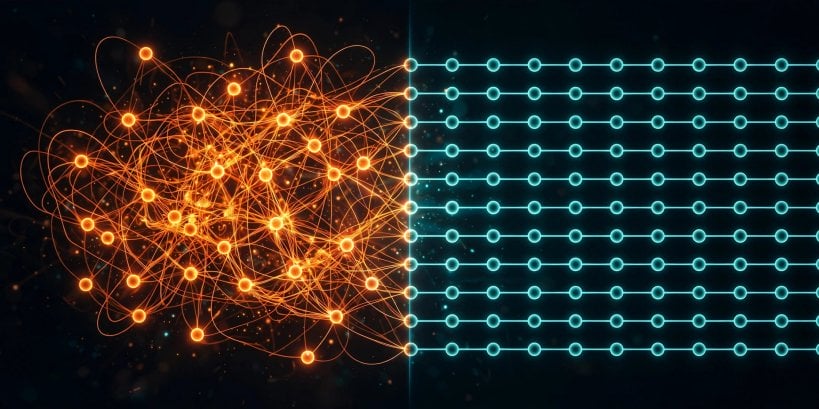
Chaos Versus Control On A 100-Qubit Chain
Led by co-first authors Bibek Pokharel (IBM) and Haining Pan (Rutgers), and supervised by Rutgers physicist Jedediah Pixley and IBM’s Maika Takita, the experiment used the Heron r2 processor known as ibm_fez. The researchers programmed a connected chain of as many as 100 of its superconducting qubits with two competing operations.
The first operation scrambled: it applied entangling gates between neighbouring qubits, spreading information the way shuffling spreads a deck of cards. The second operation controlled: it measured a single qubit mid-calculation and, if the result was one, flipped it back to zero. Each step chose between the two at random, and the working position walked along the chain — right after a scramble, left after a reset.
The design is a quantum version of the Bernoulli map, a textbook chaos model in which a number is repeatedly doubled and only its fractional part kept, against a control process that halves it. Across the experiment the team executed nearly 5,000 two-qubit entangling gates alongside nearly 5,000 mid-circuit measurement-and-reset operations.
A Phase Transition At Fifty-Fifty
By tuning how often resets occurred, the team could watch the balance of power shift. When scrambling dominated, the chain stayed chaotic, its average magnetisation hovering near zero. When resets passed roughly half of all operations, control took over and drove the qubits toward an orderly all-zero state.
The crossover was sharp, and the paper places it at a reset probability of 0.495 — essentially fifty-fifty. Crucially, the transition grew better defined as the systems got larger, from 10 to 100 qubits, matching predictions published in 2023 and 2024. “The agreement between the experiment and the theory showed that this was not an accidental feature of a small circuit,” said Pan. “It was collective behavior emerging across the quantum system.” Beyond roughly two dozen qubits, classical computers cannot simulate the system exactly — the larger runs tested physics that could not be fully checked any other way.
What The Experiment Did Not Do
The result needs one careful distinction. Resetting a qubit to a known state is not quantum error correction. Error correction has to protect information the machine does not know — an unknown quantum state — without measuring it directly, because measurement itself disturbs what it touches. This experiment protected nothing of the kind: no logical qubit was encoded, and no useful computation was corrected along the way.
What it validated is the machinery correction will run on: dynamic circuits, in which measurement results steer later operations while a calculation is still running. “To build a fault-tolerant quantum computer, we have to make these checks and corrections not just once or twice, but a huge number of times during a calculation,” said Pixley. “This experiment is a landmark on that road.” Takita, IBM’s quantum error correction lead, put the hardware challenge plainly: it “was not simply to measure a qubit, but to do it repeatedly while the rest of the processor continued to operate.”
The theme of machines checking their own work is surfacing across computing: Anthropic recently used Claude to formally prove 123 open-source libraries free of whole classes of crashes, and AI systems are now designing quantum circuits that beat the best published ones.
Why It Matters
Fault tolerance is the wall between quantum computing’s demonstrations and its uses. Qubits are disturbed by heat, stray signals and imperfect hardware, and errors compound so quickly that a long calculation on an uncorrected machine decays into noise. Every serious application — simulating molecules for drug discovery, designing battery materials and catalysts, and eventually accelerating parts of AI workloads — sits on the far side of that wall.
This experiment shows the climbing equipment works at scale. The checks and resets that correction requires can be coordinated thousands of times across 100 qubits, and the point where control beats chaos is predictable — it landed within half a percentage point of theory. For IBM, whose Heron processors anchor its quantum roadmap, that is evidence the dynamic-circuit approach its error-correction programme rests on behaves as designed. For the field, it converts a theoretical prediction about monitored quantum systems into measured fact.
Background
The project began with a bet at a 2021 birthday party, when theorist Sriram Ganeshan wagered Pixley that a classical chaos-control effect had a quantum counterpart; theory papers followed in 2023 and 2024, and a chance conversation with IBM physicist Barbara Jones turned the idea into an experiment on IBM’s flagship Heron processors. Pixley lost the bet, and paid up with two scoops of blueberry ice cream.
Source: Rutgers University; Pokharel et al., Nature Physics (2026)



0 Comments