

iFlytek has unveiled Spark X2.6, a 293-billion-parameter large language model the company says was trained entirely on domestically produced Chinese computing hardware. The model was announced on October 22 at the company’s Global 1024 Developer Festival in Beijing, where chairman Liu Qingfeng presented it as the first large model to achieve breakthroughs in code generation and agent capabilities without any foreign chips in its training stack.
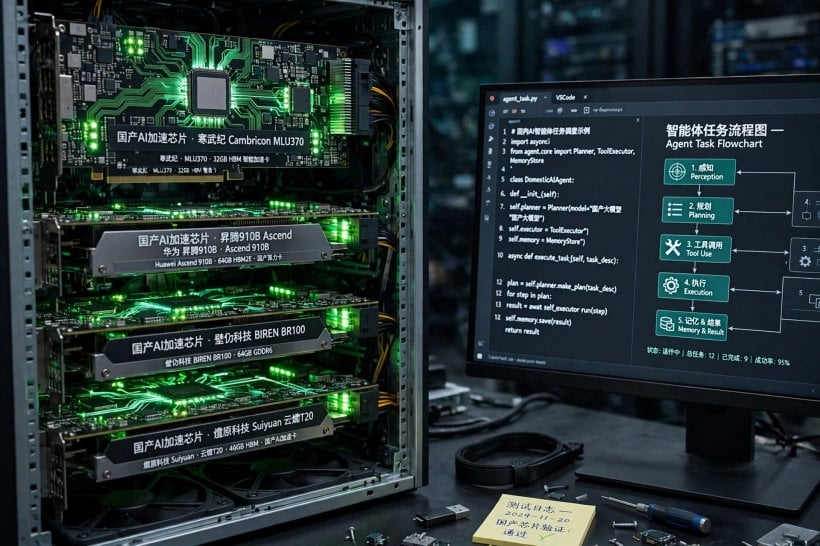
The headline specification is a mixture-of-experts architecture with 293 billion total parameters, of which 30 billion are activated per query, and a context window stretched to 1 million tokens. iFlytek is positioning the model as proof that Chinese hardware can now carry frontier-class workloads: according to the company, Spark X2.6 is the first end-cloud integrated large model in its lineup, debuting a new architecture that coordinates training and inference between cloud clusters and edge devices. The model is now available for trial on the iFlytek Spark official website.
A 293B-A30B Model Built On Home-Grown Hardware
The 293B-A30B parameter count is familiar territory for iFlytek’s flagship line — the preceding X2.5 generation used the same scale — but the company stresses that what changed is the foundation underneath it. Liu said on stage that Spark is the only major Chinese model family whose training and inference both run on domestic computing power, while rivals still train on NVIDIA hardware, and he claimed iFlytek achieved this at the smallest model size among domestic efforts. These are company claims, reported from the event by Chinese tech outlets including IT Home and NetEase Tech, both of which had reporters on site.
X2.6 ships with professional-grade security protection and customisable per-task security policies. Inference pricing is set at 0.9 yuan per million input tokens, 0.08 yuan per million on cache hits, and 3.6 yuan per million output tokens — all described as limited-time promotional rates — and the model is open for trial on iFlytek’s own platform from launch day.
Four Times The Long-Context Training Speed
The technical story iFlytek wants told is about overcoming the physical limits of domestic chips. Chinese accelerators carry less memory and narrower data-transfer bandwidth than the US chips they substitute for, which has made ultra-long-context training — the 256K-to-1M token regime that code and agent tasks demand — a particular bottleneck.
iFlytek says it broke that bottleneck with a long-range dynamic parallel training technique that automatically decomposes long- and short-range tasks and schedules them jointly across domestic platforms, lifting ultra-long-context training efficiency roughly fourfold. On the inference side, the company described two innovations: distributed inference across heterogeneous domestic compute, and a four-tier KVCache storage technology it says is the first deployed on domestic equipment, lifting inference efficiency about 4.5 times and pushing KVCache hit rates from 63 percent to 95.7 percent. All of these figures are iFlytek’s own measurements, as reported from the launch.
The Open-Source Edge Cousin Goes With It
Alongside the flagship, iFlytek released Spark X2.6-4B, an open-source model for edge devices. The company says the smaller model makes a step change in on-device agent capabilities: the share of agent tasks an edge device can complete on its own rises from 12.8 percent to more than 40 percent, with a target of 60 percent next, while end-cloud routing accuracy climbs from 81 percent to 96.1 percent. Its inference pricing is free for a limited time, building on the X2.5-4B edge model that iFlytek says has passed 2.56 million downloads since September 1 and ranks among the top four edge models globally.
Why It Matters
X2.6 matters less as a benchmark score than as a data point in the decoupling of the global AI hardware stack. For two years, the open question about US chip export controls was whether they would slow China’s frontier labs or accelerate their self-reliance; iFlytek is now claiming, on stage and with a shipping product, that domestic clusters can train a 293B-parameter model to frontier-level code and agent quality. If the company’s efficiency claims hold up in independent hands, the strategic meaning is that the ceiling on Chinese AI is being set by software engineering on domestic silicon rather than by access to foreign GPUs.
For the model ecosystem, the more immediate effect is competitive. A 1M-context MoE model with aggressive promotional pricing, paired with a free and genuinely downloaded open-source edge model, puts pricing and distribution pressure on every other Chinese lab — including DeepSeek, whose open models and API pricing set the current reference point. Developers building agents on domestic infrastructure now have a second serious option that never touches a foreign chip, alongside the new wave of open coding models landing this month.
Background
iFlytek has been building toward this announcement for years. The company has collaborated with Huawei on domestic training infrastructure since May 2023, and earlier this year it reported that MoE training efficiency on domestic hardware had climbed from 30 percent to 93 percent — a trajectory that echoes the steady cadence of open model releases reshaping the AI Models landscape this year. The 1024 Developer Festival, named for Programmer’s Day in China, also saw the launch of the Spark Audio 1.0 speech base model and a WinWork platform for enterprise digital employees.
Source: NetEase Tech, Tencent News / IT Home




0 Comments