

NVIDIA’s cheaper DGX Spark configuration arrives today. The 64GB model, announced earlier this month, starts rolling out from six hardware partners on October 23 at a starting price of $4,999, giving developers and researchers a lower entry point into local AI workstations. NVIDIA used the same week’s GTC Berlin keynote to widen what the little machines can do together: DGX Spark clusters now scale to eight systems, good for up to 1TB of pooled unified memory.
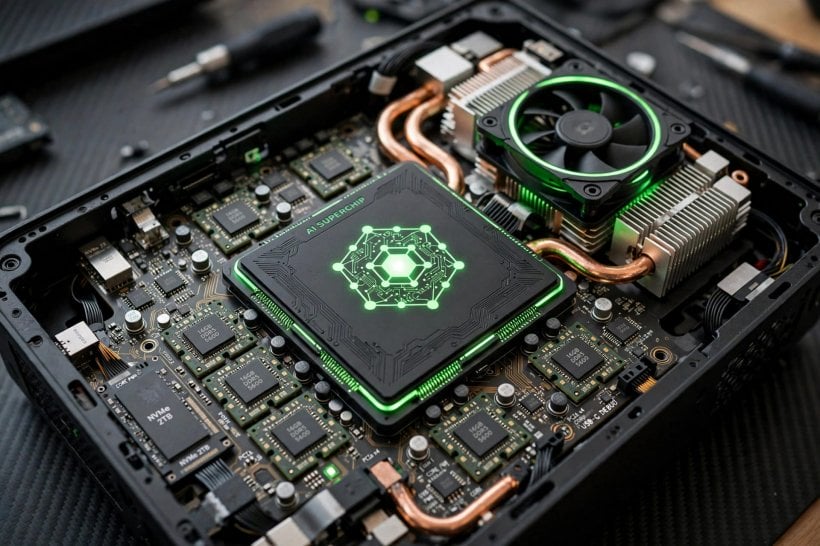
The 64GB model keeps the core hardware of its bigger sibling — the GB10 Grace Blackwell Superchip, a 20-core Arm CPU co-designed with MediaTek, ConnectX-7 networking, DGX OS and the full CUDA stack — with half the memory. Bandwidth holds at 273GB/s, and NVIDIA says a single 64GB unit can run models with up to 100 billion parameters entirely on device. The configuration is sold only through partners: Acer, ASUS, Dell, Gigabyte, HP and MSI. There is no NVIDIA-branded version this time.
From One Box To Eight: Clustering And The Model Launcher
The clustering story may matter more than the new SKU. Two 64GB systems can link directly over a QSFP cable on a 200GbE connection, pooling their memory to 128GB and supporting models up to 200 billion parameters. NVIDIA’s own numbers claim up to 1.7 times the performance of a single system in a Qwen 3.8 27B test. Manual cluster configuration now stretches to eight units; with 128GB systems that totals 1TB of unified memory, enough headroom for frontier-class models such as GLM 5.3, while an eight-unit 64GB cluster tops out at 512GB.
An NVIDIA Sync update due later this month adds native eight-system support plus a new Model Launcher that downloads a model and its container suited to the machine, then connects it to the OpenCode coding tool. October’s software update also brings a Wi-Fi Assistant that makes switching networks easier when a system runs in appliance mode, and refreshed DGX Spark Skills that feed troubleshooting, maintenance and workflow guidance into NVIDIA Sync.
The GTC Berlin Software Sweep
The cluster news arrived inside a broader local-AI software push at GTC Berlin. Underdog Desktop Agent is now available for RTX Spark, running AI models entirely on device so a personal agent can work through tasks without user data leaving the PC. NVIDIA also listed day-zero support for a batch of new models: NVIDIA Nemotron Bolt E4B, GLM, DeepSeek, Qwen, MiniMax, Liquid AI’s LFM2.5-24B-A2B and the FLUX.3 Klein diffusion model, plus RAM-efficient checkpoints starting with Qwen3.8-Flash-Next-FP4-Local for a single DGX Spark 128GB and GLM-5.3-Flash-FP4-Local across two systems.
Work with the llama.cpp and vLLM communities produced measurable speed-ups: in vLLM, faster speculative decoding and new FlashInfer prefill kernels push agentic tasks with Qwen3.8 27B up to 1.3 times faster on DGX Spark, while GLM 5.3 Flash reaches up to 1.2 times higher throughput on DGX Station. The bigger DGX Station systems are shipping today from seven partners and gain seven enterprise IT management integrations; the RTX Spark laptop line is already available from most major OEMs.
Why It Matters
The 64GB model is priced against an awkward reality: memory costs have pushed the 128GB DGX Spark well above its launch price, with outlets including The Register and Tom’s Hardware reporting it now at around $6,950. At $4,999, the 64GB configuration does not undercut AMD-based rivals on raw memory per dollar, but it keeps developers inside NVIDIA’s CUDA stack and, crucially, inside a clustering ecosystem that now scales to a terabyte of pooled memory.
The strategic read is that NVIDIA is turning DGX Spark from a single-user appliance into shared development infrastructure. Eight-system clusters, a Model Launcher wired to a coding tool, and day-zero support for the newest open models all point the same way: NVIDIA wants the model-running layer of agentic development to live on its hardware locally, not just in its cloud. The open coding models built for these machines — Recursive’s Flint 40B, which NVIDIA highlights as running across its lineup — are the software side of the same bet, alongside NVIDIA’s OpenShell agent safety stack.
Background
DGX Spark began life as Project DIGITS, the desktop AI supercomputer Jensen Huang unveiled at CES 2025, and it has been on a steady software cadence since: NVFP4 support and llama.cpp optimisations in January, the NVIDIA Sync Cluster Assistant in June, and a succession of model ports through the year. NVIDIA announced the 64GB configuration in its newsroom on October 2, positioning it as an entry point for developers and researchers rather than a replacement for the 128GB model. The GTC Berlin keynote that framed this week’s rollout was also where Huang pushed the company’s supply-chain expansion — the demand for the silicon these little boxes run on keeps rising faster than anyone can package it.
Source: Gadget Pilipinas, Shattered.io




0 Comments